Mahua Moitra backs Rajnath on army disability pension tax break
Synopsis
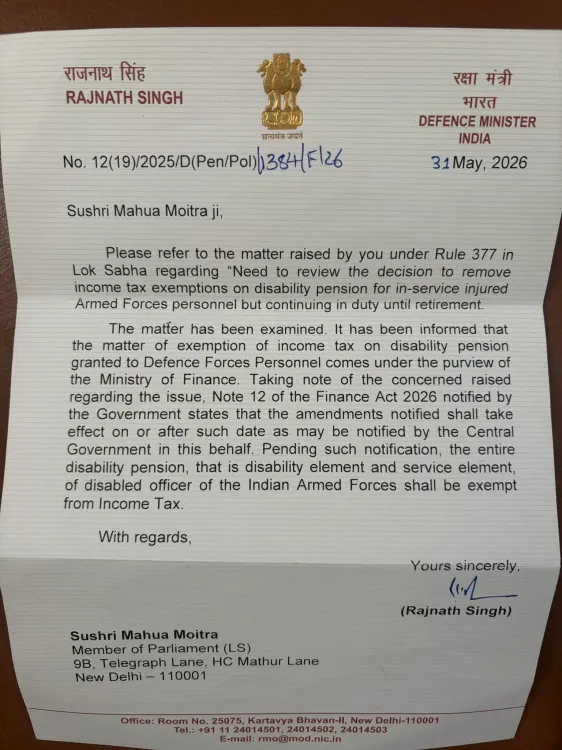
TMC MP Mahua Moitra publicly thanked Defence Minister Rajnath Singh for affirming income-tax exemptions on armed forces disability pensions will continue, and urged Finance Ministry officials to never initiate what she termed an 'offensive proposal' to tax such pensions.
Key Takeaways
TMC MP Mahua Moitra posted on X on 20 June 2026 thanking Rajnath Singh for supporting continued IT exemptions on armed forces disability pensions.
Moitra urged Finance Ministry officials to 'desist from ever initiating this offensive proposal' to tax disability pensions.
Section 10 of the Income Tax Act, 1961 has long exempted disability pensions paid to armed forces personnel from income tax.
The post reflects recurring tension between the Ministry of Defence's welfare commitments and the Ministry of Finance's tax-base mandate.
Key beneficiaries are disabled veterans whose pensions compensate for injuries sustained in military service.
The next Union Budget session and the Finance Bill will be watched for any changes to pension taxation provisions.
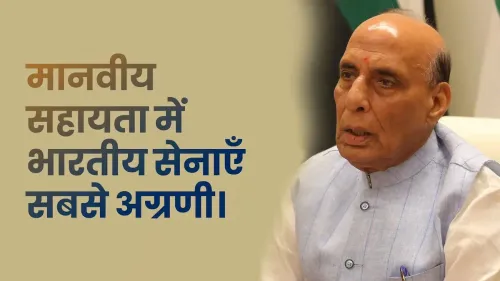
TMC MP Mahua Moitra on Saturday, 20 June 2026 publicly thanked Union Defence Minister Rajnath Singh for affirming that income-tax exemptions on disability pensions for armed forces personnel would continue, while urging the Ministry of Finance to refrain from ever reviving what she called an 'offensive proposal' to tax such pensions.
Context
Moitra's post on X addressed Singh directly, writing: 'Thank you @rajnathsingh ji for your empathy for continuing IT exemptions for armed forces disability pensions. Hoping mandarins of @FinMinIndia have similar empathy and desist from ever initiating this offensive proposal. Jai Hind.' The message signals cross-party appreciation for the Defence Minister's stance, notable given that Moitra represents the principal opposition All India Trinamool Congress in the Lok Sabha.
The post follows what appears to be a public assurance by Rajnath Singh that disability pensions paid to wounded or incapacitated military personnel will remain outside the income-tax net — a position that has historically commanded broad political consensus.
Policy Backdrop
Section 10 of the Income Tax Act, 1961 has long provided exemptions on disability pensions received by armed forces personnel, with successive administrative clarifications reaffirming the provision. The exemption is considered a key pillar of the state's commitment to the welfare of soldiers who sustain injuries in the line of duty.
Periodic friction between the Ministry of Defence and the Ministry of Finance has surfaced over the years, with the Finance Ministry's mandate to broaden the tax base occasionally coming into tension with welfare commitments to veterans. Any hint of a review of such exemptions has historically triggered swift political pushback across party lines, compelling public reaffirmations from the government.
Stakeholders and Impact
The primary beneficiaries of the existing exemption are disabled veterans and serving personnel of the Indian Army, Navy, and Air Force who receive disability pensions — payments intended to compensate for injuries or ailments attributable to military service. Removing or diluting the exemption would directly reduce the net income of some of the country's most vulnerable former service members.
Moitra's use of the word 'mandarins' — a pointed reference to senior Finance Ministry bureaucrats — reflects a broader political anxiety that technocratic budget-making processes could quietly advance proposals that elected representatives and the Defence Ministry would publicly oppose. Her post effectively places the Finance Ministry on notice that any such move would face immediate political resistance.
What's Next
Attention will now turn to the forthcoming Union Budget session and any related provisions in the Finance Bill concerning pension taxation. If the Finance Ministry tables any amendment touching disability pension exemptions, it is likely to draw sharp responses from veterans' groups, opposition MPs, and potentially from within the ruling coalition as well.
The episode underscores a recurring dynamic in Indian fiscal policy: welfare exemptions embedded in the tax code can become politically charged the moment any review is floated, making their removal practically difficult regardless of the revenue rationale.
Point of View
And it is strategically timed to publicly box in the Finance Ministry before budget deliberations intensify. The framing — thanking the Defence Minister while warning 'mandarins' — draws a deliberate line between elected political will and bureaucratic initiative, a distinction that resonates strongly with veterans' constituencies. This episode fits a well-established pattern in Indian fiscal politics where disability pension exemptions function as a near-untouchable third rail, making any Finance Ministry review politically costly regardless of the technical merits. The broader implication is that welfare provisions embedded in the tax code for the armed forces enjoy a cross-partisan shield that few other exemptions can claim.
NationPress
19 Sept 2026
Frequently Asked Questions
Are armed forces disability pensions exempt from income tax in India?
Yes. Section 10 of the Income Tax Act, 1961 provides a long-standing exemption on disability pensions received by armed forces personnel, shielding payments made to soldiers injured or incapacitated in service from income tax.
Why did Mahua Moitra thank Rajnath Singh regarding disability pensions?
TMC MP Mahua Moitra thanked Defence Minister Rajnath Singh for publicly affirming that income-tax exemptions on armed forces disability pensions would continue, expressing relief that the minister had taken a clear welfare-first position.
What is the Finance Ministry's role in armed forces pension taxation?
The Ministry of Finance controls tax policy through the Union Budget and the Finance Bill. Any proposal to modify or remove exemptions under the Income Tax Act — including those covering disability pensions — would originate or require approval from the Finance Ministry.
What does 'mandarins of Finance Ministry' mean in Mahua Moitra's post?
Moitra used the term 'mandarins' to refer to senior Indian Administrative Service bureaucrats within the Ministry of Finance , implying that technocratic officials — rather than elected politicians — may have been behind any proposal to review disability pension tax exemptions.
When could changes to armed forces pension tax exemptions be announced?
Any formal change would most likely surface during the Union Budget session through an amendment in the Finance Bill . Political observers will watch the next budget cycle closely for any provision touching pension taxation for defence personnel.