Mahua Moitra Cites 2023 SC Ruling on Anti-Defection Merger Rules
Synopsis
TMC MP Mahua Moitra has cited the Supreme Court's 2023 Subhash Desai judgment to assert that even a two-thirds legislative majority cannot create a new political faction — only a formal merger with BJP is constitutionally permissible under the Tenth Schedule.
Key Takeaways
TMC MP Mahua Moitra posted on 9 June 2026 invoking the 2023 Supreme Court ruling in Subhash Desai vs.
Principal Secretary, Governor of Maharashtra .
She argued that securing two-thirds (19 MPs) does not entitle a group to form a separate party or faction — the only valid route is a formal merger with BJP .
The Tenth Schedule of the Constitution exempts legislators from disqualification only if at least two-thirds of the original political party merges with another existing party.
The Supreme Court 's five-judge bench in 2023 explicitly held that the Lok Sabha Speaker cannot unilaterally recognise a breakaway faction as a new party.
Bhupender Yadav and the Lok Sabha Speaker were named by Moitra as actors who lack constitutional authority to create a separate faction outside the merger framework.
The Maharashtra Shiv Sena split of 2022 was the catalyst for the 2023 ruling, which has since become the definitive precedent on engineered defections.
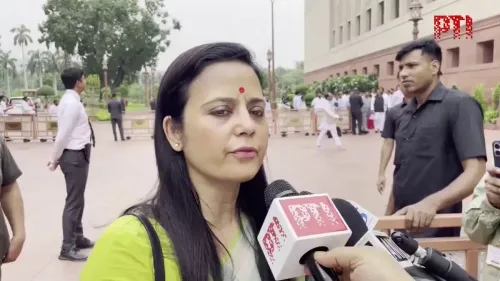
TMC MP Mahua Moitra on Tuesday, 9 June 2026 invoked a landmark Supreme Court ruling to argue that even if a group of legislators secures two-thirds of a parliamentary party's strength, the only constitutionally permissible route is a formal merger with another political party — not the creation of a separate faction or party.
Context
In her post on X, Moitra wrote that 'even if traitors get 19 MPs (2/3) which they have not — only option is to merge with BJP along with 2/3 of political party.' She added that 'Bhupinder Yadav and the Lok Sabha Speaker cannot create a separate political party or faction,' citing the 2023 five-judge bench ruling in Subhash Desai vs. Principal Secretary, Governor of Maharashtra as having 'settled this.'
The post does not name the party or legislators she is referring to, but the constitutional argument she advances is precise and grounded in settled anti-defection jurisprudence under the Tenth Schedule of the Constitution.
Policy Backdrop
The Supreme Court's 2023 judgment in the Subhash Desai case arose from the Maharashtra political crisis and the 2022 split in the Shiv Sena. A five-judge constitutional bench held that a legislative party split does not by itself create a recognised new political faction exempt from disqualification.
Under the Tenth Schedule, the only exemption from disqualification for defecting legislators is a formal merger where at least two-thirds of the original political party's members join another existing political party. The bench made clear that the Lok Sabha Speaker or any constitutional authority cannot unilaterally validate a breakaway group as a new party without satisfying this threshold.
Bhupender Yadav, a BJP Union Minister, has been named by Moitra alongside the Lok Sabha Speaker as actors who, in her reading of the law, lack the authority to engineer or recognise a separate faction outside this constitutional framework.
Stakeholders and Impact
The immediate stakeholders are legislators who may be facing or contemplating disqualification proceedings before the Lok Sabha Speaker. The ruling in Subhash Desai significantly narrowed the political space for orchestrated defections by closing the 'split' exemption that had earlier allowed smaller breakaway groups to escape disqualification.
For opposition parties, the judgment has become a key legal shield. Moitra's invocation of it signals that any disqualification or recognition proceedings that do not conform to the merger route will face constitutional challenge. The reference to '19 MPs' as a hypothetical two-thirds threshold indicates the dispute, if any, involves a parliamentary party of roughly 28-29 members.
What's Next
Should any disqualification petitions be filed before the Lok Sabha Speaker, the Subhash Desai precedent will be the primary legal test. Courts have consistently held that Speakers must adjudicate such petitions within a reasonable time and cannot indefinitely defer decisions to benefit a ruling dispensation.
Legal observers will watch whether fresh petitions are filed and whether the Supreme Court is asked to intervene, as it did in the Maharashtra case, if the Speaker's office is seen to be acting outside the constitutional boundaries set by the 2023 ruling.
Point of View
Deploying the Subhash Desai precedent as a constitutional firewall against any attempt to peel away a bloc of legislators and have them recognised as a new entity by the Speaker's office. The argument is legally sound: the 2023 ruling deliberately closed the 'split' loophole that had enabled the Maharashtra political engineering, and Moitra is signalling that the same playbook will face immediate judicial challenge. By naming both a Union Minister and the Lok Sabha Speaker in the same breath, she frames the alleged manoeuvre as a coordinated executive-legislative effort — a framing that, if borne out, would raise serious Tenth Schedule questions. The post fits a broader pattern of opposition parties using the Subhash Desai judgment as a standing deterrent against defection-driven realignments ahead of politically sensitive periods.
NationPress
23 Oct 2026
Frequently Asked Questions
What did the Supreme Court rule in the Subhash Desai case in 2023?
The Supreme Court's five-judge bench in the 2023 Subhash Desai vs. Principal Secretary, Governor of Maharashtra case held that a legislative party split does not create a recognised new faction exempt from disqualification. The only valid exemption under the Tenth Schedule is a formal merger where at least two-thirds of the original political party's members join another existing party.
What is the two-thirds rule under India's anti-defection law?
Under the Tenth Schedule of the Constitution, legislators are exempt from disqualification for defection only if at least two-thirds of the total membership of their original political party formally merges with another existing political party — not merely a legislative party group.
Can the Lok Sabha Speaker recognise a new political faction after a split?
No. The Supreme Court's 2023 ruling in Subhash Desai clarified that the Lok Sabha Speaker cannot unilaterally validate a breakaway group as a new party or faction unless the strict two-thirds merger threshold under the Tenth Schedule is satisfied.
Why is Mahua Moitra citing the Subhash Desai judgment?
Moitra is invoking the 2023 Supreme Court ruling to argue that any group of legislators — even if they number two-thirds of a parliamentary party — cannot constitute a separate political party or faction. Their only constitutionally permissible option is to formally merge with BJP, making any other arrangement liable to disqualification.
What was the Maharashtra political crisis that led to the 2023 Supreme Court ruling?
The 2022 split in the Shiv Sena, in which a faction led by Eknath Shinde broke away and claimed recognition as the 'real' party, triggered a series of legal challenges. The Supreme Court's 2023 five-judge bench ruling arose from those proceedings and set binding precedent on how the Tenth Schedule applies to party mergers and splits.