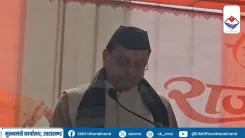
MP CM doubles gaushala grant to ₹40/day on Govardhan Puja

Synopsis
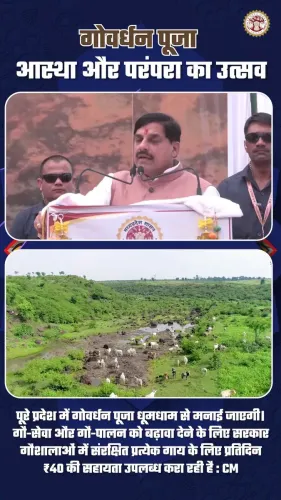
Madhya Pradesh CM Dr. Mohan Yadav announced on Govardhan Puja that the daily maintenance grant for cows in state-supported gaushalas has been doubled from ₹20 to ₹40 per cow, and that all urban local bodies will operate cow shelters, reinforcing the state's cow-welfare push.
Key Takeaways
Mohan Yadav announced the gaushala subsidy hike on 9 November 2026 , coinciding with Govardhan Puja .
The daily per-cow grant has been doubled from ₹20 to ₹40 — a 100% increase.
All urban local bodies (ULBs) in Madhya Pradesh are mandated to operate gaushalas.
The move targets improved financial sustainability of cow shelters housing stray and aged cattle.
The announcement fits a broader BJP-state pattern of linking cultural festivals to targeted cattle-welfare subsidies.
Doubling down on cow welfare just as the festival lamps are lit, Madhya Pradesh Chief Minister Dr. Mohan Yadav announced on Monday, 9 November 2026, that the state is celebrating Govardhan Puja across all districts while simultaneously hiking the daily grant for each cow sheltered in government-supported gaushalas — from ₹20 to ₹40 per cow per day.
Posting from the official Chief Minister's Office account, Dr. Yadav stated: 'प्रदेश में गौपालन को प्रोत्साहन देने के उद्देश्य से हमारी सरकार गोवर्धन पूजा को पूरे प्रदेश में हर्षोल्लास के साथ मना रही है' — 'Our government is celebrating Govardhan Puja across the state with great enthusiasm in order to encourage cow rearing.' He added that arrangements are being made to operate gaushalas in all urban local bodies alongside the revised daily subsidy.A 100% grant hike timed to festival momentum
The jump from ₹20 to ₹40 is a straight doubling of the per-cow daily maintenance grant — a signal the government intends the policy to be read as more than a bookkeeping revision. By anchoring the announcement to Govardhan Puja, the festival in which Lord Krishna is traditionally celebrated for protecting cattle and the rural community, the state ties a budgetary decision directly to cultural and religious symbolism. The result is a message that lands simultaneously with devotees, dairy farmers, and urban administrators.
Madhya Pradesh's BJP government has sustained gaushala subsidy programmes across multiple budget cycles, with per-cow grants indexed at lower rates in prior years. The revised rate now means that a gaushala housing, say, 200 cows would receive ₹8,000 per day rather than ₹4,000 — a material difference in operational sustainability for urban shelter managers who have long cited underfunding as a barrier to quality upkeep.
Urban local bodies take centre stage in the rollout
The specific mandate to establish and run gaushalas through all urban local bodies (ULBs) in the state is a structural move as much as a cultural one. Historically, cattle welfare in Madhya Pradesh was concentrated in rural gram panchayats and private trusts. Routing funding and operational responsibility through ULBs pulls municipal governments into the cow-protection network, creating accountability trails and potentially wider geographic coverage across the state's towns and cities.
Dairy farmers and rural economies in MP's agricultural belt stand to benefit indirectly — stray and aged cattle, often released by farmers once they stop producing milk, are the primary occupants of such shelters. A higher daily grant reduces the financial burden on ULBs and trusts that house these animals, keeping the shelters viable and reducing urban stray cattle numbers, a persistent civic concern.
A pattern across BJP-governed states
Madhya Pradesh's move fits a broader playbook visible across several BJP-ruled states: cultural festivals become launch-pads for targeted welfare schemes tied to cow veneration, blending religious observance with demonstrable policy action. The strategic packaging is deliberate — it allows the government to reach both the devout and the economically invested in a single announcement cycle, maximising outreach without additional communication overhead.
How smoothly the revised ₹40 grant flows to every ULB gaushala — and whether state budget allocations are adjusted to absorb the doubled outgo — will be the real test of the policy's reach. The festive announcement sets the ambition. Execution delivers the proof.
Point of View
Reaching religious sentiment and rural economic interest at the same moment. For Madhya Pradesh, routing gaushala operations through urban local bodies also signals administrative mainstreaming of what was once a trust-and-NGO-driven sector. The critical variable is fiscal follow-through — if the state budget does not proportionately scale gaushala allocations, the doubled grant risks creating shortfalls at the municipal level. Watch the next MP state budget for the line-item that proves whether this is durable policy or festival-season optics.
NationPress
9 Nov 2026
Frequently Asked Questions
What is the new gaushala grant per cow in Madhya Pradesh?
The daily grant per cow in Madhya Pradesh government-supported gaushalas has been increased to ₹40 per cow per day , doubled from the previous rate of ₹20.
Why did the MP government announce the gaushala subsidy hike on Govardhan Puja?
CM Dr. Mohan Yadav tied the announcement to Govardhan Puja , a Hindu festival celebrating cow veneration, as part of the government's stated goal of promoting cow rearing ( gau palan ) across the state.
Which bodies are responsible for running gaushalas in Madhya Pradesh now?
The state government has mandated that all urban local bodies (ULBs) in Madhya Pradesh set up and operate gaushalas, expanding shelter coverage across towns and cities.
Who is the Chief Minister of Madhya Pradesh in 2026?
Dr. Mohan Yadav has been the Chief Minister of Madhya Pradesh since December 2023 and is leading the current state government's welfare and cultural initiatives.
How does the gaushala grant increase benefit dairy farmers in Madhya Pradesh?
A higher daily grant makes urban gaushalas more financially viable for housing stray and aged cattle — animals often released by dairy farmers — reducing the burden on both farmers and municipalities dealing with stray cattle.