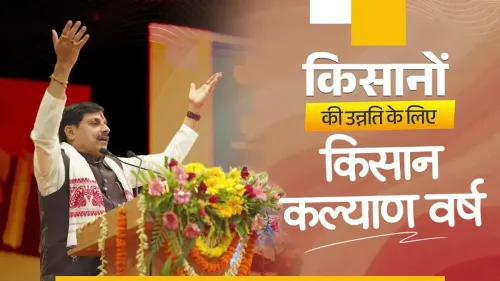
MP CM Mohan Yadav drives 'Kisan Kalyan Year' to boost farmer incomes

Synopsis
The Chief Minister's Office of Madhya Pradesh has announced that 'Kisan Kalyan Varsh 2026' under CM Dr. Mohan Yadav is giving agriculture a new direction, with the state government committed to raising farmer incomes and making cultivation more prosperous.
Key Takeaways
The Chief Minister's Office of Madhya Pradesh officially declared Kisan Kalyan Varsh 2026 as a flagship initiative to reshape the state's agriculture sector.
Mohan Yadav , in office since December 2023 , is positioning farmer welfare as the central pillar of his administration's agenda.
Madhya Pradesh is a leading producer of wheat, soybean, and pulses, making farm-sector policy critical to its rural economy.
The initiative builds on the Mukhyamantri Kisan Kalyan Yojana launched around 2020 , which offered direct financial assistance and insurance to farmers.
Specific budget allocations and measurable targets for the 2026 initiative are expected to be detailed in upcoming assembly sessions.
Farmer welfare sits at the top of the agenda in Madhya Pradesh — and the state government is making that case loudly. The Chief Minister's Office of Madhya Pradesh declared on 13 August 2026 that the ongoing Kisan Kalyan Varsh (Farmer Welfare Year) is charting a new course for agriculture under Chief Minister Dr. Mohan Yadav, with a firm resolve to raise farm incomes and make cultivation more prosperous.
The post, shared from the official CMO handle, read: 'Farmers' welfare is paramount… under the leadership of Chief Minister Dr. Mohan Yadav, the Kisan Kalyan Varsh is giving a new direction to the agriculture sector. The government is continuously working with the resolve that farmers' incomes grow and farming becomes prosperous.'
What 'Kisan Kalyan Varsh 2026' signals for MP's farmers
Madhya Pradesh is one of India's most agriculturally significant states, a major producer of wheat, soybean, and pulses. Its rural economy is deeply intertwined with the fortunes of its farming communities, which makes farmer-welfare policy a perennial political and administrative priority. The Kisan Kalyan Year 2026 is the current government's umbrella initiative to consolidate and accelerate that focus under Dr. Yadav's tenure, which began in December 2023.
The initiative builds on a longer policy lineage in the state. Madhya Pradesh launched the Mukhyamantri Kisan Kalyan Yojana around 2020, which provided direct financial assistance and insurance support to farmers — a model that successive administrations have built upon. The Department of Agriculture, Madhya Pradesh is the nodal body responsible for translating such commitments into on-ground delivery across districts.
The pattern behind the pledge
Successive governments in Madhya Pradesh have leaned on targeted schemes, input subsidies, and market interventions to support the rural economy — a reflection of how central agriculture is to the state's political calculus. Declaring a dedicated 'Kisan Kalyan Year' sharpens that commitment into a time-bound, branded campaign, keeping farmer welfare visible through the legislative and budgetary cycle. What the specific components, budget allocations, and measurable targets of the 2026 initiative look like in practice will become clearer in the coming assembly sessions.
For now, the message from Bhopal is unambiguous: Dr. Yadav's administration intends to make agriculture the centrepiece of its governance story heading into the second half of its term. The harvest of that promise is what farmers — and voters — will judge.
Point of View
' the Yadav government is deploying a well-worn but effective political tool — converting ongoing scheme delivery into a visible, time-bound narrative that keeps the ruling party's farmer-welfare credentials front and centre. This aligns with the BJP's national strategy of farmer outreach through direct-benefit schemes, even as questions about specific targets and budgets remain unanswered. The move also signals that Madhya Pradesh, a state where rural constituencies are decisive, will continue to use agriculture policy as its primary electoral currency heading toward the next cycle. The real test will be whether district-level implementation matches the headline ambition.
NationPress
13 Aug 2026
Frequently Asked Questions
What is Kisan Kalyan Varsh 2026 in Madhya Pradesh?
Kisan Kalyan Varsh 2026 is a state government initiative declared under Chief Minister Dr. Mohan Yadav to give new direction to agriculture in Madhya Pradesh, with a focus on raising farmers' incomes and making farming more prosperous.
Who is the Chief Minister of Madhya Pradesh in 2026?
Dr. Mohan Yadav is the Chief Minister of Madhya Pradesh, serving in the role since December 2023.
What is the Mukhyamantri Kisan Kalyan Yojana in MP?
The Mukhyamantri Kisan Kalyan Yojana, launched around 2020, is a Madhya Pradesh scheme that provides direct financial assistance and insurance support to farmers and forms the policy foundation for the current Kisan Kalyan Varsh initiative.
What crops does Madhya Pradesh produce?
Madhya Pradesh is one of India's leading agricultural states, with major production of wheat, soybean, and pulses, making farm-sector policy central to its economy.
What will Madhya Pradesh's Kisan Kalyan Year 2026 include?
The specific components, budget allocations, and district-level targets of Kisan Kalyan Varsh 2026 are yet to be detailed publicly and are expected to be announced in upcoming Madhya Pradesh assembly sessions.