MP CM Office: Graphite Reserves to Power EV, Battery Future
Synopsis
The Chief Minister's Office of Madhya Pradesh has declared that the state's graphite-rich geology is being leveraged to power India's electric vehicle and battery manufacturing sector, aligning with central schemes and the Atmanirbhar Bharat push for critical mineral self-reliance.
Key Takeaways
Madhya Pradesh is positioning its graphite reserves as a strategic asset for India's EV and battery manufacturing supply chain.
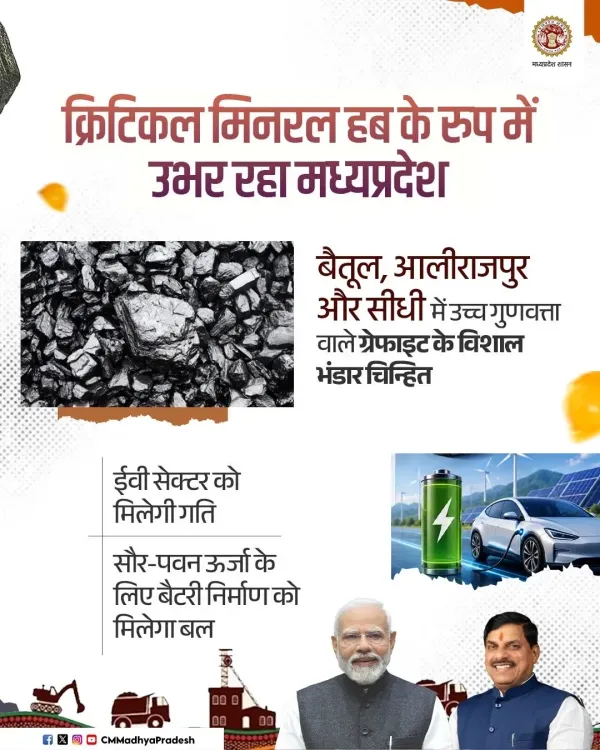
Key graphite-bearing districts in the state include Betul and Sidhi .
The post tags both CM Dr.
Mohan Yadav and the MP Mineral Department , signalling an institutional, coordinated push.
India's ACC Production Linked Incentive scheme (2021) and the National Electric Mobility Mission Plan (2013) provide the central policy framework underpinning this state-level move.
Domestic graphite sourcing is central to India's Atmanirbhar Bharat strategy to reduce battery material import dependence.
Upcoming investor summits or mining lease approvals in Madhya Pradesh will be key indicators of follow-through.
The Chief Minister's Office of Madhya Pradesh declared on Friday, 10 July 2026 that the state's rich graphite reserves are now being channelled to strengthen the future of electric vehicle and battery manufacturing in India, tagging Chief Minister Dr. Mohan Yadav and the Madhya Pradesh Mineral Department in the post.
The post, in Hindi, states: 'Graaphait bhandaron se samriddh Madhya Pradesh, ab EV aur battery nirman ke bhavishy ko nayi taakat de raha hai' — 'Madhya Pradesh, rich in graphite reserves, is now giving new strength to the future of EV and battery manufacturing.' The message positions the state as a critical contributor to India's green mobility ambitions.
Context
Madhya Pradesh holds identified graphite deposits in districts including Betul and Sidhi, making it one of the few Indian states with commercially significant reserves of this mineral. Graphite is a key raw material in lithium-ion battery anodes, which power electric vehicles and energy storage systems. As global and domestic demand for batteries surges, states with indigenous graphite stocks are drawing fresh industrial attention.
Policy Backdrop
India's push for domestic critical mineral sourcing sits within the broader Atmanirbhar Bharat framework, which seeks to reduce dependence on imported battery materials — particularly from China, which dominates global graphite processing. The Production Linked Incentive scheme for Advanced Chemistry Cells (ACC), notified in 2021, incentivises domestic battery storage manufacturing and has made states with raw material advantages strategically important. The National Electric Mobility Mission Plan, approved in 2013, further underpins India's long-term EV adoption targets, creating sustained downstream demand for battery-grade graphite.
Madhya Pradesh has been aligning its mineral and industrial policies with these central schemes to attract investment in the EV supply chain. The state's mineral department — tagged directly in the post — plays a central role in facilitating exploration leases and enabling the transition from raw extraction to value-added manufacturing.
Stakeholders and Impact
The primary beneficiaries of this policy direction include EV manufacturers, battery cell producers, and mining companies with operations or investment interest in Madhya Pradesh. For the state, leveraging graphite deposits for downstream battery manufacturing could generate significant industrial employment and attract capital investment. For India's EV ecosystem, a reliable domestic graphite supply chain reduces import vulnerability and supports cost competitiveness in battery production.
CM Dr. Mohan Yadav, who has been overseeing state industrial and mineral policies since taking office in December 2023, has consistently sought to position Madhya Pradesh as an investment destination in emerging sectors. The official tagging of the mineral department signals a coordinated institutional push rather than a standalone communication.
What's Next
Observers will watch for concrete follow-through in the form of state-level investor summits, graphite mining lease approvals, or announcements tied to battery gigafactory proposals in Madhya Pradesh. With India's EV market expanding rapidly and the central government actively incentivising domestic battery production, the state's ability to convert its mineral endowment into industrial capacity will determine whether this positioning translates into measurable economic outcomes. A formal investment conclave or a central government nod for critical mineral blocks in the state could be the next significant development to watch.
Point of View
The communication signals policy coordination rather than routine social media outreach. This positions CM Dr. Mohan Yadav as proactively aligned with New Delhi's critical minerals agenda at a time when battery supply chain security has become a national priority. The real test will be whether lease approvals and investor commitments materialise to back the narrative.
NationPress
10 Jul 2026
Frequently Asked Questions
Which districts in Madhya Pradesh have graphite deposits?
Madhya Pradesh has identified graphite deposits in districts including Betul and Sidhi , making them central to the state's emerging role in India's battery supply chain.
Why is graphite important for electric vehicles?
Graphite is a primary raw material used in the anodes of lithium-ion batteries, which power electric vehicles and energy storage systems, making domestic graphite reserves strategically valuable for India's EV sector.
What is the ACC PLI scheme and how does it relate to Madhya Pradesh?
The Production Linked Incentive scheme for Advanced Chemistry Cells (ACC) , notified by the central government in 2021 , incentivises domestic battery manufacturing; states like Madhya Pradesh with indigenous graphite reserves are well-placed to attract investment under this scheme.
What has CM Dr. Mohan Yadav said about Madhya Pradesh's mineral policy?
The Chief Minister's Office of Madhya Pradesh posted on 10 July 2026 that the state, rich in graphite reserves, is giving 'new strength to the future of EV and battery manufacturing,' with CM Dr. Mohan Yadav tagged in the communication.
How does Madhya Pradesh's graphite fit into India's Atmanirbhar Bharat plan?
India's Atmanirbhar Bharat initiative prioritises domestic sourcing of critical minerals like graphite to reduce dependence on imports for battery production; Madhya Pradesh 's reserves make it a key contributor to this self-reliance push.