MP CM Office Unveils Ujjain-Indore Metro Region Plan
Synopsis
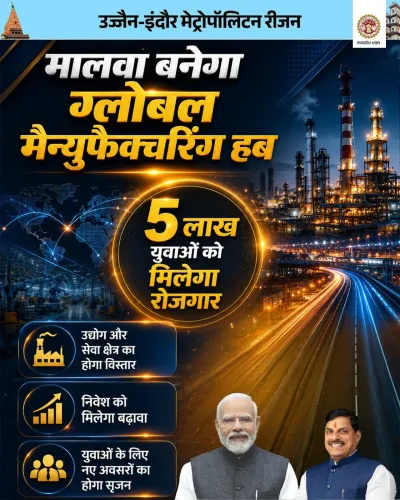
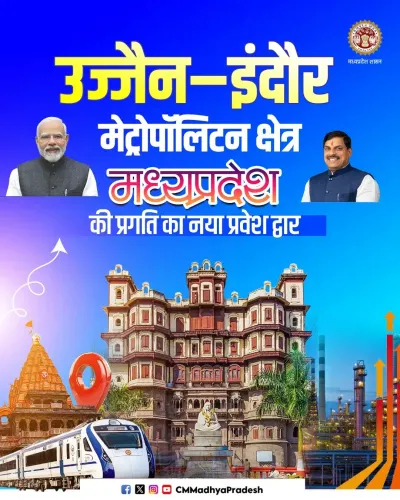
The Chief Minister's Office of Madhya Pradesh unveiled plans on 20 June 2026 to create an Ujjain-Indore Metropolitan Area, promote tourism in Ujjain, and develop special heritage clusters in Maheshwar and Mandu, continuing the state's tourism-led urban growth strategy.
Key Takeaways
The Chief Minister's Office of Madhya Pradesh announced the formation of an Ujjain-Indore Metropolitan Area on 20 June 2026 .
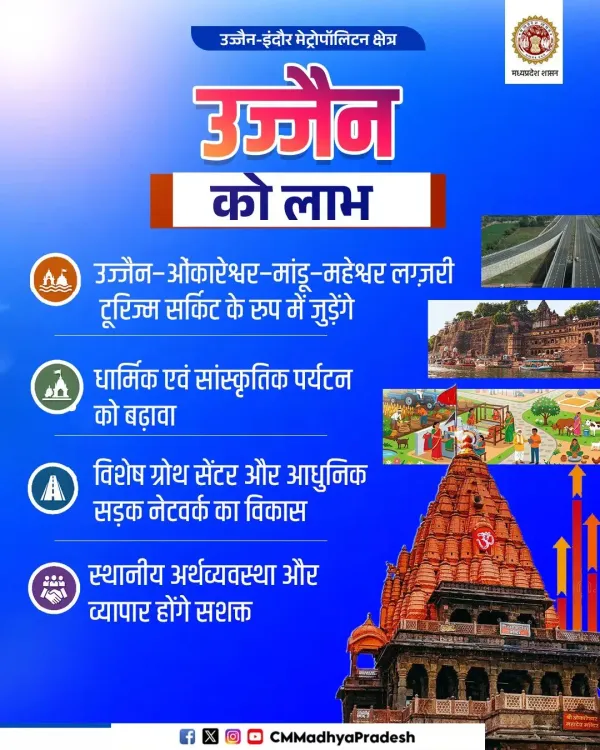
Ujjain , home to the Mahakaleshwar Jyotirlinga , is to receive dedicated tourism promotion under the new framework.
Special development clusters are planned for Maheshwar (Khargone district) and Mandu (Dhar district), both major heritage sites.
The initiative targets the tourism industry, local artisans, and heritage visitors across the Malwa-Nimar corridor.
Formal boundary notification, budget allocations, and project tendering are the key milestones to watch.
The Chief Minister's Office of Madhya Pradesh announced plans on Saturday, 20 June 2026 to develop an Ujjain-Indore Metropolitan Area, with a focus on boosting tourism in Ujjain and establishing special heritage clusters in Maheshwar and Mandu.
Context
The post, shared from the official @CMMadhyaPradesh handle, outlines three key pillars: the creation of a formal metropolitan region linking Ujjain and Indore, enhanced tourism promotion in Ujjain, and the development of specialised clusters in Maheshwar and Mandu. In Hindi, the announcement reads: 'उज्जैन में पर्यटन को मिलेगा बढ़ावा' ('Tourism in Ujjain will receive a boost') and 'महेश्वर-मांडू में विकसित होंगे विशेष क्लस्टर' ('Special clusters will be developed in Maheshwar-Mandu').
Ujjain is one of India's most significant pilgrimage destinations, home to the Mahakaleshwar Jyotirlinga temple, which draws millions of devotees annually. Indore, the state's largest city and commercial capital, serves as the economic engine of the Malwa region.
Policy Backdrop
The announcement fits within Madhya Pradesh's longer-running strategy of using metropolitan region planning to knit major urban centres with nearby heritage and pilgrimage towns. Successive state administrations have promoted integrated tourism circuits across the Malwa region, channelling infrastructure investment toward sites including Ujjain, Maheshwar, and Mandu to increase visitor footfall and generate local employment.
Maheshwar, situated on the banks of the Narmada river in Khargone district, is celebrated for its historic fort and handloom weaving tradition. Mandu, a hilltop heritage town in Dhar district, is renowned for its 15th- and 16th-century Afghan-era monuments. Both towns have been identified in earlier state tourism policies as high-potential heritage destinations requiring cluster-level development to unlock their economic value.
Stakeholders and Impact
The proposed metropolitan framework and cluster projects are expected to benefit the tourism industry, local artisans — particularly the handloom weavers of Maheshwar — heritage visitors, and hospitality businesses across the corridor. A formal Ujjain-Indore metropolitan designation could also streamline land-use planning, infrastructure investment, and transport connectivity between the two cities.
For Ujjain, enhanced tourism promotion under the metropolitan umbrella could amplify the momentum generated by the redevelopment of the Mahakaleshwar temple precinct in recent years. For Mandu and Maheshwar, dedicated clusters signal a move toward organised, policy-backed development rather than ad hoc upgrades.
What's Next
Observers will watch for a formal government notification defining the boundaries and governance structure of the Ujjain-Indore Metropolitan Area, as well as state budget allocations and tendering processes for the Maheshwar-Mandu cluster projects. The pace of implementation will be a key indicator of the administration's commitment to tourism-led urban growth in the region.
If executed, the integrated metropolitan and cluster strategy could position the Malwa-Nimar corridor as a model for blending urban economic planning with cultural tourism — a template other heritage-rich Indian states may look to replicate.
Point of View
And anchoring cluster development in Maheshwar and Mandu, the Madhya Pradesh government is attempting to create a self-reinforcing tourism corridor in the Malwa-Nimar belt. The move also signals that the administration views cultural tourism not merely as a soft-power asset but as a structural economic driver worthy of metropolitan-level governance. The real test will lie in whether the cluster projects attract sustained investment and whether the metropolitan framework translates into coordinated infrastructure rather than remaining a planning document.
NationPress
20 Jun 2026
Frequently Asked Questions
What is the Ujjain-Indore Metropolitan Area announced by the MP government?
It is a proposed metropolitan region linking Ujjain and Indore in Madhya Pradesh, announced on 20 June 2026, aimed at coordinated urban planning, tourism promotion, and heritage cluster development across the corridor.
What special clusters are planned in Maheshwar and Mandu?
The Chief Minister's Office of Madhya Pradesh announced that special development clusters will be established in Maheshwar and Mandu, though the exact scope, funding, and timelines have not yet been formally notified.
How will Ujjain benefit from the new metropolitan area plan?
Ujjain is set to receive enhanced tourism promotion under the metropolitan framework, building on its status as a major pilgrimage centre home to the Mahakaleshwar Jyotirlinga temple.
Why are Maheshwar and Mandu significant heritage sites in Madhya Pradesh?
Maheshwar, on the Narmada river in Khargone district, is known for its historic fort and handloom weaving tradition, while Mandu in Dhar district is famous for its 15th- and 16th-century Afghan-era monuments and architecture.
What are the next steps for the Ujjain-Indore Metropolitan Area project?
Key milestones include a formal government notification defining the metropolitan region's boundaries, state budget allocations for the projects, and tendering for the Maheshwar-Mandu cluster developments.