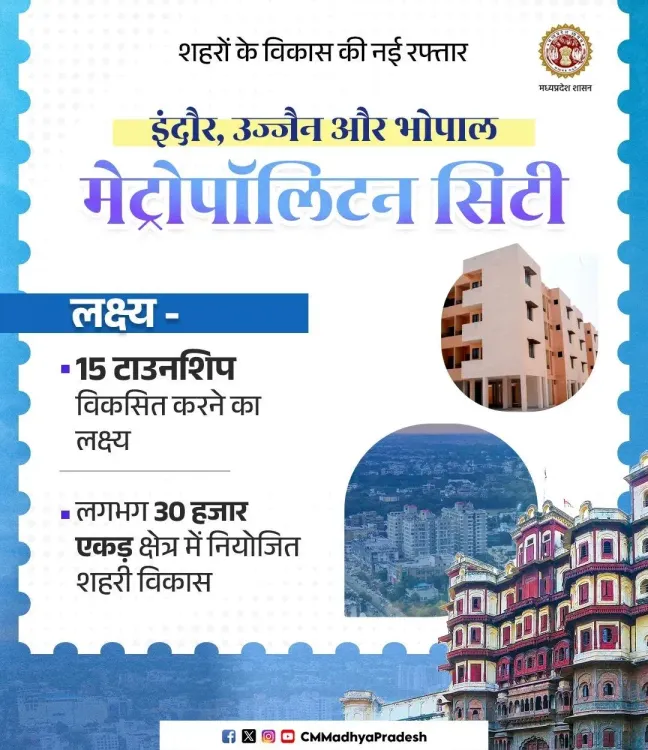
MP CM Office Targets 15 New Townships for Urban Growth
Synopsis
The Chief Minister's Office of Madhya Pradesh announced a target to develop 15 new townships, addressing rapid urbanisation pressure on major cities. Key details including locations, funding, and timelines are yet to be disclosed.
Key Takeaways
The Chief Minister's Office of Madhya Pradesh announced a target to develop 15 new townships on November 3, 2026 .
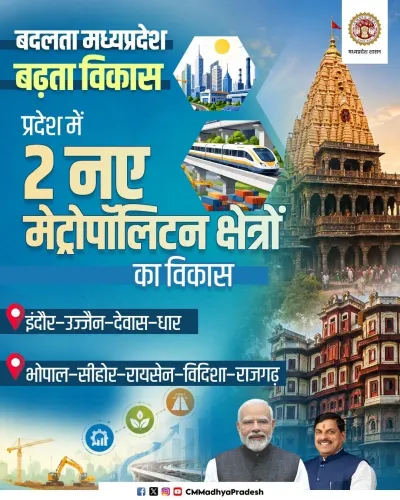
The announcement addresses growing urbanisation pressure on major MP cities including Bhopal , Indore , Jabalpur , and Gwalior .
Planned townships are designed to reduce density in existing city cores and create new residential and industrial corridors.
Specific locations, land acquisition plans, and funding mechanisms have not yet been disclosed .
Details are expected in upcoming state budget documents or urban development authority notifications.
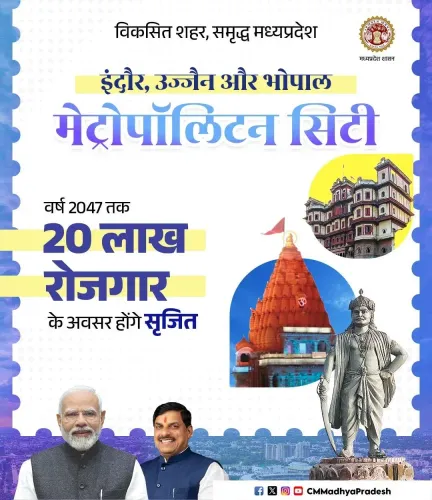
Madhya Pradesh has set its sights on a bold urban expansion — the Chief Minister's Office of Madhya Pradesh announced on Tuesday, November 3, 2026, a target to develop 15 new townships across the state, signalling an ambitious push to reshape how the state's cities grow.
The post, shared from the official Chief Minister's Office account on X, carried the announcement in brief but pointed terms: '15 nayi township viksit karne ka lakshya' — 'the target of developing 15 new townships'. Short on specifics, heavy on intent.
Why 15 New Townships — and Why Now
Madhya Pradesh is no stranger to urbanisation pressure. Rapid population movement toward major centres like Bhopal, Indore, Jabalpur, and Gwalior has strained existing municipal infrastructure for years. Planned townships — with integrated roads, utilities, and residential zones built from scratch — are increasingly the tool Indian state governments reach for when the organic spread of cities becomes unmanageable.
The logic is straightforward: new townships draw population and investment away from congested cores, create planned industrial or residential corridors, and give urban development authorities cleaner land acquisition pathways than retrofitting existing city limits. Several other Indian states have used the same playbook, with mixed results depending on execution speed and funding continuity.
What the Announcement Leaves Open
The critical details — exact locations, land acquisition frameworks, funding sources, and construction timelines — remain unannounced. Watchers of the state's urban policy will be looking closely at upcoming state budget documents and notifications from urban development authorities for those specifics. A target without a map and a budget is a starting gun, not a finish line.
Real estate developers and urban planners operating in Madhya Pradesh will be tracking whether these townships are clustered around existing growth corridors or targeted at newer, under-served regions. For ordinary residents — especially those in overcrowded urban zones — the promise of planned, affordable housing within new township limits is the number that matters most.
Fifteen townships. The ambition is on the board. Now comes the harder work of turning a target into terrain.
Point of View
Which has seen sustained migration toward its tier-1 cities, the announcement aligns with national-level urbanisation goals but will be judged entirely on execution. The absence of location and funding specifics at launch is a familiar feature of such announcements; the real test comes when land acquisition begins and developer partnerships are formalised. If the state can tie these townships to existing industrial corridors, the project has structural logic — if not, it risks becoming a line in a budget rather than bricks on ground.
NationPress
3 Nov 2026
Frequently Asked Questions
How many new townships is Madhya Pradesh planning to build?
The Chief Minister's Office of Madhya Pradesh has announced a target of 15 new townships , though locations and timelines have not yet been specified.
Where will the 15 new townships in Madhya Pradesh be located?
Specific locations have not been announced yet. Details are expected to emerge in state budget documents or urban development authority notifications.
Why is Madhya Pradesh building new townships?
Madhya Pradesh is developing new townships to manage rapid urbanisation, reduce pressure on existing cities like Bhopal and Indore , and create planned residential and industrial growth corridors.
Who will benefit from the new townships in Madhya Pradesh?
Urban residents seeking housing in planned zones, real estate developers, and industries looking for new growth corridors stand to benefit from the proposed township development.
When will the Madhya Pradesh new township project be completed?
No completion timeline has been announced. The government is expected to release a detailed plan including funding mechanisms and land acquisition frameworks in forthcoming policy documents.