MP CM Office: E-Granthalaya Portal Rolled Out in 544 Colleges
Synopsis
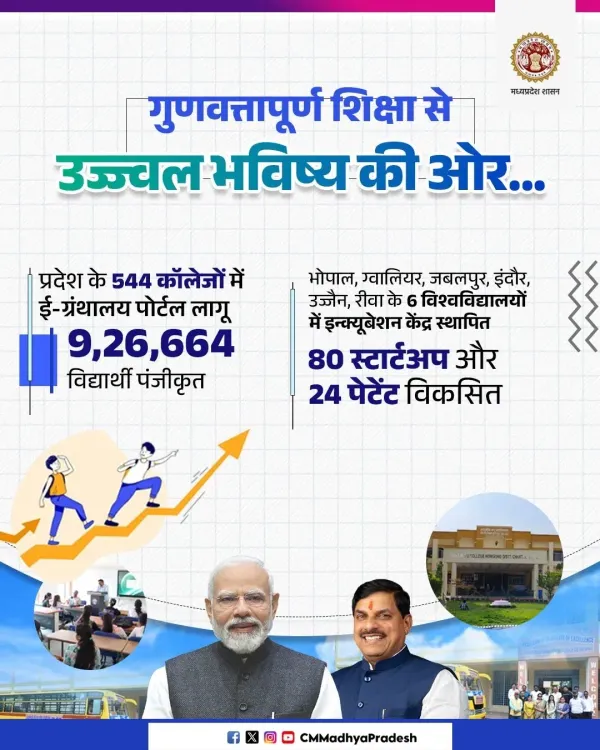
The Chief Minister's Office of Madhya Pradesh announced on 8 July 2026 that the NIC-developed e-Granthalaya library automation portal has been rolled out across 544 state colleges, advancing the state's digital higher-education infrastructure under the broader Digital India framework.
Key Takeaways
The Chief Minister's Office of Madhya Pradesh announced the implementation of the e-Granthalaya portal in 544 colleges across the state.
The portal was developed by the National Informatics Centre (NIC) under MeitY and has been in use in government institutions since around 2002 .
The rollout enables digital cataloguing, circulation management, and improved library resource access for students and librarians.
The Madhya Pradesh Higher Education Department is the nodal state body overseeing this e-governance deployment.
The move continues a national trend of states adopting centrally developed NIC platforms to digitise higher-education library networks.
Further phase-wise expansion to additional colleges and release of usage data are expected in coming academic sessions.
The Chief Minister's Office of Madhya Pradesh announced on Wednesday, 8 July 2026 that the e-Granthalaya portal has been implemented across 544 colleges in the state, marking a significant step in the digitisation of higher-education library infrastructure.
Context
The official post, shared from the Chief Minister's Office account (@CMMadhyaPradesh), stated in Hindi: 'प्रदेश के 544 कॉलेजों में ई-ग्रंथालय पोर्टल लागू' — meaning 'E-Granthalaya portal implemented in 544 colleges of the state.' The announcement signals a state-wide push to bring library automation to government-affiliated colleges under a unified digital platform.
The e-Granthalaya portal is a library management software developed by the National Informatics Centre (NIC), a central agency operating under the Ministry of Electronics and Information Technology (MeitY). It enables cataloguing, circulation management, and digital resource access within institutional libraries.
Policy Backdrop
NIC first released the e-Granthalaya software around 2002, and it has since been upgraded progressively under the broader Digital India programme to cover government libraries across the country. The platform is designed to help institutions move from manual registers and physical card catalogues to searchable digital inventories.
The Madhya Pradesh Higher Education Department, the state body overseeing colleges, is responsible for coordinating the rollout of such digital infrastructure under the state's e-governance agenda. This deployment fits into an established pattern of state governments integrating centrally developed NIC platforms into their college networks to improve catalogue search capabilities and enable remote access to resources.
Stakeholders and Impact
The primary beneficiaries of this rollout are college students and librarians across the 544 institutions now covered by the portal. For students, the system offers improved discoverability of library holdings and, depending on institutional configuration, the possibility of remote access to digital resources without a physical visit to the library.
For librarians and administrative staff, the portal streamlines circulation workflows, reduces manual record-keeping, and enables better inventory management. The move also aligns college libraries with the broader digital resource ecosystem being built under national e-governance frameworks.
What's Next
Attention will now turn to whether the Madhya Pradesh Higher Education Department extends coverage to colleges not yet included in this phase, and whether official usage or impact data will be released in subsequent academic sessions. The scale of adoption — how many students and librarians actively use the portal — will be a key metric for assessing the real-world impact of this rollout.
State governments that have adopted similar NIC platforms in the past have followed up with phase-wise expansions; Madhya Pradesh's trajectory on this front will be closely watched by other states considering comparable digitisation drives in higher education.
Point of View
The state sidesteps the cost and risk of bespoke software development, though the real test lies in adoption rates rather than deployment numbers. Announcements of this kind also serve a political signalling function, positioning the state government as an active participant in national digital governance priorities ahead of the academic year. Whether the rollout translates into measurable improvements in student research outcomes will depend on training, connectivity, and sustained administrative follow-through.
NationPress
6 Oct 2026
Frequently Asked Questions
What is the e-Granthalaya portal?
The e-Granthalaya portal is a library automation and management software developed by the National Informatics Centre (NIC) under MeitY. It supports digital cataloguing, book circulation, and resource management in government institutions, and has been in use since around 2002.
How many colleges in Madhya Pradesh have the e-Granthalaya portal?
According to the Chief Minister's Office of Madhya Pradesh, the portal has been implemented in 544 colleges across the state as of July 2026.
Who developed the e-Granthalaya library portal?
The e-Granthalaya portal was developed by the National Informatics Centre (NIC), a central government agency under the Ministry of Electronics and Information Technology (MeitY).
What are the benefits of e-Granthalaya for students?
Students gain access to a searchable digital catalogue of library holdings, making it easier to locate books and resources. The system can also enable remote access to digital materials, reducing dependence on physical library visits.
Which department is overseeing the e-Granthalaya rollout in Madhya Pradesh?
The Madhya Pradesh Higher Education Department is the state body responsible for coordinating the rollout of the e-Granthalaya portal across government-affiliated colleges in the state.