CM Mohan Yadav Highlights MP Startup Push, ₹1.5L Grants
Synopsis
The Chief Minister's Office of Madhya Pradesh cited 80 startups and 24 patents from state incubation centres, and announced grants of ₹50,000 to ₹1.5 lakh for entrepreneurs attending national and international events, as India's total registered startup count reaches 2.2 lakh.
Key Takeaways
India has 2.2 lakh registered startups as cited by the Chief Minister's Office of Madhya Pradesh.
State incubation centres in Madhya Pradesh have produced 80 startups and 24 patents .
Startups can receive ₹50,000 to ₹1.5 lakh in financial assistance for participating in national and international events.
The announcement aligns with the Startup India initiative launched in January 2016 under the central government.
The post was tagged to @PMOIndia and Chief Minister Dr.
Mohan Yadav , reflecting Centre-state coordination on the startup agenda.
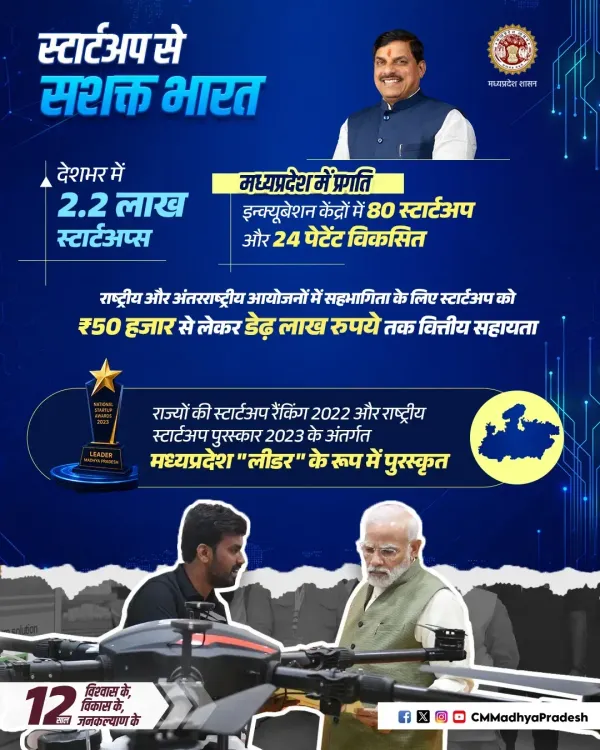
The Chief Minister's Office of Madhya Pradesh on Thursday, 11 June 2026, shared key figures on the state's startup ecosystem, citing 80 startups and 24 patents developed through incubation centres, alongside a national count of 2.2 lakh startups across India.
Context
The post, captioned 'Startup se sashakt Bharat' ('An empowered India through startups'), outlines three headline achievements. At the national level, India now hosts 2.2 lakh registered startups. Within Madhya Pradesh, state-run incubation centres have nurtured 80 startups and facilitated the development of 24 patents. Entrepreneurs participating in national and international events are eligible for financial assistance ranging from ₹50,000 to ₹1.5 lakh.
The post tags @PMOIndia and Chief Minister Dr. Mohan Yadav, signalling alignment between state-level delivery and the central government's innovation agenda. The hashtags #12YearsOfGaribKalyan, #12YearsOfSeva, and #12YearsOfKisanSamriddhi situate the announcement within a broader campaign marking twelve years of BJP-led governance at the Centre.
Policy Backdrop
The announcement builds on the Startup India initiative, launched in January 2016, which created a national framework offering tax benefits, simplified compliance, and funding pathways for new enterprises. The scheme was designed to decentralise innovation beyond metropolitan hubs into smaller cities and towns.
Madhya Pradesh has progressively layered state-specific programmes on top of this central architecture. Incubation centres — typically housed within universities and technology institutions — provide mentorship, shared infrastructure, and access to intellectual property support. The ₹50,000–₹1.5 lakh event-participation grant is aimed at reducing the financial barrier that prevents early-stage founders from showcasing their work on larger platforms.
Stakeholders and Impact
The primary beneficiaries are early-stage entrepreneurs and student innovators operating within Madhya Pradesh's incubation network. For startups at the pre-revenue stage, a grant of up to ₹1.5 lakh can be the difference between attending a national pitch event and missing the exposure entirely.
The 24 patents figure is notable: patent filings from state incubation centres are a metric that central policy reviews use to gauge the quality — not just the quantity — of startup activity. Broader beneficiaries include universities hosting incubators, local manufacturing ecosystems that may absorb startup-developed technologies, and the state's overall ranking in national innovation indices.
What's Next
The critical test for Madhya Pradesh's startup push will be the graduation rate — how many of the 80 incubated startups go on to raise institutional funding or achieve commercial scale. Analysts tracking the space will watch whether the patent pipeline translates into licensed technologies or spin-off ventures over the next two years.
With India's national startup count at 2.2 lakh, competition for talent, capital, and market access is intensifying. States that combine incubation infrastructure with consistent financial support — as Madhya Pradesh appears to be doing — are better positioned to retain founder talent rather than lose it to metros like Bengaluru, Mumbai, or Delhi.
Point of View
Not just registration volumes. The ₹50,000–₹1.5 lakh event grant, while modest by metro standards, addresses a real structural barrier for founders in tier-2 and tier-3 cities. If Madhya Pradesh sustains this support architecture, it could emerge as a credible alternative hub in India's increasingly distributed startup geography.
NationPress
26 Oct 2026
Frequently Asked Questions
How many startups are there in Madhya Pradesh incubation centres?
According to the Chief Minister's Office of Madhya Pradesh, state incubation centres have developed 80 startups and 24 patents .
What financial help do startups get in Madhya Pradesh for events?
Startups in Madhya Pradesh are eligible for grants ranging from ₹50,000 to ₹1.5 lakh to participate in national and international events and competitions.
How many startups are registered in India in 2026?
The Chief Minister's Office of Madhya Pradesh cited a figure of 2.2 lakh startups registered across India.
What is the Startup India scheme?
Startup India is a national programme launched in January 2016 to foster entrepreneurship through tax incentives, simplified compliance, and funding support for new enterprises.
Who is the Chief Minister of Madhya Pradesh overseeing startup policy?
Dr. Mohan Yadav has been the Chief Minister of Madhya Pradesh since December 2023 and is tagged in state communications on the startup ecosystem.