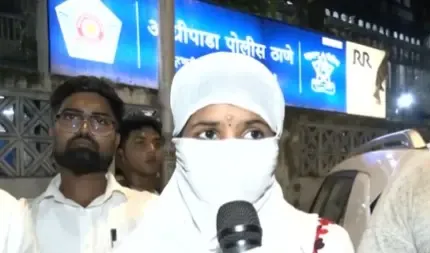
Mumbai woman allegedly converted to Islam under marriage pretext, FIR filed
Synopsis
A 22-year-old Mumbai woman allegedly converted from Hinduism to Islam after being promised marriage and financial support — and a WhatsApp wedding invite bearing her new name 'Ayesha' became the evidence that led her mother to file a complaint. It is one of the first cases under Maharashtra's newly enacted Freedom of Religion Act, 2026.
Key Takeaways
The Meghwadi Police registered FIR No.
0587/2026 against Faiz Akbar Khan on 10 November 2026 .
The accused allegedly told the 22-year-old woman , 'If you change your religion, I will marry you.' The woman reportedly went missing on 18 October 2026 ; a court marriage certificate from Bandra Court reached her family on 20 October .
A wedding invitation bearing the name 'Shravani (Ayesha)' was sent via WhatsApp on 24 October 2026 , triggering the formal complaint.
The case is registered under Section 9(1) of the Maharashtra Freedom of Religion Act, 2026 ; Sub-Inspector Indrajit Nemane is leading the probe.
A 22-year-old Mumbai woman was allegedly persuaded to convert from Hinduism to Islam under the pretext of marriage and financial assistance, the Meghwadi Police confirmed on Tuesday, 10 November 2026. An FIR has been registered against the accused, Faiz Akbar Khan, under the Maharashtra Freedom of Religion Act, 2026, marking one of the first cases to be lodged under the newly enacted law.
How the Alleged Incident Unfolded
The incident traces back to the Amina Nagar area of Jogeshwari East, Mumbai, where the accused allegedly befriended the woman and reportedly told her, 'If you change your religion, I will marry you.' The complainant — the woman's mother — alleged that Khan also promised financial support as an additional inducement.
On 18 October 2026, the woman reportedly went missing from her residence, prompting her family to file a kidnapping complaint at the Virar Police Station. Two days later, on 20 October, the woman allegedly sent her mother a certificate of a court marriage solemnised at the Bandra Court, adding a new dimension to the case.
The Wedding Invitation That Triggered the Complaint
The situation escalated on 24 October 2026, when the accused reportedly sent a wedding invitation card via WhatsApp to the woman's brother. The invitation bore the names 'Mohammad Faiz weds Shravani (Ayesha)' and listed 6 November 2026 as the scheduled wedding date.
The mother cited this invitation as key evidence of a religiously motivated conversion and approached the Meghwadi Police with a formal complaint. The case has been registered as FIR No. 0587/2026 under Section 9(1) of the Maharashtra Freedom of Religion Act, 2026.
Investigation Under Way
Sub-Inspector Indrajit Nemane has been assigned to the case and is currently probing the circumstances surrounding the alleged conversion and marriage. Police said they are working to establish the full sequence of events and verify all allegations.
Notably, this case comes amid heightened scrutiny of conversion-related complaints following the enactment of Maharashtra's Freedom of Religion Act, 2026 — legislation that critics argue broadens the scope of state oversight into religious choices, while proponents say it protects vulnerable individuals from coercion.
Legal and Social Context
The Maharashtra Freedom of Religion Act, 2026 prohibits religious conversion by means of force, allurement, or fraudulent means, with specific provisions targeting conversions linked to marriage. Similar laws are in force in several Indian states, though their application and scope remain subjects of ongoing legal debate.
Further details are awaited as the investigation proceeds and police attempt to locate and record the statement of the woman at the centre of the case.
Point of View
2026 is being tested in real-time — and the evidentiary bar it sets. A WhatsApp wedding invitation became the pivot on which a formal FIR turned, raising questions about how courts will weigh circumstantial digital evidence in conversion-related cases. The law's broad framing of 'allurement' could encompass ordinary promises made in a relationship, which legal scholars argue risks criminalising personal choices. At the same time, the case will be watched closely by those who argue the legislation exists precisely to address coercive dynamics that go unreported. The investigation's outcome — particularly whether the woman's own statement aligns with her mother's complaint — will be the decisive test.
NationPress
10 Nov 2026
Frequently Asked Questions
What is the Mumbai religious conversion case about?
A 22-year-old Mumbai woman was allegedly persuaded to convert from Hinduism to Islam by a man named Faiz Akbar Khan, who reportedly promised to marry her and provide financial support. Her mother filed a complaint after receiving a wedding invitation bearing her daughter's new name 'Ayesha', leading to an FIR under the Maharashtra Freedom of Religion Act, 2026.
What law has been invoked in this case?
The FIR was registered under Section 9(1) of the Maharashtra Freedom of Religion Act, 2026, which prohibits conversion through force, allurement, or fraudulent means. This is one of the first cases to be lodged under this newly enacted legislation.
What evidence led to the FIR being filed?
The woman's mother cited a wedding invitation sent via WhatsApp on 24 October 2026, which carried the names 'Mohammad Faiz weds Shravani (Ayesha)' with 6 November 2026 as the wedding date, as key evidence of conversion under the pretext of marriage. A court marriage certificate from Bandra Court had also been received by the family on 20 October 2026.
Who is investigating the case and what is the FIR number?
Sub-Inspector Indrajit Nemane of the Meghwadi Police Station has been assigned to the investigation. The case is registered as FIR No. 0587/2026 at the Meghwadi Police Station in Mumbai.
What is the Maharashtra Freedom of Religion Act, 2026?
The Maharashtra Freedom of Religion Act, 2026 is a state law that prohibits religious conversion through force, allurement, or fraudulent means, including conversions linked to marriage. It has provisions for criminal penalties against those found guilty of inducing conversion through such means.