President Droupadi Murmu Celebrates Nalanda University's Ancient Legacy

Synopsis
At Nalanda University's Convocation Ceremony, President Droupadi Murmu highlights the institution's historic significance and its role in today's educational landscape. She emphasizes the commitment to knowledge, dialogue, and values while urging collaboration for a brighter future.
Key Takeaways
Convocation Celebration: President Murmu addressed graduates at Nalanda University, emphasizing the enduring importance of education.
Global Representation: Over half of the graduates were international students, showcasing Nalanda's global stature.
Historical Significance: The ancient Nalanda was a prestigious center of learning for nearly eight centuries.
Intellectual Values: Emphasis on knowledge intertwined with ethics and societal welfare.
Future Aspirations: Vision for Nalanda as a leading institution in Asia and globally.
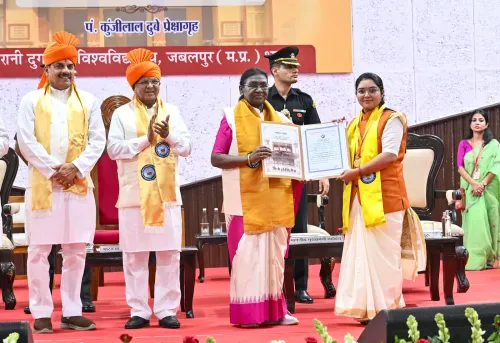
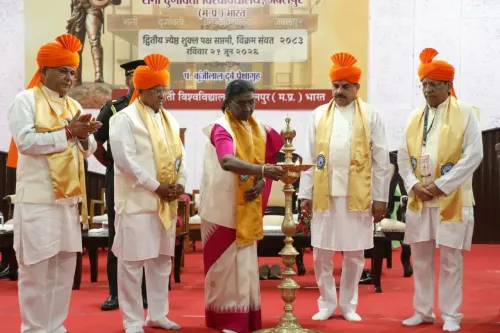
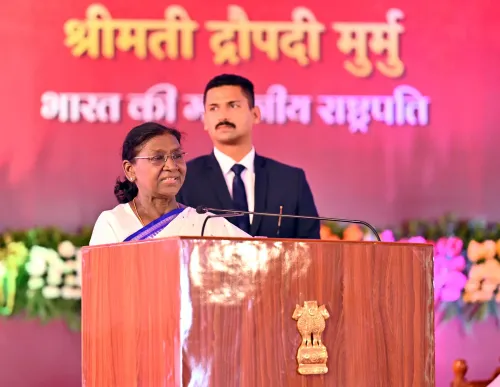
Patna, March 31 (NationPress) On Tuesday, President Droupadi Murmu graced the Convocation Ceremony of Nalanda University in Rajgir, where she delivered an inspiring address to the graduating class.
During her speech, the President characterized this convocation as a reaffirmation of a profound civilizational commitment—a commitment that ensures the persistence of knowledge, the prevalence of dialogue, and the enduring service of education to humanity.
She congratulated the graduates, emphasizing that their achievements are a testament to their hard work, discipline, and intellectual dedication.
Notably, she expressed happiness that over half of the graduating class consisted of international students from more than 30 nations, showcasing the university's expanding global reputation.
Reflecting on the past, President Murmu mentioned that the ancient Nalanda University was one of the world's most prestigious learning centers for nearly eight centuries. The loss of this institution was significant, not only for India but for the whole world.
Yet, the essence of Nalanda has persevered through time. Its revival in modernity signifies a renewed commitment, both nationally and globally, to restore this legacy in today's context.
She pointed out that this resurgence has been facilitated by visionary leadership, continuous institutional efforts, and strong collaborations among partner nations.
The President further noted that ancient Nalanda stood as a symbol of intellectual openness, embracing diverse ideologies and nurturing a rich culture of debate and dialogue.
Knowledge in Nalanda was never sought in isolation; it was deeply intertwined with ethics, society, and the broader welfare of humanity.
She asserted that these ideals are still significantly relevant today, particularly as the world faces complex and evolving challenges.
Emphasizing the importance of independent and critical thinking grounded in compassion, the President expressed her belief that Nalanda University could become a leading academic institution in Asia and globally—distinguished not just by academic prowess but also by its unwavering commitment to values.
She also noted India's profound and vibrant connection with Buddhist philosophy and practice, stressing that this relationship should be nurtured with sincerity and supported by a thorough understanding of India's classical knowledge traditions.
Buddhist scholarship, she stated, should remain firmly anchored in India's civilizational roots while actively engaging with its diverse expressions across Asia.
President Droupadi Murmu expressed her confidence that Nalanda University could rise as a premier global hub for Buddhist studies. She encouraged the university to delve into this field with determination, intellectual rigor, and openness, asserting that such initiatives would allow Nalanda to reclaim its historic role as a beacon of knowledge.
Recalling the grandeur of the ancient Nalanda, the President remarked that its library once held millions of manuscripts, representing an unparalleled repository of wisdom.
Inspired by this illustrious legacy, she posited that the institution being developed today has the potential to serve as a lasting center of learning for future generations.
She further emphasized that as India strides toward its aspiration of becoming a developed nation by 2047, institutions like Nalanda University will be crucial in shaping knowledge systems, fostering global dialogue, and promoting human values.
Point of View
President Murmu's address at Nalanda University underscores the importance of educational institutions in preserving and promoting cultural heritage. Her emphasis on global collaboration and the revival of Nalanda's legacy illustrates a strategic vision for India's role in the global educational landscape.
NationPress
21 Oct 2026
Frequently Asked Questions
What was the significance of President Murmu's address?
President Murmu's address highlighted Nalanda University's ancient legacy, the importance of knowledge and dialogue, and the university's role in shaping future educational landscapes.
How many international students graduated from Nalanda University?
More than half of the graduating cohort comprised international students from over 30 countries.
What ideals did President Murmu emphasize?
She emphasized values such as intellectual openness, ethical knowledge pursuit, and the relevance of these ideals in addressing current global challenges.
What role does Nalanda University play in Buddhist studies?
President Murmu expressed confidence that Nalanda University could become a leading global center for Buddhist studies, rooted in India's civilizational foundations.
What is the vision for India's development by 2047?
President Murmu highlighted that institutions like Nalanda University will be pivotal in shaping knowledge systems and fostering global dialogue as India aims to become a developed nation by 2047.