Nalanda University confers degrees to 219 students from 14 nations at third convocation
Synopsis
Seven of Nalanda University's eight gold medallists at its third convocation were women — a striking detail from a ceremony that also saw 219 graduates from 14 nations receive degrees in Rajgir. With the Kautilya Centre for Capacity Building now inaugurated, the revived ancient institution is quietly becoming India's most ambitious soft-power academic project.
Key Takeaways
Nalanda University held its third convocation on 19 May 2026 at its Rajgir, Bihar campus.
219 students from 14 countries — including Bangladesh, Bhutan, Myanmar, and Vietnam — received degrees.
Seven of eight gold medallists were women, highlighting strong female academic performance.
Mishra , Prime Minister's Principal Secretary, and Bihar Governor Syed Ata Hasnain attended the ceremony.
The Kautilya Centre for Capacity Building was inaugurated at the event, expanding the university's research mandate.
Winners of Shastrarth 2026 , an inter-disciplinary competition, were felicitated at the ceremony.
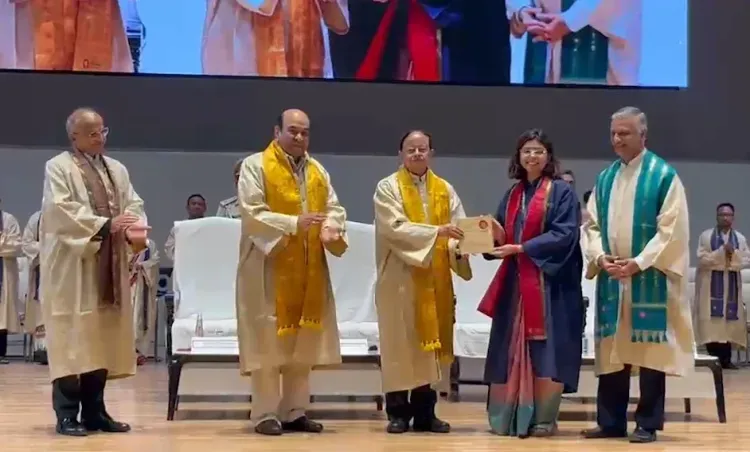
Nalanda University held its third convocation ceremony on Tuesday, 19 May 2026 at its campus in Rajgir, Bihar, conferring degrees upon 219 graduates representing 14 countries. The ceremony, attended by Bihar Governor Syed Ata Hasnain, Prime Minister's Principal Secretary P.K. Mishra, and senior officials of the Ministry of External Affairs (MEA), underscored the revived institution's growing stature as a global centre of learning.
Key Highlights of the Ceremony
Degrees were conferred at the Visvamitralay Auditorium, with eight students receiving gold medals. Women scholars dominated the honours list — seven of the eight gold medallists were female, reflecting strong academic performance across multiple disciplines. The ceremony also felicitated winners of 'Shastrarth 2026', an inter-disciplinary academic competition, and witnessed the inauguration of the Kautilya Centre for Capacity Building, launched just nine days after examinations concluded.
What P.K. Mishra Said
Addressing the gathering, P.K. Mishra drew on the university's ancient heritage. 'I was very impressed to see Nalanda. Nalanda has a long history and heritage. It was one of the great centers of learning. Now, again, we are going to build a similar center of learning from all over the world,' he said. His remarks positioned the revived institution as a deliberate soft-power project, reconnecting India's civilisational legacy with contemporary diplomacy.
A Truly International Graduating Class
Among the 14 nations represented in the graduating cohort were Bangladesh, Bhutan, Myanmar, and Vietnam — a mix that reflects the university's Indo-Pacific and South Asian outreach. Students shared their experiences at the ceremony, with Kapila Swapna, who studied Ecology and Environmental Studies, saying: 'It's a very beautiful campus. I request everyone pursuing a Master's course to get admitted here and get trained under the academic brilliance of the faculty, besides enjoying the essence of Nalanda.'
Nalanda's Revival in Context
The original Nalanda was one of the ancient world's foremost universities, drawing scholars from across Asia before its destruction in the 12th century. The modern institution, revived as an international university under an Act of Parliament, has been positioned as a centrepiece of India's 'Act East' policy. This is only its third convocation since inception, yet it already draws students from across South and Southeast Asia. Notably, the ceremony was held just nine days after examinations — a pace that signals institutional confidence in its academic calendar.
What Comes Next
With the Kautilya Centre for Capacity Building now inaugurated, Nalanda University is expanding beyond classroom instruction into policy research and leadership training. The centre is expected to draw participants from government and civil society across the region, deepening the university's role as a hub for knowledge diplomacy in the years ahead.
Point of View
14 countries — but the symbolism is outsized. Nalanda's revival is less about enrolment figures and more about India's bid to reclaim civilisational prestige as a tool of foreign policy. The presence of MEA officials at a university convocation is not incidental; it signals that New Delhi views Nalanda as a diplomatic instrument, not merely an academic one. The real test will be whether the institution builds research depth and faculty of global standing, or remains a heritage-branded soft-power showcase.
NationPress
8 Oct 2026
Frequently Asked Questions
How many students graduated at Nalanda University's third convocation?
Nalanda University conferred degrees upon 219 students at its third convocation ceremony on 19 May 2026 in Rajgir, Bihar. The graduating cohort represented 14 countries across South and Southeast Asia.
Which countries were represented in Nalanda University's graduating class?
The graduating class included students from 14 nations, among them Bangladesh, Bhutan, Myanmar, and Vietnam. The international composition reflects the university's focus on Indo-Pacific and South Asian academic outreach.
Who received gold medals at the Nalanda University convocation 2026?
Eight students received gold medals at the ceremony, with seven of the eight being women scholars. Their performance spanned multiple academic disciplines offered at the university.
What is the Kautilya Centre for Capacity Building inaugurated at Nalanda?
The Kautilya Centre for Capacity Building is a new research and leadership training facility inaugurated at Nalanda University during the third convocation ceremony. It is expected to draw participants from government and civil society across the region, expanding the university's role beyond classroom instruction.
Why is Nalanda University significant for India's foreign policy?
Nalanda University is positioned as a centrepiece of India's 'Act East' policy, reviving an ancient institution that once drew scholars from across Asia. The attendance of Ministry of External Affairs officials at its convocation underscores its role as a soft-power diplomatic instrument.