KOSPI gains 2.08% on chip bargain buying as Iran tensions, AI doubts linger
Synopsis
South Korea's KOSPI pared a 3.3% opening surge to trade up just over 2% by mid-morning on 9 July, as retail investors sold into the rally while institutions and foreigners snapped up beaten-down chip stocks. SK Hynix's 6.65% jump — fuelled by a seven-times-oversubscribed US listing — was the session's standout, but Iran tensions and AI demand uncertainty kept the broader recovery in check.
Key Takeaways
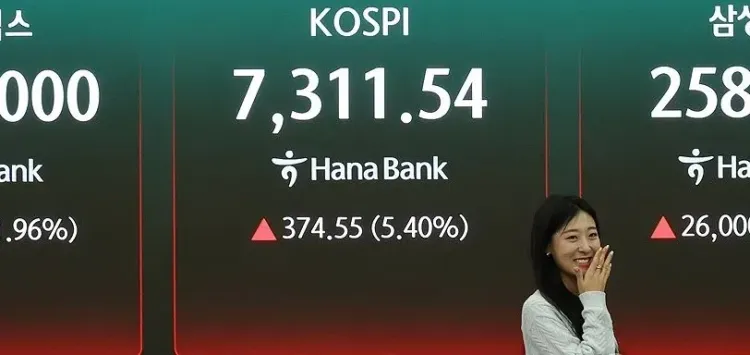
KOSPI was up 150.61 points (2.08%) at 7,397.40 as of 11:20 am on 9 July , after opening 3.3% higher.
Institutions and foreign investors were net buyers of 985.8 billion won and 144.9 billion won respectively; retail investors sold a net 1.07 trillion won .
SK Hynix jumped 6.65% after its US listing was reported to be more than seven times oversubscribed .
Hyundai Motor fell 2.38% and Hanwha Aerospace declined 6.72% , bucking the broader trend.
South Korea issued its largest-ever euro-denominated FX stabilisation bonds worth 1.7 billion euros (US$1.94 billion) with three- and seven-year maturities.
The Korean won weakened to 1,504.65 per US dollar , down 2.25 won from the previous session.
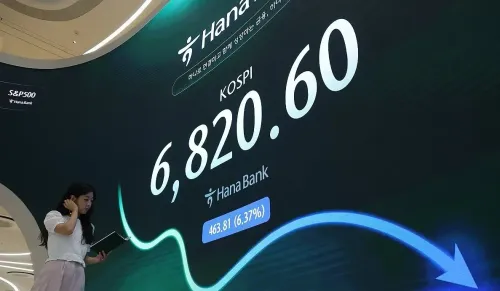
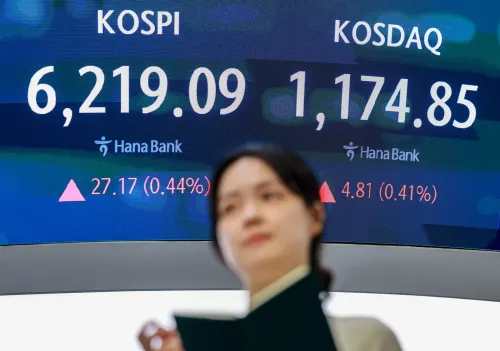
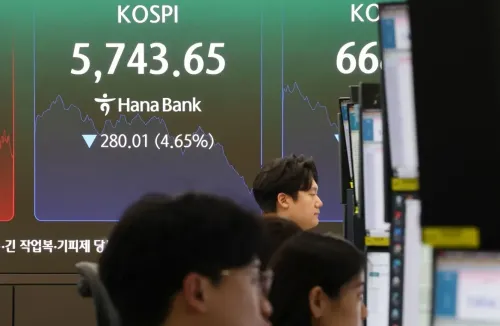
South Korea's benchmark Korea Composite Stock Price Index (KOSPI) was trading up 150.61 points, or 2.08 percent, at 7,397.40 as of 11:20 am local time on Thursday, 9 July, paring a sharper early rally as retail investors cashed out even as institutions and foreign buyers scooped up bargain-priced semiconductor stocks following a recent steep sell-off. The index had opened 3.3 percent higher before trimming those gains.
Who Was Buying, Who Was Selling
Institutions and foreign investors were net buyers, purchasing 985.8 billion won (approximately US$655 million) and 144.9 billion won worth of shares, respectively. Retail investors, however, moved in the opposite direction, offloading a net 1.07 trillion won — a divergence that analysts say reflects differing risk appetites amid ongoing geopolitical uncertainty.
Tech Stocks Lead the Recovery
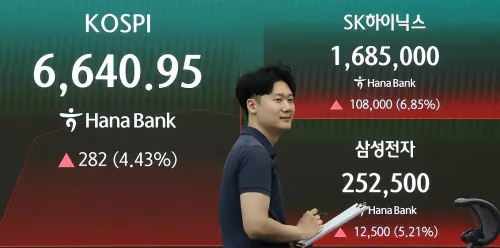
Semiconductor names drove the rebound. Samsung Electronics rose 1.8 percent, while SK Hynix surged 6.65 percent after reports that its planned US listing was more than seven times oversubscribed — a signal of robust international investor appetite for Korean chip exposure. SK Telecom climbed 4.52 percent, and budget carrier Air Busan gained 7.5 percent.
Not all sectors participated in the rally. Top automaker Hyundai Motor fell 2.38 percent, and defence conglomerate Hanwha Aerospace declined 6.72 percent, suggesting sector-specific headwinds rather than a broad-based recovery.
Geopolitical and AI Uncertainty Cloud the Outlook
Analysts cautioned that the rebound should not be read as a full-throated recovery. Renewed tensions in the Middle East — with Iran cited as a specific flashpoint — continue to weigh on investor sentiment. Additionally, uncertainty over the next phase of artificial intelligence (AI) demand has introduced fresh caution into technology valuations globally.
Overnight, US markets closed mixed: the Dow Jones Industrial Average fell 1.09 percent, while the tech-heavy Nasdaq Composite edged up 0.2 percent — a split result that underscores the uneven risk environment feeding into Asian markets.
Korean Won and FX Bond Issuance
The Korean won was trading at 1,504.65 won per US dollar as of 11:20 am, down 2.25 won from the previous session, reflecting mild currency pressure alongside the equity volatility.
Separately, South Korea's Ministry of Finance and Economy announced it had issued euro-denominated foreign exchange stabilisation bonds worth 1.7 billion euros (approximately US$1.94 billion) — the largest-ever such issuance by Seoul. The bonds carry maturities of three and seven years and are designed to bolster foreign currency reserves against external financial shocks. Officials said the strong demand reflected the country's solid standing in global capital markets.
What to Watch Next
Market participants will monitor further developments on Iran-linked geopolitical tensions and any fresh signals on AI capital spending from major US technology companies. The SK Hynix US listing outcome will also be closely tracked as a gauge of overseas demand for Korean semiconductor assets. A sustained institutional buying pattern could support the KOSPI in the near term, but retail selling pressure and macro headwinds remain live risks.
Point of View
While institutions and foreigners are the ones doing the conviction buying in semiconductors. That divergence is a classic 'smart money versus retail' split, and it raises the question of whether this is a durable floor or a dead-cat bounce. The SK Hynix US listing demand is genuinely encouraging, but Iran-linked risk and the unresolved AI demand trajectory mean the KOSPI's recovery remains hostage to macro events well outside Seoul's control.
NationPress
8 Oct 2026
Frequently Asked Questions
Why did the KOSPI rise on 9 July 2025?
The KOSPI rose 2.08% to 7,397.40 on 9 July, driven by institutional and foreign buying of semiconductor stocks following a recent sharp sell-off. SK Hynix's 6.65% surge, fuelled by strong demand for its US listing, was a key catalyst.
Why did the KOSPI trim its earlier gains?
The index opened 3.3% higher but pared gains as retail investors sold a net 1.07 trillion won worth of shares, offsetting buying by institutions and foreign investors. Ongoing concerns over Iran-linked geopolitical tensions and AI demand uncertainty also capped the rally.
What happened with SK Hynix on 9 July?
SK Hynix shares jumped 6.65% after reports that its planned US stock listing was more than seven times oversubscribed, signalling strong international investor appetite for the South Korean chip maker.
What are South Korea's euro-denominated FX stabilisation bonds?
These are bonds issued by South Korea's Ministry of Finance and Economy to raise foreign currency reserves and buffer against external financial shocks. On 8 July, Seoul issued 1.7 billion euros worth — its largest-ever such issuance — with three- and seven-year maturities.
Which stocks fell despite the broader KOSPI recovery?
Hyundai Motor declined 2.38% and Hanwha Aerospace fell 6.72%, bucking the wider market trend. Their declines point to sector-specific pressures in autos and defence rather than a broad-based risk-off move.