KOSPI crashes 9.99% on 23 June as Samsung, SK Hynix lead semiconductor rout
Synopsis
South Korea's KOSPI shed nearly 10 percent in a single session on 23 June, with Samsung Electronics and SK Hynix each losing over 12 percent as foreign investors fled semiconductor stocks. The Korea Exchange triggered a circuit breaker for the 10th time on record — a rare double-digit correction that exposes how sharply global tech sentiment can reprice markets built on chipmaker valuations.
Key Takeaways
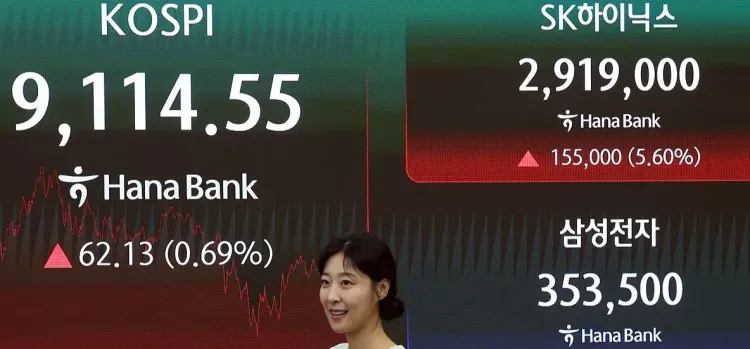
KOSPI plunged 910.71 points (9.99%) to close at 8,203.84 on 23 June .
The Korea Exchange (KRX) triggered a circuit breaker for the 10th time on record and 4th time this year .
Samsung Electronics fell 12.31% ; SK Hynix dropped 12.47% ; Hyundai Motor lost 12.05% .
Foreign investors net sold 4.13 trillion won ; institutional investors offloaded 4.55 trillion won ; retail investors net bought 8.58 trillion won .
Total trade volume reached 483.7 million shares worth 59.9 trillion won (approx.
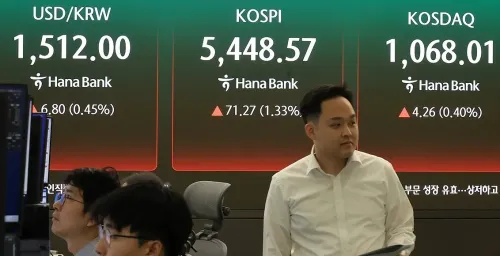
The South Korean won weakened to 1,539.1 per US dollar as of 3:30 pm local time .
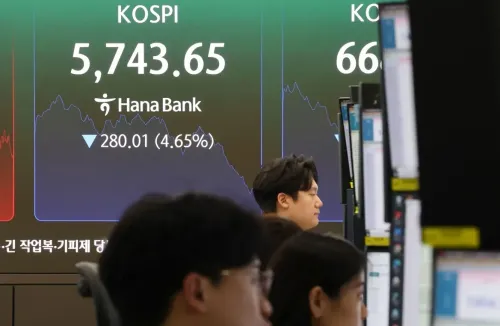
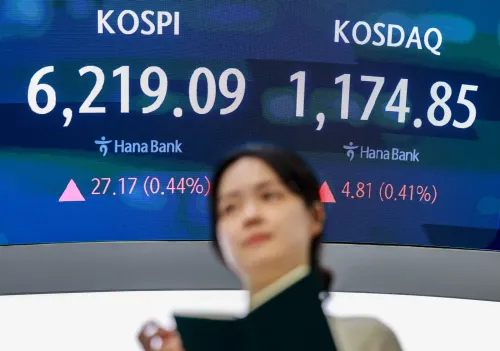
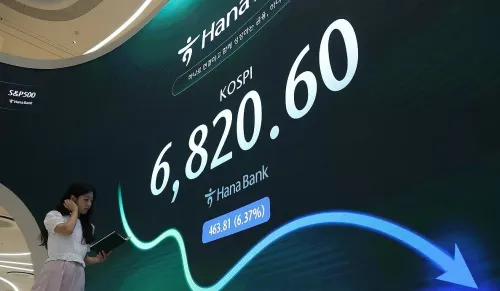
South Korea's benchmark Korea Composite Stock Price Index (KOSPI) plunged 910.71 points, or 9.99 percent, to close at 8,203.84 on Tuesday, 23 June, as foreign and institutional investors aggressively offloaded major semiconductor stocks amid profit-taking and tracking overnight losses in US technology shares. The South Korean won also weakened, closing at 1,539.1 won per US dollar as of 3:30 pm local time.
Circuit Breaker Triggered for 10th Time on Record
The Korea Exchange (KRX) activated a circuit breaker at approximately 2:33 pm after the KOSPI dropped more than 8 percent from the previous session's close, halting all stock trading for 20 minutes. This marked the fourth such halt this year and the 10th time on record that the KRX has deployed the emergency mechanism. The index had touched an intra-day high of 9,175.45 before the sharp reversal, underscoring the severity of the day's swing.
Scale of the Sell-Off
Trade volume was exceptionally heavy at 483.7 million shares valued at 59.9 trillion won (approximately US$38.9 billion). Losers outnumbered winners by a stark margin of 856 to 46. Foreign investors sold a net 4.13 trillion won worth of shares, while institutional investors offloaded a net 4.55 trillion won. Retail investors moved in the opposite direction, net buying 8.58 trillion won — a sign that domestic individual investors attempted to absorb the foreign exodus.
Chipmakers and Blue Chips Bear the Brunt
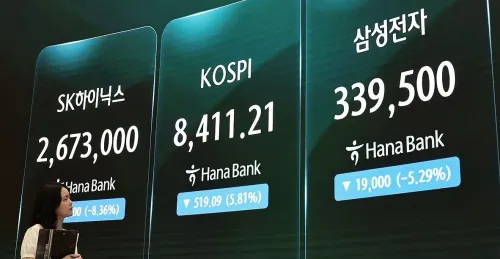
Among large-cap shares, chipmaker Samsung Electronics tumbled 12.31 percent to 310,000 won, while rival SK Hynix fell 12.47 percent to 2.55 million won. Top automaker Hyundai Motor declined 12.05 percent to 511,000 won, and battery manufacturer LG Energy Solution dropped 6.1 percent to 362,000 won. Virtually all large-cap shares ended in negative territory.
What Triggered the Rout
'Valuation concerns have grown for major South Korean semiconductor stocks after they repeatedly hit record highs in a short period, prompting heavy selling by foreign investors and increasing market volatility,' said Seo Sang-young, an analyst at Mirae Asset Securities. Seo added that the near 1 percent decline in Nasdaq futures further dampened sentiment toward domestic chipmakers.
Overnight, US technology stocks came under pressure, with the tech-heavy Nasdaq Composite falling 1.3 percent. Shares of SpaceX reportedly tumbled more than 16 percent after reports emerged that the company is selling bonds to fund its artificial intelligence initiatives. Meanwhile, US Vice President JD Vance indicated that a 'very good foundation' had been established for negotiations toward a final agreement with Iran, though the diplomatic development did little to lift risk appetite in global markets.
What to Watch Next
The scale of retail buying — nearly matching combined foreign and institutional outflows — suggests domestic investors are betting on a near-term floor, but analysts warn that sustained Nasdaq weakness could extend the pressure on South Korean chipmakers. This is the fourth circuit-breaker event of the year for the KRX, pointing to elevated volatility that may persist as long as US technology sentiment remains fragile.
Point of View
And the KOSPI's fourth circuit breaker of the year signals that South Korean equities have become a high-beta proxy for US tech sentiment rather than a market with independent price discovery. The irony is stark: Samsung and SK Hynix have been among the world's best-performing semiconductor stocks this year precisely because of AI-driven demand, yet that same AI narrative — embodied by SpaceX's bond sale and Nasdaq's wobble — is now the instrument of their sharpest single-day destruction. Retail investors absorbing nearly 8.58 trillion won in a single session may prove prescient or reckless depending on where Nasdaq opens next. What the day confirms is that South Korea's market structure, dominated by a handful of globally-exposed chipmakers, leaves it acutely vulnerable to sentiment shifts that originate thousands of kilometres away.
NationPress
22 Sept 2026
Frequently Asked Questions
Why did the KOSPI crash nearly 10 percent on 23 June?
The KOSPI fell 9.99 percent on 23 June as foreign and institutional investors aggressively sold major semiconductor stocks, tracking a 1.3 percent decline in the Nasdaq Composite overnight. Valuation concerns after repeated record highs in South Korean chipmaker shares, combined with a reported 16 percent fall in SpaceX shares and renewed US technology sector anxiety, triggered the broad sell-off.
What is a circuit breaker and why did the KRX activate one?
A circuit breaker is an automatic mechanism that halts all stock trading for a set period when a benchmark index falls beyond a specified threshold, designed to prevent panic-driven free-falls. The Korea Exchange activated the circuit breaker at around 2:33 pm on 23 June after the KOSPI dropped more than 8 percent from the previous session's close, suspending trading for 20 minutes. It was the 10th such activation on record and the fourth this year.
Which South Korean stocks fell the most on 23 June?
Samsung Electronics tumbled 12.31 percent to 310,000 won, SK Hynix dropped 12.47 percent to 2.55 million won, and Hyundai Motor declined 12.05 percent to 511,000 won. LG Energy Solution also fell 6.1 percent to 362,000 won, with virtually all large-cap shares ending in negative territory.
How did retail investors respond to the KOSPI crash?
Retail investors moved against the tide, net buying 8.58 trillion won worth of shares even as foreign investors sold a net 4.13 trillion won and institutional investors offloaded a net 4.55 trillion won. This suggests domestic individual investors viewed the sharp decline as a buying opportunity.
What is the outlook for South Korean markets after this crash?
Analysts caution that sustained weakness in US technology stocks and Nasdaq futures could continue to pressure South Korean chipmakers, given their heavy exposure to global AI and semiconductor demand cycles. The frequency of circuit-breaker events — four in 2025 alone — points to elevated market volatility that may persist as long as US tech sentiment remains uncertain.