KOSPI tanks 6.37% to 6,820 as tech stocks crash amid Middle East tensions
Synopsis
South Korea's KOSPI shed 6.37% in a single session — its steepest fall in recent memory — as Samsung plunged nearly 9% and SK Hynix cratered over 11%. A surprise Bank of Korea rate hike, fresh US strikes on Iran, and a classic post-rally profit rout hit simultaneously, exposing just how fragile Wednesday's 6% rebound really was.
Key Takeaways
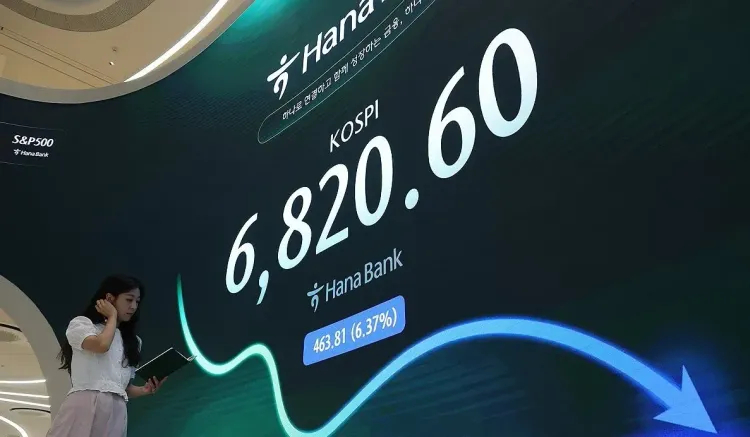
The KOSPI closed down 463.81 points (6.37%) at 6,820.60 on 16 July , after touching an intraday low of 6,730.87 .
The Korea Exchange triggered a sell-side sidecar for 20 minutes at 9:10 a.m. after the index fell more than 5 percent .
Samsung Electronics plunged 8.77% and SK Hynix tumbled 11.53% , leading the technology sector rout.
The Bank of Korea raised its benchmark rate by 25 basis points to 2.75% — its first hike in 3½ years .
Foreign and institutional investors sold a combined net 3.75 trillion won ; retail buyers absorbed 3.66 trillion won .
The Korean won firmed to 1,480.4 per US dollar, while bond yields fell across the curve.
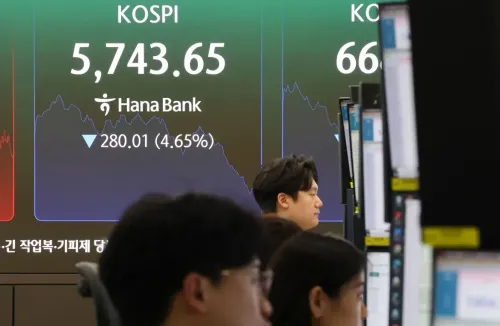
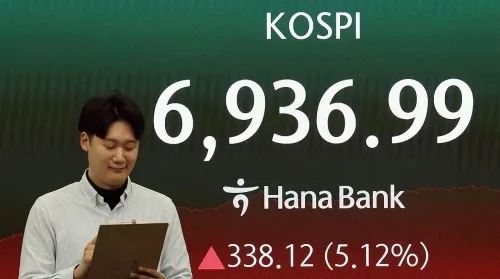
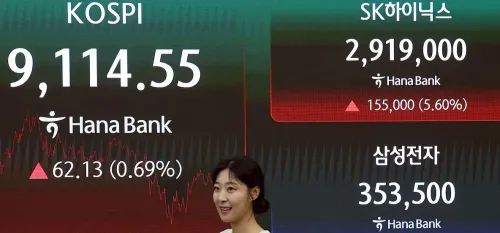
South Korea's benchmark Korea Composite Stock Price Index (KOSPI) plunged 463.81 points, or 6.37 percent, to close at 6,820.60 on Thursday, 16 July, as steep losses in technology heavyweights and escalating Middle East tensions battered investor confidence. The index, which had opened 4.45 percent lower, touched an intraday low of 6,730.87 before recovering marginally into the close.
Circuit Breaker Triggered
The Korea Exchange, the country's bourse operator, activated a sell-side sidecar on the KOSPI for 20 minutes at around 9:10 a.m. after the benchmark fell more than 5 percent in early trade. The move is a standard volatility-management mechanism designed to slow automated sell orders during sharp market dislocations.
What Drove the Sell-Off
The session's losses came on the heels of a 6.24 percent surge on Wednesday, when softer-than-expected US inflation data had briefly lifted sentiment by easing fears of near-term Federal Reserve interest rate hikes. Thursday's reversal reflected classic profit-taking compounded by fresh macro headwinds.
Kang Jin-hyeok, an analyst at Shinhan Securities Co., attributed the fall to two concurrent pressures: 'Profit-taking followed sharp gains in technology stocks a session earlier, while persistent concerns over the semiconductor industry kept the index under pressure.'
Adding to the strain, the Bank of Korea (BOK) raised its benchmark interest rate by 25 basis points to 2.75 percent — its first hike in 3½ years — to counter inflation. Meanwhile, fresh US strikes on Iran intensified regional uncertainty and renewed concerns over potential disruptions to energy supplies from the Middle East.
Technology Stocks Lead Losses
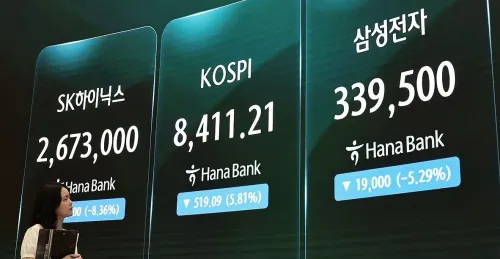
Market bellwether Samsung Electronics plunged 8.77 percent to 255,000 won, while rival chipmaker SK Hynix tumbled 11.53 percent to 1,842,000 won. The semiconductor sector bore the brunt of both profit-taking and structural demand concerns. Top automaker Hyundai Motor fell 2.07 percent to 425,000 won, and steelmaker POSCO Holdings slipped 0.95 percent to 311,500 won.
Not all stocks finished lower. Shipbuilder Hanwha Ocean rose 5.73 percent to 86,700 won, while beverage firm Hitejinro gained 2.47 percent to 14,910 won, reflecting selective demand in defence-adjacent and domestic-consumption sectors.
Institutional Flows and Currency
Institutional and foreign investors sold a net 2.37 trillion won (approximately US$1.6 billion) and 1.38 trillion won worth of shares, respectively. Retail investors absorbed much of that supply, buying a net 3.66 trillion won. The Korean won strengthened marginally, quoted at 1,480.4 won per US dollar at 3:30 p.m., up from 1,484.7 won in the previous session. Bond prices rose as yields fell — the three-year Treasury yield dropped 1.8 basis points to 3.848 percent, while the five-year benchmark yield declined 1.3 basis points to 4.099 percent.
What to Watch Next
Markets will closely track further developments in the Middle East, particularly any escalation involving energy infrastructure, as well as signals from the US Federal Reserve on the rate trajectory. The BOK's rate decision will also be scrutinised for its effect on domestic borrowing costs and corporate earnings in the coming quarters.
Point of View
The second through energy and supply-chain channels. The 6.24% Wednesday surge was always fragile, built on a single US inflation print rather than any change in underlying conditions. The Bank of Korea's decision to hike into a sell-off signals that policymakers are prioritising inflation control over market stability, a trade-off that could weigh on corporate earnings guidance in the quarters ahead. With Samsung and SK Hynix together commanding a disproportionate share of the KOSPI's weight, the index has effectively become a leveraged proxy for global chip sentiment — a concentration risk that Thursday made impossible to ignore.
NationPress
15 Oct 2026
Frequently Asked Questions
Why did the KOSPI fall sharply on 16 July?
The KOSPI fell 6.37% to 6,820.60 on 16 July due to a combination of profit-taking after Wednesday's 6.24% surge, persistent concerns over the semiconductor sector, a surprise Bank of Korea rate hike to 2.75%, and fresh US military strikes on Iran that heightened Middle East tensions. Technology heavyweights Samsung Electronics and SK Hynix led the decline.
What is a sell-side sidecar and why was it activated?
A sell-side sidecar is a temporary circuit-breaker mechanism used by the Korea Exchange to slow automated sell orders when markets fall sharply. It was activated for 20 minutes at around 9:10 a.m. on 16 July after the KOSPI dropped more than 5 percent in early trade.
How much did Samsung Electronics and SK Hynix fall?
Samsung Electronics fell 8.77% to 255,000 won, while SK Hynix tumbled 11.53% to 1,842,000 won. Both declines were driven by profit-taking and ongoing concerns about the global semiconductor industry's demand outlook.
What did the Bank of Korea decide on 16 July?
The Bank of Korea raised its benchmark interest rate by 25 basis points to 2.75% on 16 July — its first rate increase in 3½ years. The hike was aimed at curbing inflation, even as it added to market pressure on the same day.
How did foreign and retail investors respond to the sell-off?
Foreign investors sold a net 1.38 trillion won and institutional investors offloaded a net 2.37 trillion won (approximately US$1.6 billion). Retail investors moved in the opposite direction, buying a net 3.66 trillion won, partially cushioning the broader market decline.