KOSPI falls 124 points on tech rout and US-Iran conflict fears
Synopsis
South Korea's KOSPI opened nearly 3% lower on 11 June as a global AI stock rout — led by Nvidia's 3.73% drop and Super Micro Computer's 28% collapse — collided with Iran's threat to block the Strait of Hormuz. The dual shock hit autos, defence, and batteries hard, and a softer US inflation print wasn't enough to steady nerves.
Key Takeaways
KOSPI fell 124.91 points (1.62%) to 7,605.91 as of 11:20 am on 11 June , after opening nearly 3% lower.
Wall Street losses overnight — Nasdaq down 1.98% , Dow down 1.87% — were driven by an AI valuation sell-off; Super Micro Computer tumbled 28% .
Iran threatened to block the Strait of Hormuz following additional US strikes, adding geopolitical risk to market sentiment.
Hyundai Motor fell 4.32% , Kia dropped 5.51% , and Hanwha Aerospace plunged 5.43% .
Samsung Electronics lost 1.49% ; SK Hynix was a rare gainer, up 0.63% .
The Korean won weakened to 1,528 per US dollar , down 3.8 won on the session.
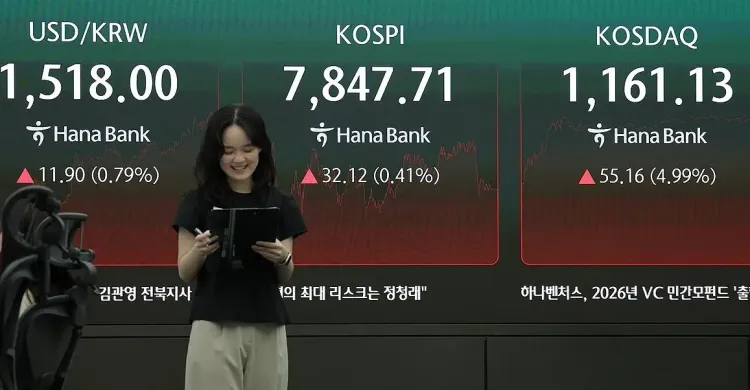
South Korea's benchmark Korea Composite Stock Price Index (KOSPI) dropped 124.91 points, or 1.62%, to 7,605.91 as of 11:20 am local time on Thursday, 11 June, as a global technology sell-off and escalating US-Iran tensions rattled investor confidence in Seoul. The index had opened nearly 3% lower before partially recovering in choppy morning trade.
Wall Street Sell-Off Sets the Tone
Overnight losses on US markets provided the initial jolt. The Dow Jones Industrial Average closed 1.87% lower, the S&P 500 shed 1.62%, and the tech-heavy Nasdaq Composite dropped 1.98% as investors unwound positions in richly valued artificial intelligence stocks. Nvidia dipped 3.73%, Broadcom slid 5.12%, Super Micro Computer tumbled 28%, and AMD fell 4.86%.
US-Iran Tensions Add Geopolitical Risk
Market sentiment was further weighed down by reports that the United States launched additional strikes against Iran, prompting Tehran to threaten action against any vessel attempting to pass through the Strait of Hormuz. The threat raised fears of a broader conflict that could disrupt global oil supply chains — a scenario with direct consequences for energy-intensive manufacturing economies such as South Korea.
Key Stocks in the Red
Across Seoul's market, losses were broad-based. Samsung Electronics — the KOSPI's largest constituent — fell 1.49%, while chipmaking rival SK Hynix bucked the trend, gaining 0.63%. Samsung Electro-Mechanics declined 3.38% and SK Group retreated 2.76%.
The auto sector was among the hardest hit. Top carmaker Hyundai Motor slipped 4.32%, affiliate Kia contracted 5.51%, and parts manufacturer Hyundai Mobis dropped 4.04%. In the energy and defence segment, Doosan Enerbility fell 5.38% and Hanwha Aerospace plunged 5.43%. Battery makers LG Energy Solution and Samsung SDI lost 1.69% and 3.42% respectively.
Inflation Data Offers Little Relief
The US Consumer Price Index for May came in softer than expected, but the print failed to calm nerves. According to Seo Sang-young, an analyst at Mirae Asset Securities, the data was insufficient to rule out a hawkish policy pivot by the US Federal Reserve, keeping rate-sensitive technology valuations under pressure.
Currency and Outlook
The Korean won weakened to 1,528 won per US dollar as of 11:20 am, down 3.8 won from the previous session. With Strait of Hormuz risks unresolved and the Fed's next move uncertain, analysts expect continued volatility in Seoul equities through the week.
Point of View
And energy import dependence that makes any Strait of Hormuz disruption an immediate cost shock. The softer US CPI print — ordinarily a relief valve — was neutralised by geopolitical noise, signalling that markets are no longer trading on fundamentals alone. Notably, SK Hynix's gain even as Samsung bled suggests investors are making micro-level bets within the chip sector rather than fleeing it entirely. The real risk is a prolonged Iran standoff: South Korea imports a significant share of its crude through the Gulf, and a sustained shipping disruption would hit manufacturing margins well beyond the trading screen.
NationPress
20 Sept 2026
Frequently Asked Questions
Why did the KOSPI fall on 11 June?
The KOSPI fell 124.91 points to 7,605.91 on 11 June due to a combination of a global AI stock sell-off on Wall Street and escalating US-Iran tensions, including Iran's threat to block the Strait of Hormuz. A softer US inflation print failed to offset these concerns.
Which South Korean stocks were hit hardest?
Kia dropped 5.51%, Hanwha Aerospace plunged 5.43%, and Doosan Enerbility fell 5.38%, making them the session's biggest decliners. Hyundai Motor, Samsung Electro-Mechanics, and SK Group also recorded losses exceeding 2%.
What happened to US tech stocks overnight?
The Nasdaq Composite fell 1.98% overnight as investors sold AI-linked stocks on valuation concerns. Super Micro Computer collapsed 28%, while Nvidia, Broadcom, and AMD each fell between 3.7% and 5.1%.
How does the US-Iran conflict affect South Korean markets?
Iran's threat to close the Strait of Hormuz — a critical oil shipping lane — raised fears of supply disruptions that would raise energy costs for South Korea, a major crude importer. The uncertainty added a geopolitical risk premium across energy-sensitive sectors including autos and manufacturing.
What did the US inflation data show, and why did it not help markets?
The US Consumer Price Index for May came in softer than expected, which would normally support risk assets. However, according to Mirae Asset Securities analyst Seo Sang-young, it was not enough to rule out a hawkish Federal Reserve pivot, leaving rate-sensitive tech valuations under continued pressure.