Seoul shares KOSPI climbs 3.92% on Hormuz hopes, easing AI fears
Synopsis
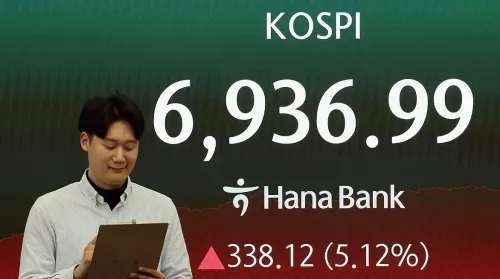
Seoul's KOSPI bounced nearly 4 percent in a single session — its second straight recovery after a brutal 5.12 percent crash — as two forces aligned: hopes of a US-Iran deal to reopen the Strait of Hormuz eased oil and inflation fears, while Palantir's blowout earnings quieted the narrative that AI spending was a bottomless pit with no returns.
Key Takeaways
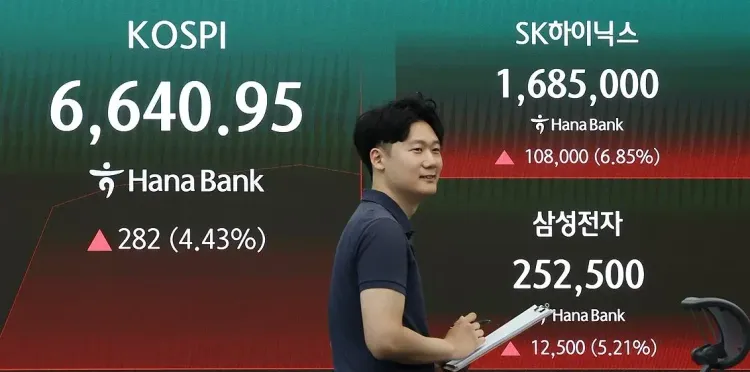
The KOSPI rose 249.33 points (3.92%) to 6,608.28 as of 11:20 am on 5 August .
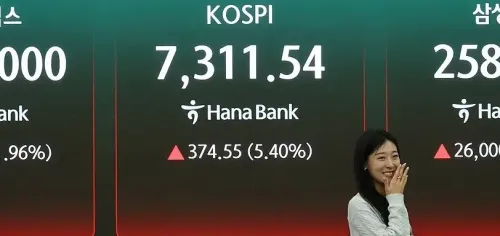
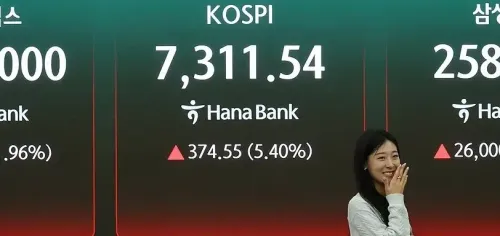
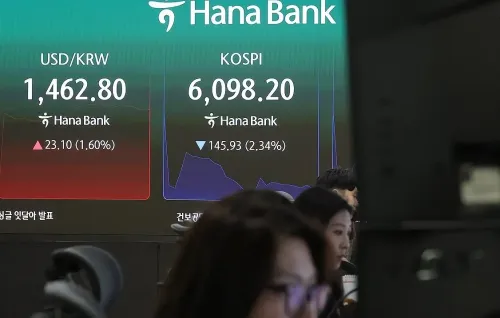
The rally followed a 5.12 percent crash two sessions earlier and a 1.62 percent partial recovery on Tuesday.
Hopes for a US-Iran interim deal on the Strait of Hormuz and Palantir's strong earnings were the twin catalysts.
SK hynix led tech gains at +5.71% ; Samsung Electronics added 2.71% .
Foreign and institutional investors net-bought 427.7 billion won and 370.8 billion won respectively; retail investors net-sold 795.5 billion won .
Oil-linked stocks SK Innovation and S-Oil bucked the trend, falling 1.62% and 1.35% respectively.
South Korea's benchmark Korea Composite Stock Price Index (KOSPI) surged 249.33 points, or 3.92 percent, to 6,608.28 as of 11:20 am IST on Wednesday, 5 August, extending the previous session's recovery as hopes for a United States-Iran interim agreement over the Strait of Hormuz and easing concerns over artificial intelligence (AI) profitability buoyed investor sentiment across Asian markets.
Key Developments
The index opened 3.85 percent higher, building on Tuesday's 1.62 percent gain — itself a partial rebound from a steep 5.12 percent plunge the day before. The Korea Exchange (KRX) activated a buy-side sidecar for the KOSPI for five minutes at 9:25 am after the index surged on technology stock gains, a circuit-breaker mechanism triggered to prevent runaway momentum.
What Drove the Rally
Two catalysts converged to lift sentiment. First, reports of a potential interim deal to reopen the Strait of Hormuz — a critical chokepoint through which roughly 20 percent of global oil flows — raised expectations of sustained crude price declines and reduced inflationary pressure. Second, strong quarterly earnings from Palantir Technologies, the US enterprise software firm, helped reassure investors that heavy capital spending on AI by major technology companies could still yield profitable returns.
Overnight, Wall Street reflected the same optimism: the Dow Jones Industrial Average rose 1.71 percent to 54,085.88, while the tech-heavy Nasdaq Composite climbed 2.59 percent to 26,584.99.
Institutional and Foreign Buying
Institutional investors net-bought 370.8 billion won (approximately US$260 million) worth of shares, while foreign investors added a net 427.7 billion won. Retail investors moved in the opposite direction, net-selling 795.5 billion won — a pattern that suggests professional money was leading the recovery rather than retail momentum.
Stock Movers
Technology stocks led the advance in Seoul. Market bellwether Samsung Electronics rose 2.71 percent, while chipmaking rival SK hynix climbed 5.71 percent. Top carmaker Hyundai Motor gained 3.06 percent and national flag carrier Korean Air added 4.02 percent. On the downside, leading refiner SK Innovation fell 1.62 percent and S-Oil declined 1.35 percent, reflecting lingering pressure on oil-linked stocks even as crude prices eased.
Broader Economic Signal
Separately, a Bank of Korea report released on Wednesday showed that foreign tourists' spending in South Korea accounted for 1.17 percent of the country's gross domestic product (GDP) in 2025, underscoring a rise in inbound travel that adds a modest but growing buffer to domestic consumption. With geopolitical risk around the Hormuz potentially easing, markets will watch whether oil prices hold lower and whether AI earnings momentum can sustain the current tech-led rebound.
Point of View
And on US tech earnings to validate AI capex. Neither is a domestic lever Seoul can pull. If the Hormuz deal stalls or Palantir's optimism proves idiosyncratic, this recovery could unwind as fast as it built. The retail sell-off against institutional buying also signals that local investors remain unconvinced — a caution worth tracking.
NationPress
19 Sept 2026
Frequently Asked Questions
Why did the KOSPI rise sharply on 5 August?
The KOSPI climbed 3.92 percent to 6,608.28 on 5 August, driven by hopes of a US-Iran interim agreement to reopen the Strait of Hormuz and eased concerns over AI profitability following strong earnings from Palantir Technologies. The rally extended a partial recovery from a 5.12 percent crash two days earlier.
What is the Strait of Hormuz and why does it matter for stock markets?
The Strait of Hormuz is a critical maritime chokepoint through which a significant share of global oil supplies passes. Any agreement to keep it open reduces supply-disruption risk, which can lower oil prices and ease inflationary pressures — both positive signals for equity markets worldwide.
Which South Korean stocks gained the most?
SK hynix led with a 5.71 percent gain, followed by Korean Air at 4.02 percent, Hyundai Motor at 3.06 percent, and Samsung Electronics at 2.71 percent. Technology and transport stocks drove the bulk of the advance.
Who was buying and who was selling in the Seoul market?
Institutional investors net-bought 370.8 billion won and foreign investors net-bought 427.7 billion won, while retail investors net-sold 795.5 billion won. The divergence suggests professional money led the recovery while individual investors remained cautious.
What is a buy-side sidecar and why was it triggered?
A buy-side sidecar is a temporary circuit-breaker mechanism used by the Korea Exchange to pause program buying for five minutes when the market surges too rapidly. It was activated at 9:25 am on Wednesday after the KOSPI spiked on technology stock gains, intended to prevent runaway momentum.