KOSPI drops 1.23% to 5,593 as AI spending doubts fuel third-day tech rout
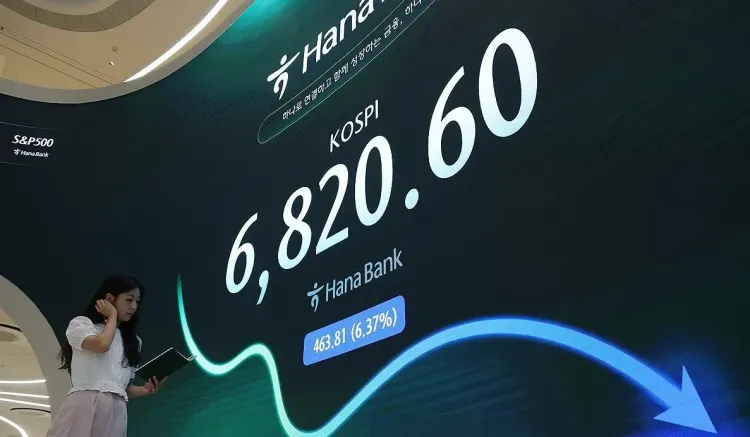
Synopsis
South Korea's KOSPI extended its losing run to three sessions on 30 July, shedding 1.23% as retail investors dumped tech stocks worth a net 1.43 trillion won. The dual pressure of Fed ambiguity and deepening doubt over AI investment returns hammered Samsung and SK Hynix — even as shipbuilding and defence names bucked the trend on US partnership deals.
Key Takeaways
The KOSPI fell 69.68 points (1.23%) to close at 5,593.56 on 30 July , its third consecutive losing session.
SK Hynix plunged 5.64% and Naver slid 4.05% , leading tech-sector losses.
The US Federal Reserve held rates at 3.5–3.75% for a fifth straight meeting , offering no clarity on future cuts.
Retail investors sold a net 1.43 trillion won ; foreign investors net-bought 1.34 trillion won .
HD KSOE surged 10% and Hanwha Aerospace jumped 6.79% , bucking the trend on shipbuilding and defence momentum.
The Korean won strengthened to 1,437.4 per US dollar from 1,446.7 the prior day.
Seoul's benchmark Korea Composite Stock Price Index (KOSPI) closed 69.68 points, or 1.23 percent, lower at 5,593.56 on Thursday, 30 July, extending a bruising three-session losing streak as retail investors aggressively offloaded technology shares. Concerns over whether heavy artificial intelligence (AI) spending by major tech firms will deliver returns commensurate with their elevated valuations continued to weigh on sentiment, compounded by fresh uncertainty over the US Federal Reserve's interest rate trajectory.
How the Session Played Out
The index opened 0.33 percent higher and briefly touched an intraday high of 5,976.82 before reversing sharply, hitting a session low of 5,547.41 before recovering slightly to close at 5,593.56. The volatile swing underscored the fragile investor confidence that has characterised South Korean equities this week. Trade volume was moderate at 375.17 million shares worth 37.6 trillion won (approximately US$26.2 billion), with gainers outnumbering losers 606 to 277 — a divergence that reflects selective buying even as the headline index fell.
What Spooked the Market
The twin triggers were a Fed policy decision and mounting AI valuation anxiety. On Wednesday (US time), the Federal Reserve held its benchmark interest rate unchanged at 3.5–3.75 percent for the fifth consecutive meeting, offering little forward guidance on the timing of any future easing. That ambiguity left investors without a clear catalyst to re-enter rate-sensitive positions. Simultaneously, analysts flagged growing scepticism over whether the massive capital expenditure by large technology companies on AI infrastructure will translate into proportionate revenue growth — a concern that has rattled global tech indices over the past week.
Tech Stocks Lead Losses
Market bellwether Samsung Electronics fell 0.72 percent to 207,000 won, while memory chipmaker SK Hynix plunged 5.64 percent to 1.32 million won, among the steepest single-stock declines of the session. Internet platform Naver slid 4.05 percent to 201,500 won. Outside tech, top automaker Hyundai Motor declined 0.71 percent to 351,000 won, national carrier Korean Air shed 0.6 percent to 24,650 won, and energy firm Doosan Enerbility dipped 0.99 percent to 60,200 won.
Bright Spots: Shipbuilding and Defence
Against the broadly negative tide, HD Korea Shipbuilding & Offshore Engineering (HD KSOE) surged 10 percent to 368,500 won after the company announced it had signed a memorandum of understanding (MOU) with US-based Fraser Industries LLC to support the revival of American shipbuilding capacity under Seoul's 'Make American Shipbuilding Great Again' initiative. Defence conglomerate Hanwha Aerospace jumped 6.79 percent to 865,000 won, continuing a broader rally in South Korean defence names on the back of elevated global security spending.
Flows and Currency
Institutional investors and foreign buyers provided a partial floor, purchasing a net 66.3 billion won and 1.34 trillion won worth of stocks, respectively. Retail investors, however, sold a net 1.43 trillion won — the dominant force behind the day's decline. The Korean won strengthened to 1,437.4 won per US dollar as of 3:30 pm local time, up from 1,446.7 won the previous day. Bond yields edged higher: the three-year Treasury yield rose 3.1 basis points to 3.831 percent, and the five-year government bond yield climbed 4.1 basis points to 4.078 percent. With the Fed still non-committal on rate cuts and AI-related earnings scrutiny intensifying ahead of the next round of Big Tech results, South Korean equities face continued headwinds in the near term.
Point of View
Samsung and SK Hynix, sit at the intersection of both. The fact that retail investors absorbed the bulk of the selling while institutions and foreigners net-bought suggests the smart money is not yet panicking, but the absence of a Fed pivot catalyst means the floor remains untested. The HD KSOE and Hanwha Aerospace gains are a reminder that Korea's defence and shipbuilding pivot toward the US market is a structural story running counter to the tech-driven headline noise.
NationPress
13 Sept 2026
Frequently Asked Questions
Why did the KOSPI fall on 30 July?
The KOSPI dropped 1.23% to 5,593.56 on 30 July as retail investors sold tech stocks heavily for the third consecutive session, driven by concerns over AI spending valuations and the US Federal Reserve's decision to hold rates at 3.5–3.75% without offering clear guidance on future cuts.
Which stocks fell the most on the KOSPI today?
SK Hynix led declines with a 5.64% drop to 1.32 million won, followed by Naver down 4.05% to 201,500 won, and Samsung Electronics down 0.72% to 207,000 won. Hyundai Motor, Korean Air, and Doosan Enerbility also closed lower.
What is the concern over AI spending affecting markets?
Investors are questioning whether the massive capital expenditure by major technology companies on AI infrastructure will generate returns sufficient to justify their current elevated valuations. This scepticism has pressured global tech indices and is particularly acute for South Korean chipmakers like SK Hynix, which supply AI hardware.
Which stocks gained despite the broader KOSPI decline?
HD Korea Shipbuilding & Offshore Engineering (HD KSOE) surged 10% to 368,500 won after signing an MOU with US firm Fraser Industries LLC under Seoul's 'Make American Shipbuilding Great Again' initiative. Hanwha Aerospace also jumped 6.79% to 865,000 won.
How did foreign and institutional investors respond to the sell-off?
Institutions net-bought 66.3 billion won and foreign investors net-purchased 1.34 trillion won worth of shares, partially cushioning the fall. Retail investors, however, were net sellers of 1.43 trillion won, driving the day's decline.