What Caused the Valuation Fears to Rout the South Korean Stock Market?
Synopsis
South Korea's stock market faced a dramatic decline amid valuation fears of tech stocks during the AI boom. After a remarkable increase, the KOSPI index plummeted, leading to significant trading disruptions. Analysts weigh in on the market's future amidst foreign sell-offs and retail investor activity.
Key Takeaways
KOSPI index dropped significantly due to valuation fears.
Concerns are rising over a potential tech bubble .
Samsung Electronics and SK Hynix have shown remarkable growth.
Foreign investors have sold off large amounts of stocks.
Retail investors are showing strong interest in the market.
Seoul, Nov 5 (NationPress) Following a remarkable surge over the past several months, South Korea's stock market experienced a significant downturn on Wednesday, largely driven by concerns regarding the overvaluation of technology stocks amidst an ongoing artificial intelligence (AI) boom.
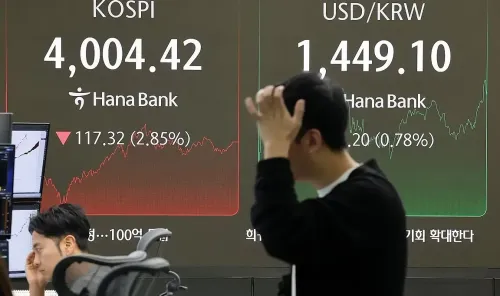
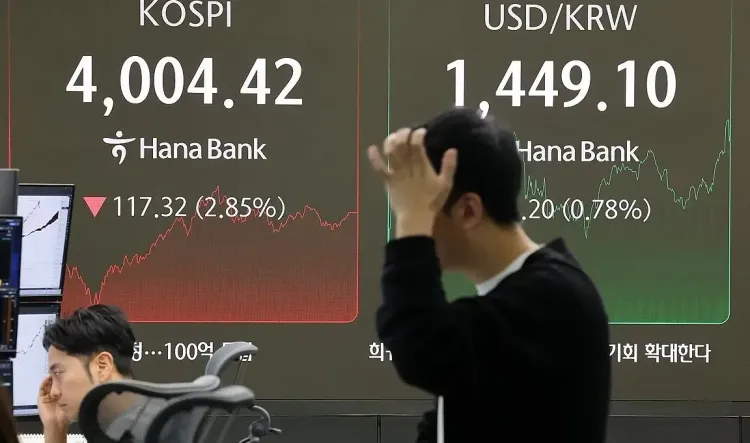
In response to these valuation fears, the nation's benchmark index, the Korea Composite Stock Price Index (KOSPI), plummeted by 117.32 points, or 2.85 percent, settling at 4,004.42 after briefly dipping to a low of 3,867.81 during the day. The total market capitalisation on the primary exchange fell by 97 trillion won (approximately US$67 billion), as reported by Yonhap news agency.
The market collapse prompted a trading halt for five minutes during the morning session.
This downturn followed nearly an 80 percent rally in the stock market since April, making it the top performer among major economies, primarily due to gains in sectors such as chip manufacturing, defense, and shipbuilding.
Samsung Electronics, a leading company by market value, has seen its shares rise by nearly 80 percent, while its competitor, SK Hynix, nearly tripled in valuation.
According to a report from Samsung Securities, while AI-driven stocks have propelled the bull market in the United States, there are increasing concerns regarding when these companies will begin to see profits from their substantial investments. The local market followed Wall Street's decline, largely due to profit-taking activities in the tech sector.
Foreign investors continued their selling trend from the previous session, offloading a net of 2.5 trillion won in local stocks—marking the largest sell-off since August 13, 2021.
Conversely, retail investors purchased a net of 2.5 trillion won. The previous night, U.S. stock indices ended lower, with the S&P 500 decreasing by more than 1 percent and the tech-heavy Nasdaq dropping by over 2 percent.
Concerns regarding a potential tech bubble lingered after leaders from Goldman Sachs and Morgan Stanley cautioned that the stock market might be entering a correction phase.
Local analysts suggest that the KOSPI may indeed be entering a phase of correction, but they do not anticipate it to be prolonged.
"While market volatility may increase in the short term, this does not signify a shift into a medium- to long-term correction phase," stated Lee Jae-won, an analyst with Hana Securities.
Lee emphasized that the local stock market has several factors that could foster upward momentum, including an impending revision of the Capital Markets Act designed to enhance shareholder returns.
Samsung Securities expressed optimism regarding the future of South Korean companies, particularly its chip manufacturers, which are expected to boost the KOSPI in the coming period.
"The earnings outlook for domestic companies remains favorable, alongside an increase in exports and improved profitability for semiconductor products noted in October. Strong profit momentum is anticipated to persist in the Korean stock market," the brokerage added.
Point of View
I emphasize the importance of staying informed about market fluctuations. While the recent downturn in the KOSPI index raises concerns, it is essential to recognize the underlying strengths in South Korea's economy, particularly within the semiconductor sector. We must remain vigilant yet optimistic about the potential for recovery as adjustments unfold.
NationPress
26 Sept 2026
Frequently Asked Questions
What triggered the decline in South Korea's stock market?
The decline was primarily driven by fears of overvaluation in technology stocks amid an artificial intelligence boom, leading to significant profit-taking.
How much did the KOSPI index fall?
The KOSPI index fell by 117.32 points, or 2.85 percent, during the recent market crash.
What is the outlook for South Korean stocks moving forward?
Analysts suggest that while the KOSPI may undergo a correction phase, the positive earnings outlook for local companies, particularly in the semiconductor sector, bodes well for future performance.
What actions are foreign and retail investors taking?
Foreign investors have been selling off local stocks, while retail investors have been actively purchasing, leading to a balanced market activity.
Are concerns about a tech bubble warranted?
Yes, there are growing concerns about a potential tech bubble, as highlighted by warnings from leaders at major financial institutions.