CM Sukhu Orders MRI, Mammography Upgrades Across HP Hospitals
Synopsis
Himachal Pradesh CM Sukhvinder Singh Sukhu chaired a high-level health review in Shimla on 16 July 2026, announcing 1.5T MRI machines for eight district and regional hospitals, 3T MRI units for all seven government medical colleges, digital mammography at five facilities, 42 handheld X-ray machines for remote TB detection, and faster paramedical recruitment.
Key Takeaways
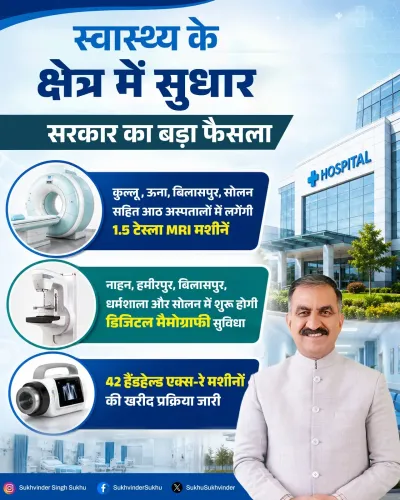
1.5 Tesla MRI machines will be installed at Regional Hospitals Bilaspur, Kullu, Una, Solan, Dharamshala and Palampur , at District Hospital Kinnaur , and at Dr.
Parmar Government Medical College, Nahan .
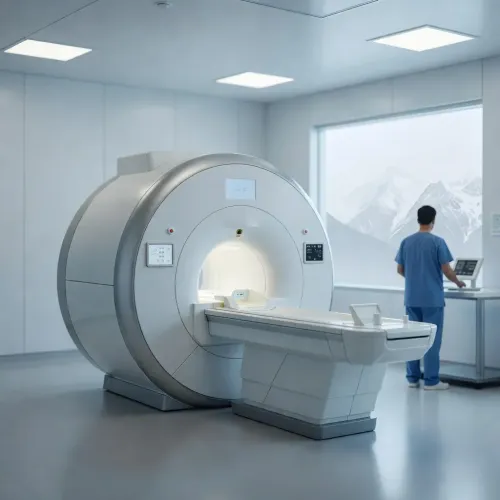
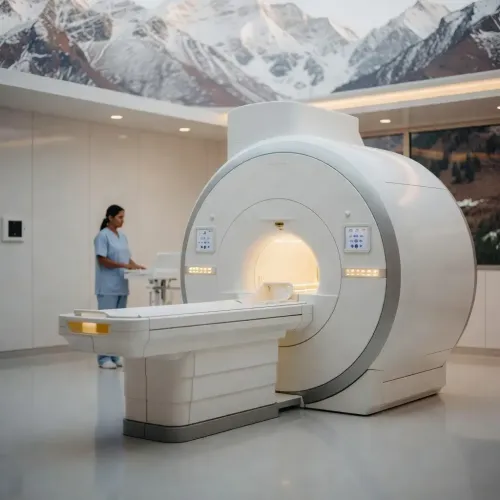
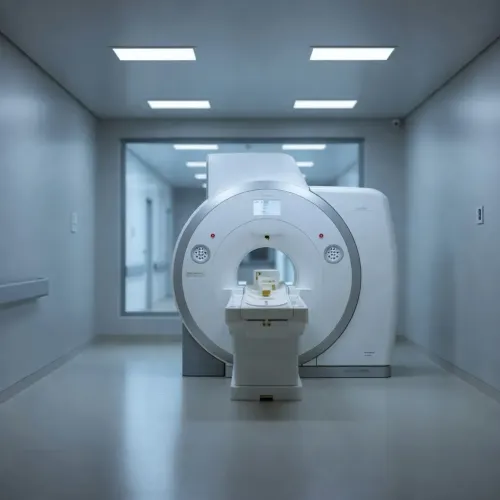
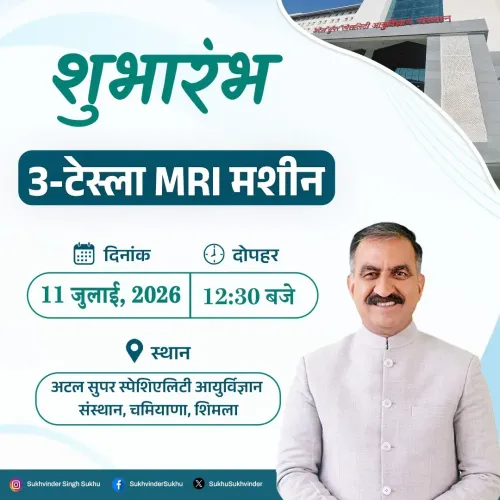
3 Tesla MRI machines are being installed across all seven government medical colleges in Himachal Pradesh.
Digital mammography machines will be set up at District Hospitals Nahan and Hamirpur and Regional Hospitals Bilaspur, Solan and Dharamshala .
42 handheld X-ray machines are being procured for remote areas to aid chest screening and early TB detection ; 14 units have already been received.
CM Sukhu directed acceleration of recruitment of doctors, paramedical staff and technicians for all seven government medical colleges.
Quality medicine procurement must be completed within defined timelines, per instructions issued at the meeting.
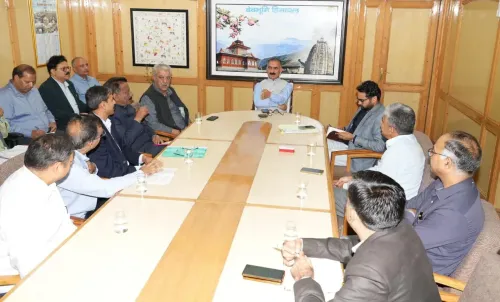
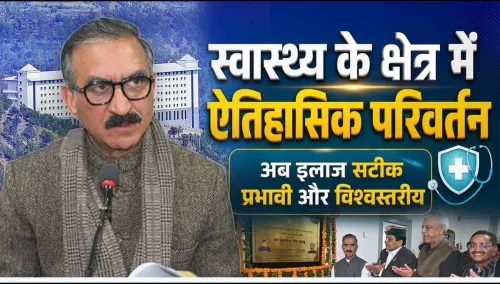
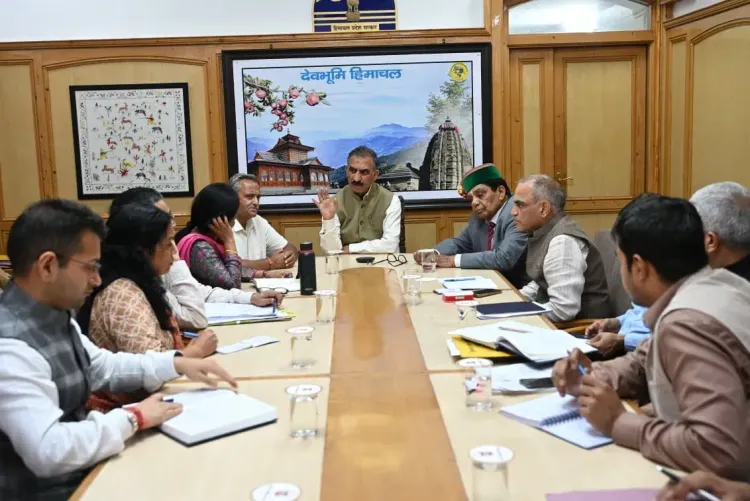
Himachal Pradesh Chief Minister Sukhvinder Singh Sukhu chaired a high-level review meeting of the state Health Department in Shimla on Thursday, 16 July 2026, announcing a sweeping package of diagnostic infrastructure upgrades for government hospitals and medical colleges across the state. The decisions, taken in the presence of Health and Family Welfare Minister Dr. (Colonel) Dhani Ram Shandil and senior officials, cover advanced MRI installations, digital mammography units, handheld X-ray machines for remote areas, and accelerated recruitment of medical and paramedical staff.
Context
Posting on X in Hindi, CM Sukhu outlined a multi-point resolution from the meeting. He stated that "1.5 Tesla MRI machines" (1.5 Tesla MRI machines) will be installed at Regional Hospital Bilaspur, Kullu, Una, Solan, Dharamshala and Palampur, at District Hospital Kinnaur, and at Dr. Y.S. Parmar Government Medical College and Hospital, Nahan. Simultaneously, "teen Tesla MRI machines" (3 Tesla MRI machines) — described as state-of-the-art — are being installed in all government medical colleges in the state. Himachal Pradesh currently operates seven government medical colleges.
The Chief Minister also announced that digital mammography machines will be set up at District Hospital Nahan, District Hospital Hamirpur, and Regional Hospitals Bilaspur, Solan and Dharamshala to improve diagnostic health services, particularly for women's health screening.
Policy Backdrop
The upgrades sit within a longer arc of health infrastructure expansion in Himachal Pradesh. The state added several new government medical colleges between 2017 and 2022, increasing its institutional capacity across districts. The current push focuses on equipping those colleges and existing regional hospitals with advanced diagnostic tools — a gap that had persisted since the colleges were established.
The emphasis on both 1.5 Tesla and 3 Tesla MRI tiers reflects a deliberate strategy: higher-field machines for tertiary medical college settings, and the more widely available 1.5 Tesla units for district and regional hospitals where patient volumes are high but specialist infrastructure has lagged. This tiered approach aligns with national health policy priorities for strengthening secondary and tertiary care in underserved, hilly geographies.
Stakeholders and Impact
One of the more operationally specific decisions concerns 42 handheld X-ray machines being procured to serve remote and difficult terrain areas, with a focus on chest screening and early detection of tuberculosis (TB). Of these, 14 machines have already been received, with the procurement process for the remainder ongoing. TB detection in remote hill districts has historically been delayed due to the absence of portable diagnostic tools.
CM Sukhu directed officials to accelerate the recruitment of doctors, paramedical staff and technicians to ensure all seven government medical colleges are adequately staffed. He also mandated that the procurement of quality medicines be completed within defined timelines. Paramedical staff shortages have been a persistent bottleneck in translating equipment procurement into actual patient care.
What's Next
The key milestones to watch are the installation timelines for MRI and mammography machines across the listed hospitals, and the finalisation of paramedical recruitment for the seven medical colleges. The government has set time-bound targets for medicine procurement, signalling intent to close implementation gaps that have dogged earlier upgrade rounds. If executed on schedule, the upgrades would significantly reduce the need for patients in remote Himachal districts to travel to Shimla or Chandigarh for advanced imaging.
Point of View
Costlier task of equipping those institutions. Announcing both 1.5T and 3T MRI tiers simultaneously suggests a calibrated, tiered infrastructure strategy rather than a uniform rollout — a politically defensible approach in a state where district rivalries over resource allocation are sharp. The focus on handheld X-ray machines for TB detection in remote areas is notable: it acknowledges that Himachal's mountainous geography makes fixed-facility diagnostics insufficient on their own. The real test, however, will be whether procurement and recruitment directives translate into operational timelines — a gap that has undermined similar announcements in earlier budget cycles.
NationPress
15 Oct 2026
Frequently Asked Questions
Which hospitals in Himachal Pradesh will get new MRI machines?
1.5 Tesla MRI machines will be installed at Regional Hospitals Bilaspur, Kullu, Una, Solan, Dharamshala and Palampur , at District Hospital Kinnaur , and at Dr. Y.S. Parmar Government Medical College and Hospital, Nahan . All seven government medical colleges will receive 3 Tesla MRI machines .
What did CM Sukhu announce for TB detection in remote Himachal Pradesh areas?
The state is procuring 42 handheld X-ray machines specifically for chest screening and early TB detection in remote and difficult terrain areas. Of these, 14 machines have already been delivered and are in use.
Where will digital mammography machines be installed in Himachal Pradesh?
Digital mammography machines will be installed at District Hospital Nahan , District Hospital Hamirpur , and Regional Hospitals Bilaspur, Solan and Dharamshala to improve diagnostic services for women.
How many government medical colleges does Himachal Pradesh have?
Himachal Pradesh has seven government medical colleges . All seven are slated to receive 3 Tesla MRI machines and are targeted for accelerated paramedical staff recruitment under the decisions announced on 16 July 2026 .
Who attended the Himachal Pradesh health department meeting on 16 July 2026?
The meeting was chaired by Chief Minister Sukhvinder Singh Sukhu in Shimla . Health and Family Welfare Minister Dr. (Colonel) Dhani Ram Shandil and other senior officials were also present.