KOSPI nosedives 5.81% to 8,411 as AI chip rally unwinds on profit-taking
Synopsis
After surging nearly 9 percent in two sessions on AI euphoria, South Korea's KOSPI gave back more than half those gains in a single day — falling 5.81 percent and briefly triggering a circuit breaker. The culprit: fears that soaring memory chip prices could choke off the very AI investment boom that drove the rally.
Key Takeaways
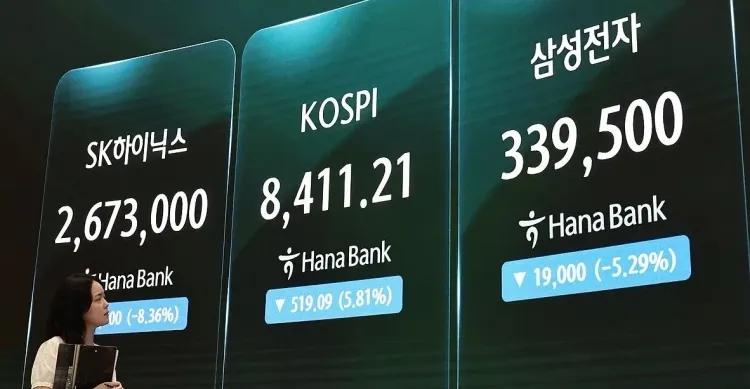
KOSPI fell 519.09 points ( 5.81% ) to 8,411.21 on 26 June , after rallying 5.42% on Thursday and 3.26% on Wednesday.
A circuit breaker was triggered at 12:10 p.m. after losses briefly exceeded 8% , halting KOSPI trading for 20 minutes .
Samsung Electronics dropped 5.3% ; SK hynix slumped 8.36% ; SK Square plunged 9.43% .
Foreigners and institutions sold a net 4.6 trillion won and 3.8 trillion won respectively; retail investors bought a net 8.2 trillion won .
The Korean won strengthened to 1,532 per US dollar as of 3:30 p.m. , up 10.7 won on the day.
Analyst Han Ji-young of Kiwoom Securities flagged fears that high memory chip prices could dampen large-scale AI investment.
South Korea's benchmark Korea Composite Stock Price Index (KOSPI) plummeted 519.09 points, or 5.81 percent, to close at 8,411.21 on Friday, 26 June, as investors aggressively locked in profits following a blistering AI-driven rally. The index had surged 5.42 percent on Thursday and 3.26 percent on Wednesday, making Friday's reversal a sharp but not entirely unexpected correction.
Circuit Breaker Triggered as Losses Deepened
The KOSPI opened 1.31 percent lower and rapidly extended its decline, at one point falling more than 8 percent to an intraday low of 8,126.84. The severity of the slide prompted the bourse operator to activate a circuit breaker at 12:10 p.m., halting trading of KOSPI shares for 20 minutes to prevent a disorderly rout. Trade volume was exceptionally heavy at 508.9 million shares worth 51.5 trillion won (approximately US$33.5 billion), with decliners sharply outnumbering gainers at 777 to 111.
Semiconductor Stocks Bear the Brunt
Chipmakers were the hardest hit. Samsung Electronics, the world's largest memory chipmaker, tumbled 5.3 percent to 339,500 won, while runner-up SK hynix slumped 8.36 percent to 2.67 million won. SK Square, the parent company of SK hynix, plunged 9.43 percent to 1.72 million won. Samsung Electro-Mechanics, an electronic-components affiliate of Samsung Electronics, shed 0.2 percent to 1.99 million won.
Financial stocks also declined. Hana Financial Group sank 3.77 percent to 109,700 won, and Samsung Securities skidded 6.32 percent to 103,800 won.
What Spooked the Market
The sell-off was partly triggered by overnight developments on Wall Street, where tech heavyweights finished mixed. Micron Technology jumped 15.7 percent on strong earnings, but Apple dropped 6.1 percent after the company raised prices on many of its products due to expensive memory chips — a move that rattled sentiment across the supply chain.
Han Ji-young, an analyst at Kiwoom Securities, said: 'Investors are worried that too expensive memory chips would raise prices of end-use products and undermine demand for memory chips, and that would discourage tech companies from increasing large-scale AI investment.' The concern reflects a broader anxiety: that the AI investment supercycle could hit a speed bump if hardware costs squeeze returns for downstream buyers.
Foreign and Institutional Selling Dominated
Foreigners sold a net 4.6 trillion won worth of shares, while institutions offloaded a net 3.8 trillion won. Retail investors moved in the opposite direction, scooping up a net 8.2 trillion won — a pattern consistent with individual investors buying the dip during institutional exits. The Korean won, meanwhile, strengthened, quoted at 1,532 won per US dollar as of 3:30 p.m., up 10.7 won from the previous session.
What Comes Next
The KOSPI's three-day swing — up nearly 9 percent over Wednesday and Thursday before giving back more than half those gains on Friday — underscores the volatility embedded in AI-theme trades. Market watchers will closely monitor US Federal Reserve signals, global memory chip pricing trends, and any further guidance from major tech firms on capital expenditure plans, which remain the primary driver of South Korea's semiconductor-heavy index.
Point of View
Too fast. A near-9 percent two-day surge built on AI optimism was always fragile once the supply-chain arithmetic caught up: if memory chips are expensive enough to push Apple into price hikes, the very companies funding AI infrastructure will think twice about their capex. South Korea's semiconductor index is effectively a leveraged proxy for global AI spending confidence — and that confidence just blinked. The retail-versus-institutional divergence is also telling: individual investors buying the dip against a wall of foreign and institutional selling is a pattern that has historically preceded further downside in Seoul before a sustainable floor forms.
NationPress
25 Sept 2026
Frequently Asked Questions
Why did the KOSPI fall nearly 6 percent on 26 June?
The KOSPI fell 5.81 percent to 8,411.21 on 26 June as investors locked in profits following a sharp AI-driven rally of nearly 9 percent over the previous two sessions. Concerns that high memory chip prices could raise end-product costs and curb AI investment further weighed on sentiment.
What triggered the KOSPI circuit breaker on Friday?
The circuit breaker was activated at 12:10 p.m. after the KOSPI's intraday losses exceeded 8 percent, with the index touching a low of 8,126.84. Trading was halted for 20 minutes to prevent a disorderly sell-off.
Which stocks fell the most during the KOSPI crash?
SK Square led declines with a 9.43 percent drop, followed by SK hynix at 8.36 percent and Samsung Securities at 6.32 percent. Samsung Electronics fell 5.3 percent, while Hana Financial Group shed 3.77 percent.
How did foreign and retail investors behave during the sell-off?
Foreigners sold a net 4.6 trillion won and institutions offloaded 3.8 trillion won, while retail investors bought a net 8.2 trillion won — effectively absorbing the institutional and foreign selling pressure.
What is the concern about AI investment and memory chip prices?
Analysts at Kiwoom Securities warned that surging memory chip costs could push up prices of finished products, weakening consumer demand and potentially discouraging tech companies from scaling up AI infrastructure spending — the very theme that had powered the KOSPI's recent rally.