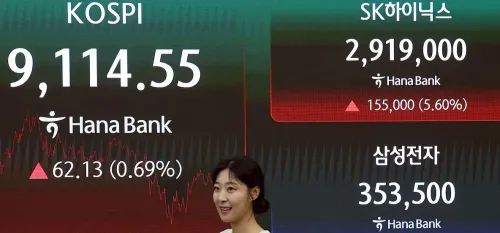
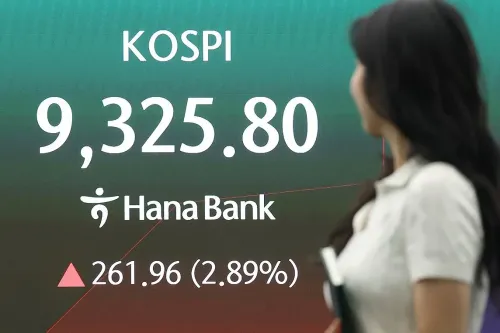
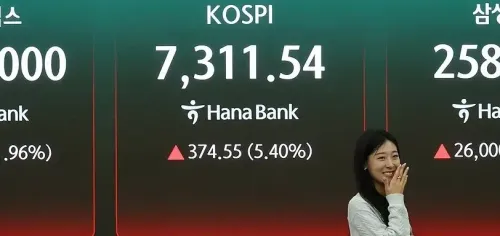
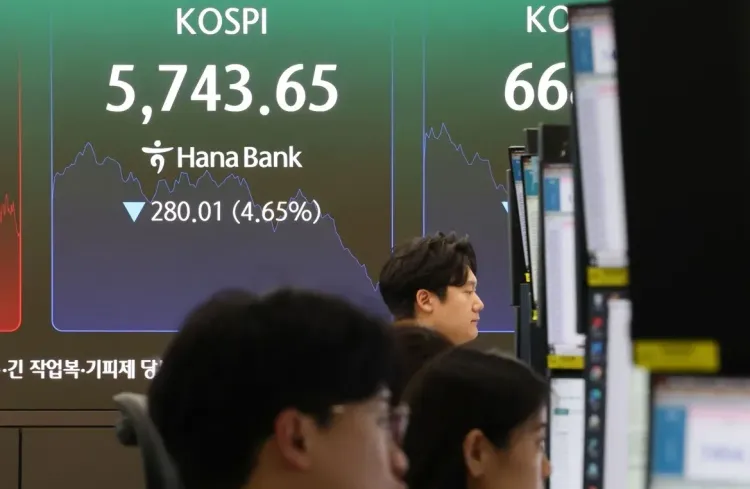
KOSPI falls 280 points on profit-taking after record 17% single-day surge
Synopsis
South Korea's KOSPI logged its steepest single-day gain on record — 17 percent — on Friday, only to open Monday down more than 4 percent as investors cashed out. The reversal, led by Samsung and SK Hynix shedding over 6 percent each, illustrates how extreme single-session moves sow the seeds of their own correction, even when external signals — Amazon's blowout cloud earnings, easing Middle East tensions — remain supportive.
Key Takeaways
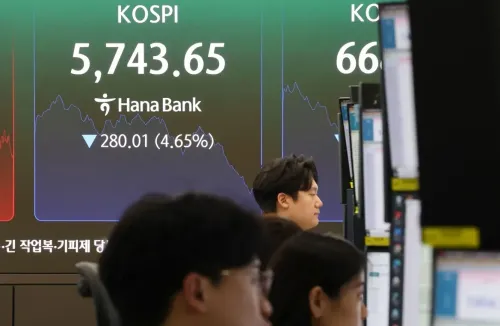
The KOSPI fell 280.05 points (4.25%) to 6,315.4 by 9:15 a.m. on 3 August , after opening down 3.6% .
The pullback followed a record 17% single-day gain on the previous Friday — the sharpest in KOSPI history.
Samsung Electronics dropped 6.48% and SK Hynix fell 6.69% , leading large-cap losses.
Amazon 's cloud revenue surged 37% in Q2 2025, lifting Wall Street — but Seoul diverged on domestic profit-taking.
South Korea's first-time exporters reached 19,746 in 2025, the largest year-on-year rise in five years, with combined exports of US$6.9 billion .
The Korean won traded at 1,433.3 per US dollar , up 2.2 won from the previous session.
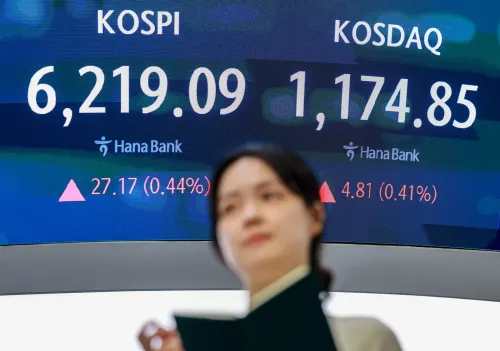
South Korea's benchmark Korea Composite Stock Price Index (KOSPI) opened sharply lower on Monday, 3 August, as investors moved to lock in gains following the index's historic single-session rally the previous Friday. By 9:15 a.m. local time, the KOSPI had shed 280.05 points, or 4.25 percent, to trade at 6,315.4 — after initially opening down 3.6 percent.
A Historic Surge Invites a Sharp Pullback
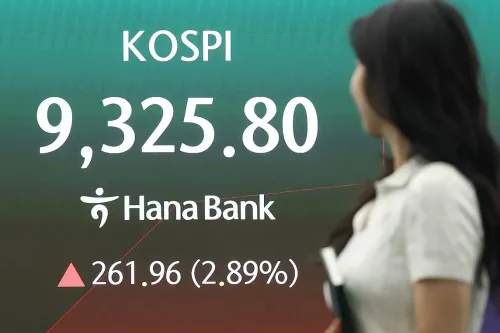
The selloff followed an extraordinary 17 percent single-day gain on Friday — the sharpest one-day rise in the KOSPI's recorded history. Han Ji-young, an analyst at Kiwoom Securities, had flagged the likelihood of early-week profit-taking. 'We may see investors attempt profit-taking early this week, as the benchmark KOSPI vaulted around 17 percent Friday, the sharpest single-day gain on record,' Han said.
This kind of mean-reversion is typical after extreme single-session moves, particularly when the underlying catalyst — in this case, a broader risk-on mood — has not fundamentally changed the earnings outlook for individual companies.
Wall Street Divergence and Amazon's AI Boost
Notably, Seoul's decline came despite a positive close on Wall Street on Friday, where robust earnings from Amazon lifted sentiment around the artificial intelligence sector. Revenue at Amazon's cloud computing unit jumped 37 percent in the second quarter ending June 2025, surpassing market expectations. The divergence between US and Korean markets underscores how domestic profit-taking dynamics can override external tailwinds.
Key Movers: Chips and Batteries Lead Losses
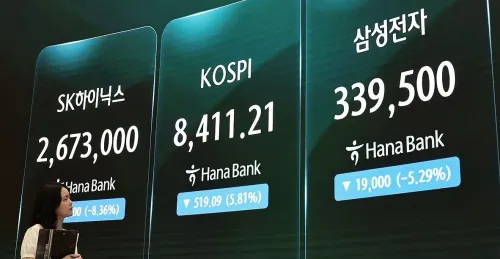
Among large-cap shares, chip giant Samsung Electronics fell 6.48 percent, while industry rival SK Hynix dropped 6.69 percent. Battery maker LG Energy Solution declined 4.27 percent, and major financial group KB Financial edged down 0.47 percent. Defence conglomerate Hanwha Aerospace bucked the trend, adding 0.55 percent — reflecting continued investor interest in the defence sector amid geopolitical uncertainty.
The Korean won was quoted at 1,433.3 won per US dollar, up 2.2 won from the previous session, suggesting some currency stabilisation even as equities retreated.
Middle East Tensions Ease, Adding a Cautious Tailwind
On the geopolitical front, signals of de-escalation in the Middle East offered a partial offset to market anxiety. US President Donald Trump said talks with Iran would resume on Monday (US time), after he called off what he described as a 'massive attack' on the country. Easing tensions in the region could reduce energy price volatility — a factor that South Korean manufacturers and exporters watch closely.
South Korea's First-Time Exporters Hit a Five-Year High
Separately, trade data released on Monday offered a brighter picture of South Korea's export ecosystem. The number of first-time exporters — defined as businesses with no export records in the preceding three years — rose nearly 4 percent in 2025 from a year earlier, reaching 19,746 companies, up from 19,041 in 2024, according to the Korea Customs Service. This marks the largest year-on-year increase in the past five years. The combined exports of these companies climbed 13.2 percent year-on-year to US$6.9 billion — the highest level since 2019 — adding fresh momentum to the country's trade diversification story.
With profit-taking likely to persist through the early part of the week, market participants will be watching whether the KOSPI can find a floor near current levels or whether the unwinding extends further.
Point of View
Not a structural reversal, but it exposes a vulnerability: the KOSPI's record Friday surge was driven more by sentiment than by earnings revisions, making it inherently fragile. The fact that Samsung and SK Hynix — the index's twin engines — each shed over 6 percent suggests institutional investors, not retail traders, led the exit. Meanwhile, the first-time exporter data is the story that mainstream coverage will underplay: 19,746 new exporters and US$6.9 billion in combined shipments at a five-year high signals that South Korea's trade base is broadening even as headline indices gyrate. That structural diversification is the more durable signal here.
NationPress
17 Sept 2026
Frequently Asked Questions
Why did the KOSPI fall sharply on 3 August 2025?
The KOSPI fell 280.05 points, or 4.25%, to 6,315.4 on 3 August as investors moved to lock in profits following the index's record 17% single-day gain the previous Friday. Profit-taking in large-cap technology and battery stocks drove the decline.
Which stocks led the KOSPI decline on Monday?
Chip maker SK Hynix led losses with a 6.69% drop, followed by Samsung Electronics at 6.48% and LG Energy Solution at 4.27%. Defence firm Hanwha Aerospace was a rare gainer, adding 0.55%.
What was the KOSPI's record gain that preceded the selloff?
The KOSPI surged approximately 17% on Friday — the sharpest single-day gain in the index's recorded history. Kiwoom Securities analyst Han Ji-young attributed Monday's profit-taking directly to that extraordinary rally.
How did Amazon's earnings affect Asian markets?
Amazon reported a 37% jump in cloud computing revenue for the second quarter of 2025, exceeding expectations and lifting Wall Street on Friday. However, Seoul diverged from the positive US lead, with domestic profit-taking overriding the external tailwind.
What does the South Korea first-time exporter data show?
The number of first-time exporters in South Korea rose nearly 4% in 2025 to 19,746 companies — the largest annual increase in five years, according to the Korea Customs Service. Their combined exports reached US$6.9 billion, the highest since 2019.