CM Saini Backs Jind-Sonipat Hydrogen Train Under NaMo Green Rail
Synopsis
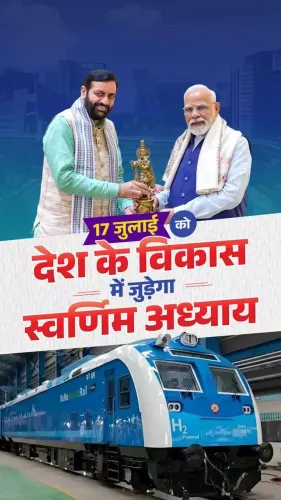
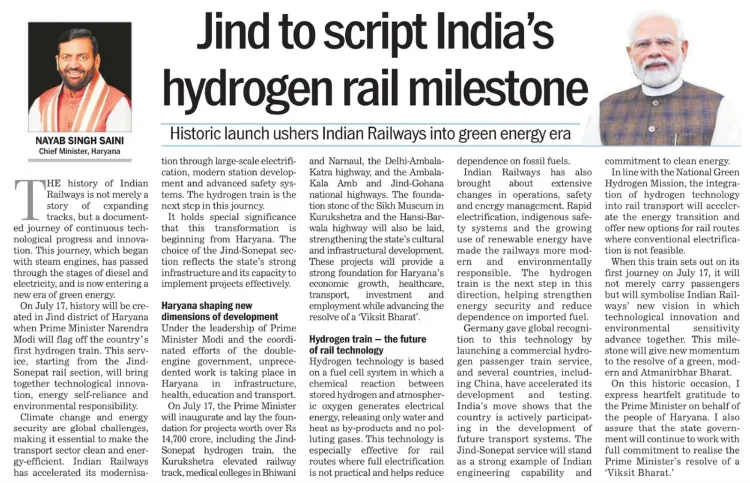
Haryana Chief Minister Nayab Singh Saini on 16 July 2026 championed the NaMo Green Rail Jind-Sonipat Hydrogen Train Project, framing it as proof of India's indigenous green technology capability and a milestone toward PM Modi's Viksit Bharat vision for 2047.
Key Takeaways
CM Nayab Singh Saini publicly endorsed the #NaMoGreenRail Jind-Sonipat Hydrogen Train Project on 16 July 2026 .
The corridor connects Jind in central Haryana to Sonipat , which borders Delhi NCR , making it a strategically important green mobility route.
The project is positioned under the #ViksitBharat framework and credited to PM Narendra Modi's leadership and the talent of Indian engineers .
The National Green Hydrogen Mission , approved in January 2023 , provides the central policy framework enabling hydrogen applications in Indian Railways.
Indian Railways has a stated target of net-zero carbon emissions by 2030 , with hydrogen trains as a key pillar.
Exact operational timelines and funding details for the Jind-Sonipat corridor remain to be officially announced.
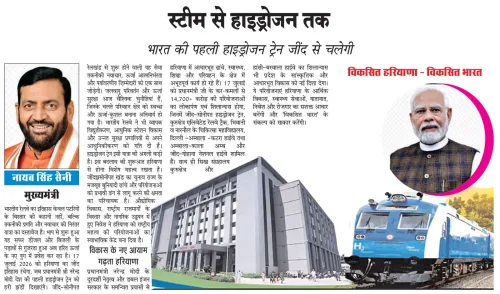
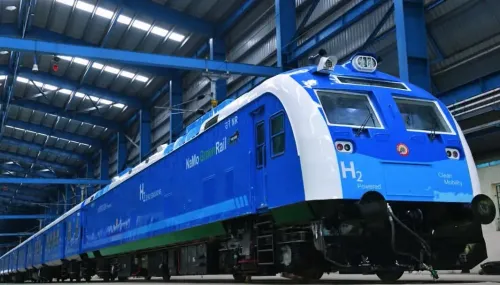
Haryana Chief Minister Nayab Singh Saini on Thursday, 16 July 2026, hailed the #NaMoGreenRail Jind-Sonipat Hydrogen Train Project as a landmark step in India's transition to green rail transport, crediting the initiative to Prime Minister Narendra Modi's vision for a developed India by 2047.
Context
In his post on X, CM Saini wrote: 'From Haryana to the Nation, the future of rail is turning green!' He described the project as reflecting 'India's growing capability to develop and deploy cutting-edge technologies,' and attributed it to 'the talent of Indian engineers and inspired by the vision and leadership' of Prime Minister Modi. The corridor links Jind, a district in central Haryana, with Sonipat, which borders the Delhi NCR region, making it a strategically significant route for green mobility.
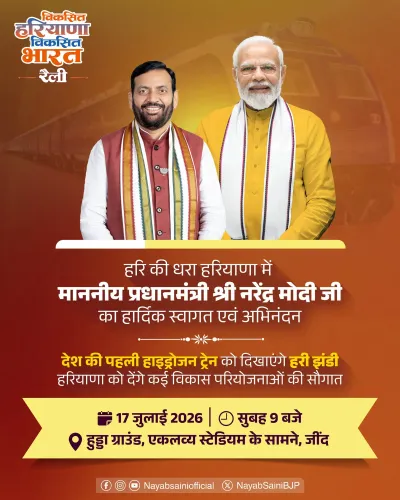
The project is branded under the #NaMoGreenRail initiative and is positioned within the broader #ViksitBharat framework — the government's goal of transforming India into a fully developed nation by 2047.
Policy Backdrop
The National Green Hydrogen Mission, approved by the Union Cabinet in January 2023, laid the policy foundation for hydrogen applications in transport and industry, explicitly including railways as a priority sector. The mission aims to position India as a global hub for green hydrogen production and deployment.
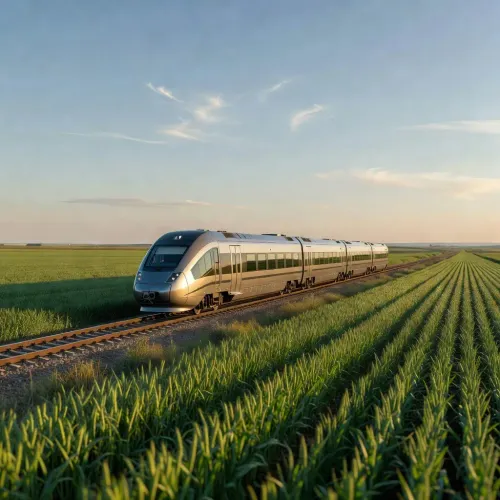
Indian Railways has separately committed to achieving net-zero carbon emissions by 2030, with hydrogen fuel-cell trains forming a critical pillar of that roadmap. The Jind-Sonipat corridor, if operationalised, would represent one of the first hydrogen-powered passenger rail routes in the country, developed through indigenous engineering under the Atmanirbhar Bharat framework.
Haryana's role in hosting this pilot underscores the state-centre coordination model being applied to sustainable infrastructure, where central missions are channelled through state governments for on-ground implementation.
Stakeholders and Impact
Railway commuters on the Jind-Sonipat route stand to benefit from cleaner, quieter hydrogen-powered services if the project advances to full operation. The corridor's proximity to Delhi NCR also gives it significance as a model for decarbonising suburban and inter-city rail in densely populated corridors.
Indian engineers and green technology firms are identified as central contributors to the project, aligning with the government's push to build domestic capability in hydrogen fuel-cell technology rather than rely on imports. This positions the project as both an infrastructure and an industrial policy statement.
Broader stakeholders include clean energy advocates and state-level planners watching whether Haryana's experience can be replicated across other rail corridors under future railway budget allocations.
What's Next
Attention will now turn to the progress of hydrogen train prototypes, the scheduling of route trials on the Jind-Sonipat stretch, and whether the project receives dedicated funding through upcoming railway budget cycles or Haryana's state green energy policy. The exact operational timeline and technical specifications for the corridor have not yet been made public.
As India scales its green hydrogen ambitions, the Jind-Sonipat pilot will be closely watched as a test case for whether hydrogen rail can move from policy commitment to passenger service within the current decade.
Point of View
Reinforcing BJP's narrative of technology-led governance ahead of any future electoral cycle in Haryana. The Jind-Sonipat corridor's proximity to Delhi NCR amplifies its symbolic value, turning a regional rail pilot into a national showcase for indigenous hydrogen capability. It also signals that the Centre's National Green Hydrogen Mission is beginning to find tangible, named infrastructure expressions rather than remaining a policy document. Whether the project can deliver operational trains within Indian Railways' 2030 net-zero deadline will determine whether this moment is remembered as a turning point or a political announcement.
NationPress
16 Jul 2026
Frequently Asked Questions
What is the NaMo Green Rail Jind-Sonipat Hydrogen Train Project?
It is a proposed hydrogen-powered train corridor between Jind and Sonipat in Haryana, branded under the NaMo Green Rail initiative and aligned with India's National Green Hydrogen Mission and Indian Railways' net-zero 2030 target.
When did CM Nayab Singh Saini announce support for the hydrogen train project?
CM Saini posted his endorsement on X on Thursday, 16 July 2026, describing the project as a historic step toward Viksit Bharat.
What is the National Green Hydrogen Mission and how does it relate to railways?
The National Green Hydrogen Mission was approved by the Union Cabinet in January 2023 to scale green hydrogen production and deployment in India, with railways listed as a priority application sector.
Why is the Jind-Sonipat route significant for hydrogen rail?
Sonipat borders the Delhi NCR region, making the Jind-Sonipat corridor a high-visibility route that could serve as a model for decarbonising suburban and inter-city rail in densely populated areas.
Has Indian Railways committed to hydrogen trains?
Yes. Indian Railways has set a net-zero carbon emissions target by 2030 and has identified hydrogen fuel-cell trains as a key element of its decarbonisation strategy, with pilots like the Jind-Sonipat project forming part of that roadmap.