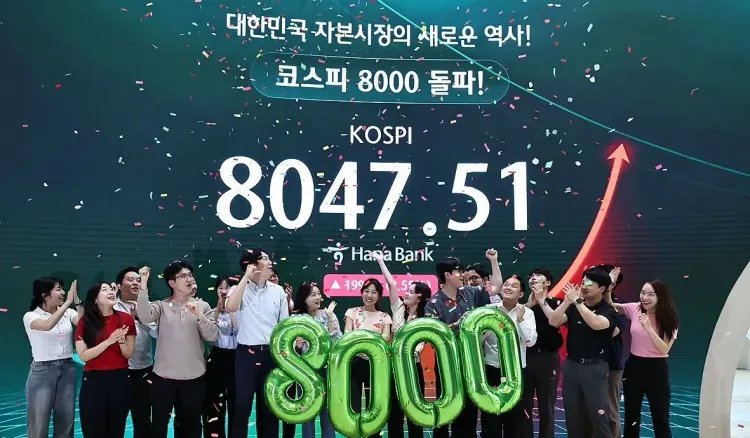
KOSPI crosses 8,000-point milestone for first time, closes at 8,047
Synopsis
South Korea's KOSPI has done what no one had seen before — closed above 8,000 points. The record close on 27 May 2025 was powered by a rare convergence: foreign investors ending a 13-session sell-off, US-Iran ceasefire optimism reopening risk appetite, and an AI-fuelled semiconductor surge that has made SK hynix and Samsung Electronics the engines of nearly half the market's daily trading volume.
Key Takeaways
The KOSPI closed at 8,047.51 points on 27 May 2025 — the first-ever close above the 8,000-point level.
The index rose 2.55 percent on the day, touching an intraday high of 8,131.15 points .
Foreign investors returned as net buyers for the first time in 13 trading sessions .
SK hynix surged 5.72 percent to 2.05 million won ; Samsung Electronics gained 2.22 percent to 299,000 won .
Samsung Electronics and SK hynix together account for roughly 43 percent of KOSPI's daily average trading value this month.
Some analysts have flagged bubble risk given the rally's heavy concentration in two semiconductor stocks.
South Korea's benchmark Korea Composite Stock Price Index (KOSPI) closed above the historic 8,000-point level for the first time on Tuesday, 27 May 2025, finishing the session at 8,047.51 points — a gain of 2.55 percent from the previous close. The milestone was driven by a return of foreign buying and growing optimism that the United States and Iran may be nearing a deal to end the ongoing conflict in the Middle East.
Record-Breaking Session
The index opened sharply higher at 8,070.91 points, surpassing the previous intraday high of 8,046.78 points reached on 15 May. During intraday trading, the KOSPI climbed as high as 8,131.15 points before settling at 8,047.51 at the close — marking the first time the main bourse has ever ended a session above the 8,000-point threshold.
Foreign Investors Return as Net Buyers
Foreign investors turned net buyers of local South Korean stocks for the first time in 13 consecutive trading sessions, providing the critical demand push that carried the index past its historic level. Analysts attributed the reversal largely to easing geopolitical risk, as expectations of a US-Iran peace framework improved global risk appetite.
US President Donald Trump stated that peace negotiations with Iran were progressing 'nicely', while cautioning that military strikes would resume on a larger scale if a deal was not finalised. According to reports, Washington and Tehran were working toward a framework that would include a 60-day ceasefire extension, the reopening of the Strait of Hormuz, and continued talks on Iran's nuclear programme.
AI Boom Fuels Semiconductor Rally
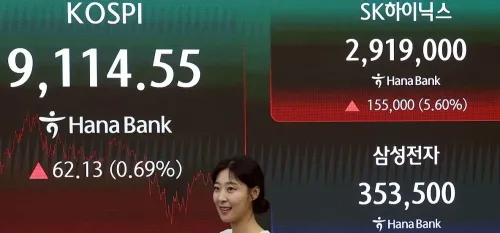
Heavyweight semiconductor stocks have been the primary engine behind the KOSPI's sustained rally. Shares of SK hynix Inc. surged 5.72 percent to close at 2.05 million won (approximately US$1,329), while Samsung Electronics Co. gained 2.22 percent to 299,000 won. Together, the two stocks have accounted for roughly 43 percent of the daily average trading value on the KOSPI so far this month.
The market capitalisation of SK hynix rose to 1,473 trillion won, putting it on course to approach the US$1 trillion stock-value milestone and potentially close the gap with Samsung Electronics. The AI-driven spending boom has been a key catalyst, with both companies positioned as major beneficiaries of surging global demand for advanced memory chips.
Bubble Risks and What Analysts Are Watching
While some analysts expect the rally to continue in the near term, there are notable caution flags. A handful of market observers have warned of a potential bubble forming around AI-linked equities, noting that the bull run has been disproportionately concentrated in just two semiconductor names. The narrow leadership of the rally — with Samsung Electronics and SK hynix driving nearly half of all trading activity — raises questions about the broader market's resilience if either stock falters.
Investors will be watching closely for any developments in US-Iran negotiations and the next round of global AI spending data, both of which could determine whether the KOSPI consolidates above 8,000 or retreats from its historic high.
Point of View
000-point close is a headline number, but the composition of the rally deserves scrutiny. Two stocks — Samsung Electronics and SK hynix — are driving nearly half of all daily trading volume, meaning the index's record is less a broad market verdict and more a semiconductor referendum. The AI spending boom is real, but concentration risk of this magnitude has historically preceded sharp corrections when sentiment shifts. The US-Iran ceasefire narrative adds a geopolitical wildcard: if talks stall, the foreign buying that catalysed Tuesday's move could reverse just as quickly. South Korea's market is celebrating a milestone; the question is whether the foundations beneath it are as solid as the number suggests.
NationPress
10 Oct 2026
Frequently Asked Questions
What is the KOSPI and why is the 8,000-point level significant?
The Korea Composite Stock Price Index (KOSPI) is South Korea's primary stock market benchmark, tracking the performance of all common stocks listed on the Korea Exchange. Closing above 8,000 points on 27 May 2025 marks the first time in the index's history that it has ended a trading session at this level, making it a widely watched milestone for both domestic and international investors.
What drove the KOSPI to a record close on 27 May 2025?
Three factors converged: foreign investors ended a 13-session net-selling streak and returned as net buyers; optimism grew that the US and Iran were nearing a ceasefire and nuclear framework deal; and heavyweight semiconductor stocks SK hynix and Samsung Electronics surged on continued AI spending momentum. The index rose 2.55 percent to close at 8,047.51 points.
How did SK hynix and Samsung Electronics perform on the day?
SK hynix jumped 5.72 percent to close at 2.05 million won (approximately US$1,329), while Samsung Electronics gained 2.22 percent to 299,000 won. Together, the two stocks have represented about 43 percent of KOSPI's daily average trading value so far in May 2025.
What is the US-Iran situation and how does it affect South Korean markets?
US President Donald Trump stated that peace negotiations with Iran were progressing well, with Washington and Tehran reportedly working toward a framework involving a 60-day ceasefire extension, reopening of the Strait of Hormuz, and continued nuclear talks. Reduced Middle East conflict risk improves global risk appetite, encouraging foreign investors to re-enter emerging and export-driven markets like South Korea.
Are analysts concerned about a bubble in South Korean stocks?
Some analysts have raised bubble concerns, noting that the KOSPI's bull run has been heavily concentrated in AI-linked semiconductor stocks. With Samsung Electronics and SK hynix accounting for nearly half of daily trading volume, the rally's breadth is limited, and a shift in AI spending sentiment or foreign fund flows could expose the market to a sharp correction.