Sickle cell mission: President Murmu hails MP's 7 crore screening feat

Synopsis
India's National Sickle Cell Anaemia Elimination Mission has screened 7 crore people ahead of schedule — a feat President Murmu called one of the largest genetic disease screening drives in the world. With 2.5 lakh patients detected and 20 lakh carriers identified, the harder challenge now begins: delivering sustained care to every one of them before 2047.
Key Takeaways
President Droupadi Murmu attended International Sickle Cell Day at Omkareshwar, Madhya Pradesh on 19 June .
The National Sickle Cell Anaemia Elimination Mission screened 7 crore individuals — from newborns to age 40 — ahead of schedule.
The mission detected approximately 2.5 lakh patients and over 20 lakh carriers of sickle cell disease.
Madhya Pradesh screened over 4 lakh women under the 'Swasth Woman, Sashakt Parivar Abhiyan' between 17 September and 2 October 2025 .
The 'Sickle Mitra' programme has trained NCC cadets, NGO representatives, and government officials to support patients and spread awareness.
India aims to eliminate sickle cell disease well before 2047 .
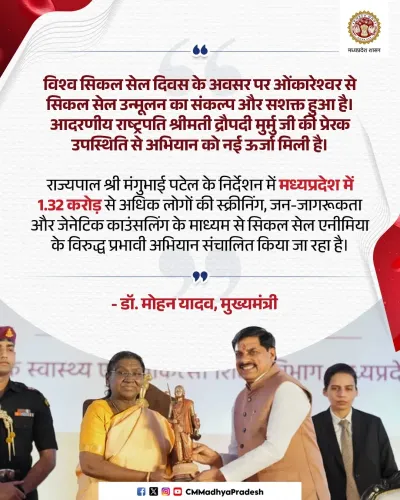
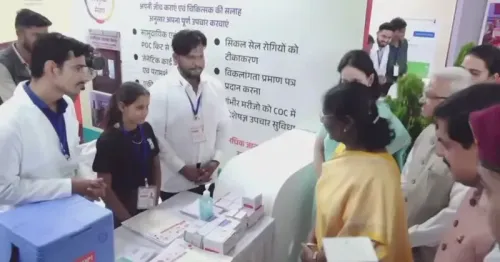
President Droupadi Murmu on Friday, 19 June attended the International Sickle Cell Day commemoration at Omkareshwar, Madhya Pradesh, lauding India's National Sickle Cell Anaemia Elimination Mission as one of the largest genetic disease screening drives in the world. The event marked a significant milestone in the country's push to eradicate sickle cell disease ahead of the 2047 national target.
Screening Target Achieved Ahead of Schedule
Addressing the gathering, President Murmu highlighted that the mission's ambitious goal of screening 7 crore individuals — covering newborns through those up to 40 years of age — had been accomplished before the stipulated deadline. She described this as a reflection of India's serious commitment to public health at scale.
The mission has so far detected approximately 2.5 lakh patients and identified more than 20 lakh carriers of sickle cell disease. The President underscored that the sheer scale of these numbers demands sustained healthcare support and deeper community understanding of the condition.
Madhya Pradesh's Standout Contribution
President Murmu specifically praised Madhya Pradesh for its proactive role, citing the record screening of over 4 lakh women during the 'Swasth Woman, Sashakt Parivar Abhiyan' held between 17 September and 2 October 2025. She described the campaign as a model for state-level intervention in combating genetic disorders.
The President also highlighted the 'Sickle Mitra' initiative, launched by the Madhya Pradesh government on the previous International Sickle Cell Day. Under this programme, representatives from government and non-government institutions, voluntary organisations, and NCC cadets have been trained to raise awareness and provide assistance to patients in affected communities.
Centre and States Commended for Joint Action
President Murmu commended both the Central government and state administrations for going beyond mere identification of patients and carriers, ensuring that proper healthcare infrastructure and support systems are in place for those affected. This comes amid a broader national effort to address tribal and rural populations disproportionately affected by sickle cell disease in states such as Madhya Pradesh, Chhattisgarh, and Jharkhand.
Notably, sickle cell anaemia has historically received limited policy attention relative to its disease burden, making the mission-mode approach a significant policy shift. The Omkareshwar event was thus both a progress report and a public reaffirmation of political will at the highest level.
Road to 2047: What Comes Next
President Murmu expressed confidence that the collective momentum across states — driven by community engagement, trained volunteers, and government coordination — would enable India to achieve its goal of eliminating sickle cell-related diseases well before 2047. With screening largely complete, the next phase will test the system's capacity to deliver long-term care and counselling to the 2.5 lakh detected patients and their families.
Point of View
Treatment, and carrier-informed family planning support to 2.5 lakh patients and 20 lakh carriers — many of them in remote tribal belts with thin public health infrastructure. The 2047 elimination target is politically resonant, but elimination of a genetic disorder requires generational behaviour change, not just a one-time screening camp. The mission's next phase will reveal whether this was a policy landmark or a headline milestone.
NationPress
19 Sept 2026
Frequently Asked Questions
What is the National Sickle Cell Anaemia Elimination Mission?
It is a Government of India initiative aimed at eliminating sickle cell disease by 2047 through mass genetic screening, patient identification, and sustained healthcare support. The mission targeted screening 7 crore individuals from newborns to age 40, a goal it achieved ahead of schedule.
How many people have been screened under the sickle cell mission?
The mission screened 7 crore individuals ahead of its scheduled deadline, detecting approximately 2.5 lakh patients and identifying over 20 lakh carriers of sickle cell disease across India.
What is the 'Sickle Mitra' initiative in Madhya Pradesh?
'Sickle Mitra' is a Madhya Pradesh government programme launched on International Sickle Cell Day last year, under which NCC cadets, NGO representatives, and government officials are trained to raise awareness and assist sickle cell patients in their communities.
Why did President Murmu attend the event at Omkareshwar?
President Droupadi Murmu attended the International Sickle Cell Day commemoration at Omkareshwar on 19 June to mark India's progress under the elimination mission and to reaffirm the government's commitment to eradicating sickle cell disease before 2047.
Which states are most affected by sickle cell disease in India?
Sickle cell disease disproportionately affects tribal and rural populations, with states such as Madhya Pradesh, Chhattisgarh, and Jharkhand among the most impacted. Madhya Pradesh has been particularly active, screening over 4 lakh women under a dedicated campaign in 2025.