CM MP Office: President Murmu to Lead World Sickle Cell Day Event
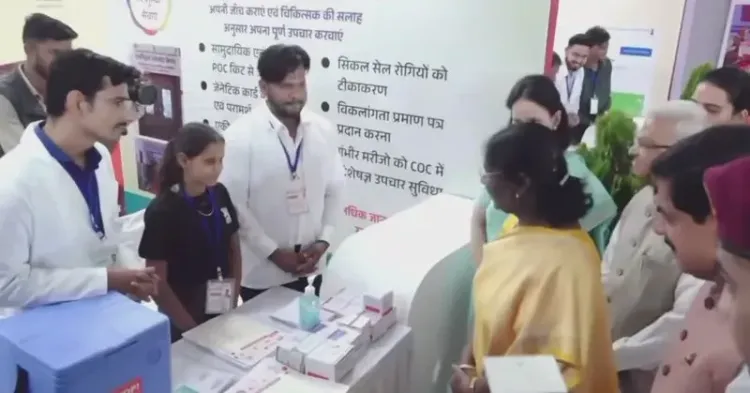
Synopsis
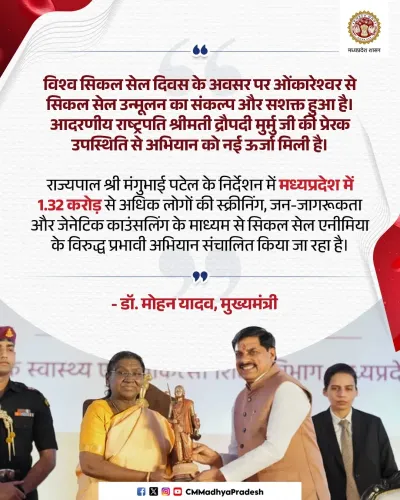
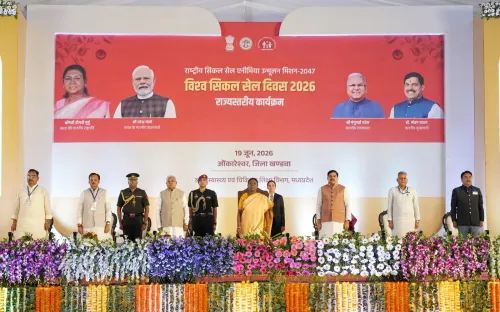
President Draupadi Murmu will preside as chief guest over Madhya Pradesh's state-level World Sickle Cell Day 2026 programme at Omkareshwar in Khandwa district on 19 June, spotlighting the Union government's drive to eliminate sickle cell anaemia from tribal belts by 2047.
Key Takeaways
The Chief Minister's Office of Madhya Pradesh announced a state-level event for World Sickle Cell Day 2026 on 19 June 2026 .
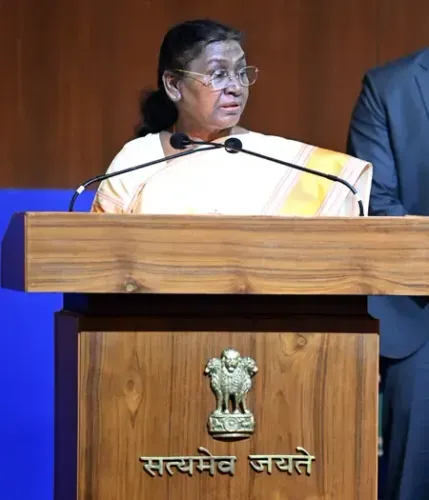
Draupadi Murmu — India's first tribal woman President — is the chief guest at the programme.
The event is being held at Omkareshwar, Khandwa district , a region with high sickle cell disease prevalence among tribal populations.
The programme aligns with the National Sickle Cell Anaemia Elimination Mission launched in July 2023 , targeting elimination by 2047 across 17 high-prevalence states including Madhya Pradesh.
The event was broadcast live, indicating a government push for broad public awareness beyond the physical venue.
The Chief Minister's Office of Madhya Pradesh announced on Friday, 19 June 2026 that President Smt. Draupadi Murmu will serve as the chief guest at a state-level programme marking World Sickle Cell Day 2026, to be held at Omkareshwar, Khandwa district.
Context
World Sickle Cell Day is observed every year on 19 June, a date established by the United Nations to raise global awareness of sickle cell disease — a hereditary blood disorder that disproportionately affects tribal communities across central India. The Madhya Pradesh government's decision to host a state-level event at Omkareshwar, a pilgrimage town along the Narmada in Khandwa district, places the occasion in a region with documented high prevalence of the disease among Scheduled Tribe populations.
President Murmu, who took office in July 2022 as India's first tribal woman to hold the post, has consistently participated in events centred on tribal health and welfare, lending symbolic and institutional weight to such programmes.
Policy Backdrop
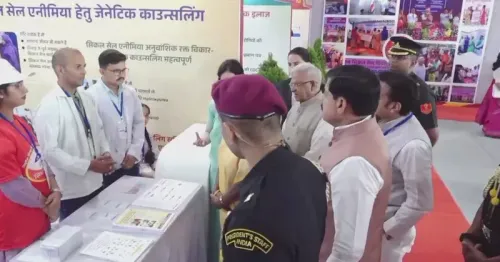
The event sits within the framework of the National Sickle Cell Anaemia Elimination Mission, launched by the Union Ministry of Health and Family Welfare in July 2023 with the goal of eliminating sickle cell anaemia by 2047. The mission prioritises 17 high-prevalence states, with Madhya Pradesh among them, and focuses on mass screening and genetic counselling in tribal districts.
Madhya Pradesh has operated district-level screening and counselling initiatives since the early 2010s; the national mission effectively scaled those efforts, channelling central resources into states like MP where the tribal belt carries a heavy disease burden. Khandwa district itself has been identified as a high-prevalence zone, making the choice of Omkareshwar as venue a pointed policy signal.
Stakeholders and Impact
The primary beneficiaries of sustained sickle cell policy are tribal communities across Madhya Pradesh's Narmada valley and Vindhya-Satpura belt, where inter-generational transmission of the sickle cell trait remains a public-health challenge. Patients, carriers, and their families stand to gain from expanded screening infrastructure, early diagnosis, and genetic counselling that can inform family-planning decisions.
Presidential participation in state-level health events has historically been used to signal top-level political commitment to health equity in Scheduled Tribe areas, often accelerating administrative follow-through at the district level. Civil-society organisations working on tribal health in central India are likely to use the occasion to press for faster roll-out of counselling centres and treatment facilities.
What's Next
Attention will now turn to whether the Omkareshwar event produces concrete programmatic announcements — such as new screening-camp targets for 2026-27 or supplementary state budget allocations for genetic counselling infrastructure in high-prevalence districts. The event was also broadcast live, per the link shared by the Chief Minister's Office, suggesting the government intends wide public outreach beyond the physical venue.
As the National Sickle Cell Anaemia Elimination Mission moves deeper into its implementation phase, state-level milestones like this one will increasingly serve as accountability checkpoints for the broader 2047 elimination target.
Frequently Asked Questions
What is World Sickle Cell Day and when is it observed?
World Sickle Cell Day is observed every year on 19 June , a date established by the United Nations to raise global awareness of sickle cell disease, a hereditary blood disorder that severely affects red blood cells.
Why was the MP World Sickle Cell Day 2026 event held at Omkareshwar, Khandwa?
Khandwa district , where Omkareshwar is located, has a substantial tribal population and documented high prevalence of sickle cell disease, making it a symbolically and epidemiologically significant venue for the state-level programme.
What is the National Sickle Cell Anaemia Elimination Mission?
The National Sickle Cell Anaemia Elimination Mission was launched by the Union Ministry of Health and Family Welfare in July 2023 , aiming to eliminate sickle cell anaemia from India by 2047 through mass screening and genetic counselling in 17 high-prevalence states , including Madhya Pradesh.
Why is President Draupadi Murmu significant to sickle cell awareness events?
President Draupadi Murmu , who took office in July 2022 as India's first tribal woman President, has consistently participated in events focused on tribal health and welfare, lending institutional weight to policy commitments on diseases that disproportionately affect Scheduled Tribe communities.
Which communities are most affected by sickle cell disease in Madhya Pradesh?
Tribal communities across Madhya Pradesh's Narmada valley and Vindhya-Satpura belt bear the heaviest burden of sickle cell disease in the state, with inter-generational transmission of the sickle cell trait remaining a significant public-health challenge.