CM Madhya Pradesh Highlights President Murmu's Sickle Cell Push

Synopsis
President Draupadi Murmu used her Madhya Pradesh visit to spotlight sickle cell disease, with CM Mohan Yadav affirming the state's commitment to continuous screening, awareness, and treatment under the national elimination mission targeting tribal communities by 2047.
Key Takeaways
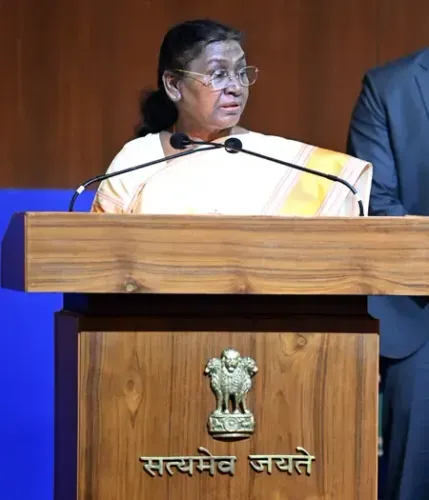
President Draupadi Murmu delivered a public awareness message on sickle cell disease during her visit to Madhya Pradesh .
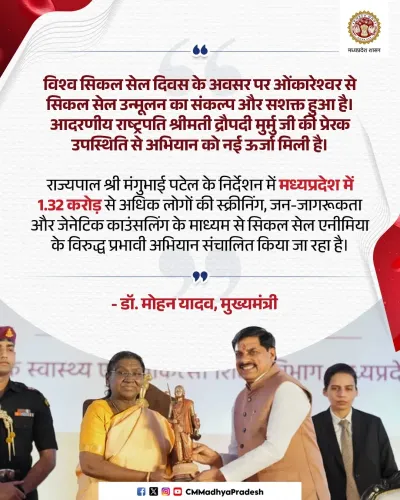
CM Mohan Yadav and the state government described the President's message as a matter of pride and reaffirmed their commitment to eradicating the disease.
The state is running continuous screening, awareness, and treatment programmes targeting tribal populations.
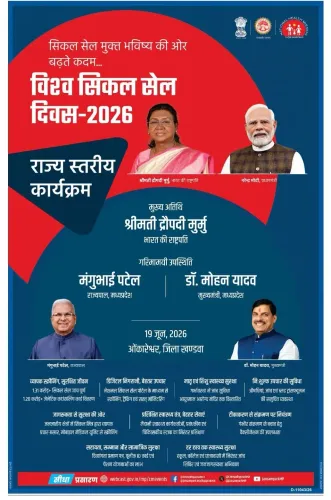
The effort is aligned with the National Sickle Cell Anaemia Elimination Mission , launched by PM Narendra Modi in July 2023 , which aims to screen 7 crore people aged 0-40.
Madhya Pradesh has one of the largest tribal populations in India and is among the highest-burden states for sickle cell anaemia.
The national mission targets complete elimination of sickle cell disease by 2047 .
The Chief Minister's Office of Madhya Pradesh on Tuesday, 23 June 2026 stated that President Draupadi Murmu, during her visit to the state, delivered a public awareness message on sickle cell disease — a serious genetic blood disorder with high prevalence among tribal communities. Chief Minister Mohan Yadav credited the guidance of Prime Minister Narendra Modi for the state's accelerating development trajectory, of which the health push forms a key part.
Context
The post, shared by the official CMO Madhya Pradesh handle, quotes CM Mohan Yadav as saying the state considers it a matter of pride (gaurav ka vishay) that President Murmu used her state visit to spread awareness about sickle cell disease. The statement underlines the significance of a constitutional head lending visibility to a health issue that disproportionately affects tribal populations in central India.
Madhya Pradesh is home to one of the largest Scheduled Tribe populations in the country, making it one of the highest-burden states for sickle cell anaemia. The disease causes chronic pain, organ damage, and shortened life expectancy, and remains under-diagnosed in remote tribal belts.
Policy Backdrop
The awareness push aligns directly with the National Sickle Cell Anaemia Elimination Mission, launched by Prime Minister Narendra Modi in July 2023 from Ranchi, Jharkhand. The mission targets screening of 7 crore people aged 0 to 40 years across high-burden tribal districts, with the goal of eliminating the disease by 2047.
The Madhya Pradesh government has stated it is ensuring continuous screening, awareness, and effective treatment arrangements (satatam screening, jagrukta evam upchar ki prabhavi vyavastha) for the disease's eradication. This state-level effort is positioned as an operational extension of the central mission, channelled through existing public health infrastructure under the National Health Mission.
Stakeholders and Impact
The primary beneficiaries are tribal communities across Madhya Pradesh's high-burden districts, where sickle cell anaemia has historically gone undetected due to limited healthcare access. Rural health workers are central to the screening drive, conducting camps at the grassroots level to identify carriers and affected individuals early.
Presidential endorsement of a health programme carries symbolic and institutional weight, often accelerating administrative focus and budgetary prioritisation at the state level. The CMO's public acknowledgement of President Murmu's message signals the state government's intent to sustain momentum on the issue beyond the visit itself.
What's Next
The immediate focus will be on expanding district-level screening camps in tribal areas and integrating confirmed sickle cell cases with Ayushman Bharat health coverage for treatment support. Sustained follow-through — moving from awareness to diagnosis to long-term care — will determine the programme's real-world impact in the state.
With the 2047 elimination target set at the national level, Madhya Pradesh's ability to scale its screening and treatment infrastructure in the coming years will be a critical benchmark for the mission's progress across central India.
Point of View
Her association with a disease that overwhelmingly burdens Scheduled Tribe communities carries distinct political and symbolic force. The CMO's prompt amplification of her message signals that the Madhya Pradesh government is keen to position itself as a frontrunner in the national elimination mission, especially ahead of potential reviews of state-level progress. This pattern of using high-profile constitutional visits to reinforce flagship health programmes reflects a broader BJP governance strategy of layering symbolic endorsement onto policy delivery. The real test, however, lies in converting awareness into measurable screening coverage and treatment uptake in the state's most remote tribal districts.
NationPress
22 Sept 2026
Frequently Asked Questions
What did President Draupadi Murmu say about sickle cell disease in Madhya Pradesh?
During her visit to Madhya Pradesh, President Draupadi Murmu delivered a public awareness message about sickle cell disease, urging greater attention to this serious genetic blood disorder that disproportionately affects tribal communities.
What is the National Sickle Cell Anaemia Elimination Mission?
The National Sickle Cell Anaemia Elimination Mission was launched by Prime Minister Narendra Modi in July 2023 from Ranchi, Jharkhand. It aims to screen 7 crore people aged 0 to 40 years in high-burden tribal districts and eliminate the disease by 2047.
Why is sickle cell disease a major concern in Madhya Pradesh?
Madhya Pradesh has one of the largest Scheduled Tribe populations in India, and sickle cell anaemia is highly prevalent among tribal communities. Limited healthcare access in remote areas has historically led to under-diagnosis and under-treatment of the condition.
What steps is the Madhya Pradesh government taking to fight sickle cell disease?
The Madhya Pradesh government is conducting continuous screening camps, public awareness campaigns, and ensuring treatment arrangements for sickle cell patients, in alignment with the central government's national elimination mission.
Who is CM Mohan Yadav and what is his role in the sickle cell drive?
Mohan Yadav has been the Chief Minister of Madhya Pradesh since December 2023. He has reaffirmed the state government's commitment to sickle cell disease eradication through sustained screening, awareness, and treatment programmes targeting tribal populations.