President Murmu Calls on CPES and IES Officers to Champion Inclusive Growth and Transform Lives

Synopsis
In a significant address, President Droupadi Murmu urged officers of CPES and IES to focus on inclusive growth and the real-world impact of economic policies, emphasizing their role in nation-building and improving citizens' lives.
Key Takeaways
Importance of CPES and IES: Key players in India's economic development.
Inclusive Growth: Policies must benefit all, especially vulnerable populations.
Continuous Learning: Officers should focus on professional excellence and empathy.
Electricity's Role: Essential for industrial growth and quality of life.
Collaboration: Coordination between services is crucial for effective policy implementation.
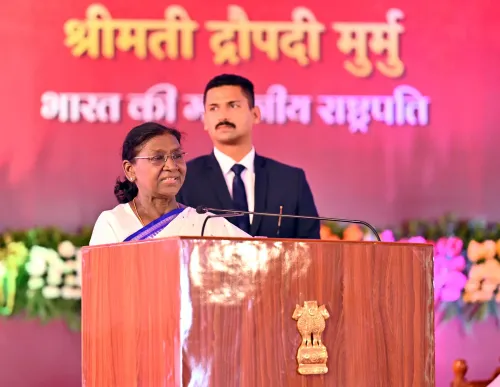
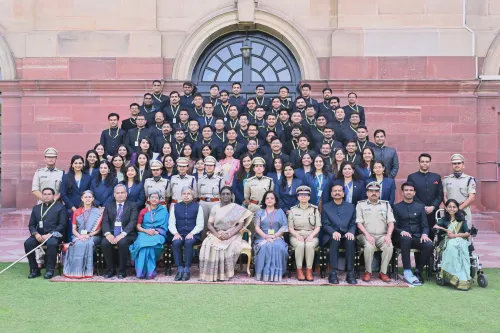
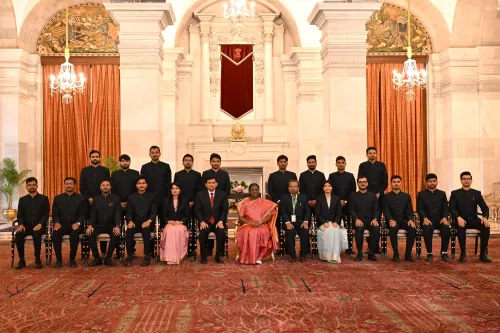
New Delhi, March 27 (NationPress) President Droupadi Murmu on Friday highlighted the vital contributions of the Central Power Engineering Service (CPES) and the Indian Economic Service (IES) in influencing India’s growth path and ensuring that economic policies yield real benefits for the populace.
While addressing the officers of both services during their visit to Rashtrapati Bhavan, the President remarked that they are positioned at the forefront of India's development narrative and will be crucial in fostering a more robust, self-sufficient nation. She pointed out that their efforts will greatly affect policy creation, reform execution, and the advancement of inclusive and sustainable growth across various sectors.
President Murmu called upon the officers to take a proactive and solution-focused stance in governance. She stressed that India's swift economic evolution necessitates that policymakers and technical experts remain adaptable, inventive, and deeply dedicated to serving the public. She encouraged them to view challenges as avenues to meaningfully contribute to nation-building.
The President underscored the necessity of continuous professional development and excellence, asserting that modern governance requires not just technical prowess but also compassion and ethical dedication. She reminded the officers that policies should be attuned to the diverse needs of the population and rooted in real-world effects.
Addressing CPES personnel, Murmu identified electricity as a fundamental component for industrial advancement, technological progress, and enhanced living standards. She recognized the service’s role in establishing a strong power framework, encompassing generation, transmission, and distribution systems, while upholding reliability, efficiency, and safety measures.
In her discussion with IES officers, she emphasized that their function has become increasingly crucial in a swiftly changing global and domestic economic landscape. She stated that IES officers will play a key role in shaping economic policy, managing inflation, promoting job creation, and tackling socio-economic disparities.
President Murmu asserted that policymaking must transcend mere data and figures. "Every data point represents a human narrative," she stated, adding that the genuine success of economic policies is measured by their ability to improve lives, particularly for the most vulnerable members of society.
She also emphasized the necessity for collaboration between technical services like CPES and analytical bodies like IES to ensure that development initiatives are both strategically planned and efficiently executed. According to her, such collaboration is vital for realizing long-term national objectives and ensuring equitable regional development.
This interaction highlighted the government’s commitment to aligning technical skills and economic strategies with outcomes that prioritize citizens, reaffirming the essential role of civil services in facilitating inclusive and sustainable growth across the nation.
Point of View
President Murmu’s address reflects a strategic vision aimed at enhancing governance through technical expertise and economic insight. The importance placed on inclusive growth and responsiveness to citizens' needs indicates a proactive approach to policy-making, essential for addressing India's socio-economic challenges.
NationPress
24 Sept 2026
Frequently Asked Questions
What did President Murmu emphasize in her address?
President Murmu emphasized the significance of the CPES and IES in shaping economic policies that benefit citizens and urged them to adopt a forward-looking approach in governance.
Why is electricity important according to President Murmu?
President Murmu described electricity as a key driver of industrial growth, technological innovation, and improved quality of life, highlighting its importance for national development.
What call to action did President Murmu make to CPES and IES officers?
She called on the officers to embrace challenges as opportunities for meaningful contributions to nation-building and to ensure policies are responsive to the diverse needs of the population.
How can CPES and IES collaborate effectively?
President Murmu stressed the need for coordination between CPES and IES to design and implement development initiatives effectively, ensuring long-term national goals are met.
What is the overarching theme of President Murmu's address?
The overarching theme is the importance of aligning technical expertise with citizen-centric outcomes to drive inclusive and sustainable growth in India.