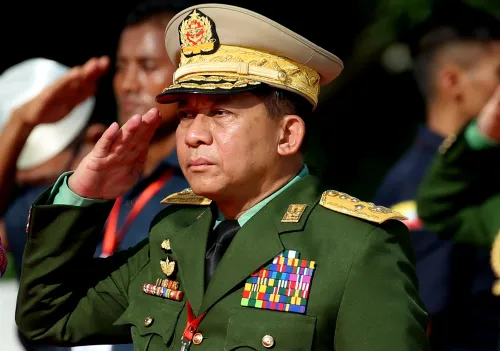
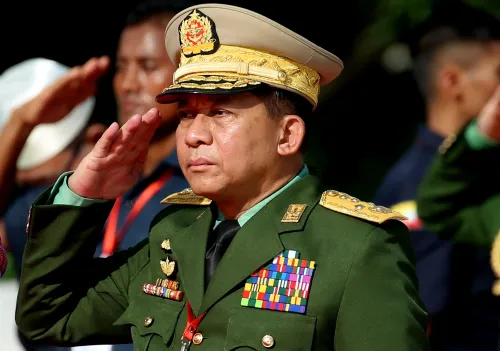
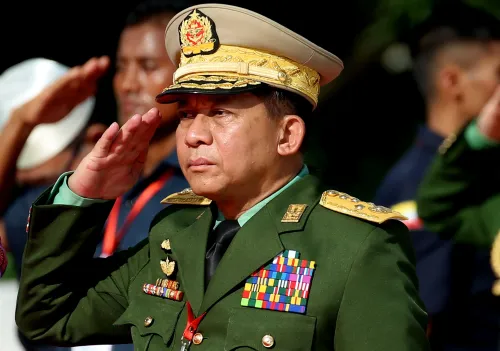
General Min Aung Hlaing Becomes Myanmar's President: A Step Towards Democracy or Continuation of Military Rule?
Synopsis
The appointment of General Min Aung Hlaing as Myanmar's President raises critical questions about the future of democracy in the country. Is this a genuine shift towards civilian governance, or simply a façade for continued military dominance? Discover the implications of this leadership change.
Key Takeaways
General Min Aung Hlaing's presidency may reinforce military rule rather than democratization.
Critics highlight a history of human rights abuses under his leadership.
Over 80% of government ministers are linked to the military.
The recent elections appear to formalize military governance.
The country faces significant economic challenges during this transition.
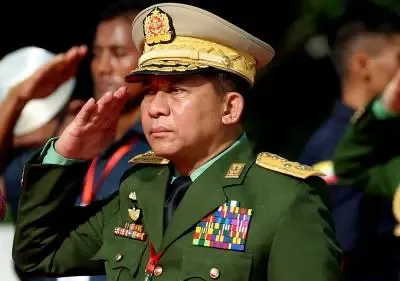
New Delhi, April 12 (NationPress) The appointment of General Min Aung Hlaing, the former head of Myanmar's military junta, as the nation's new President has sparked a significant discussion regarding the country's evolving political landscape. Observers are intensely debating whether this marks a shift toward a civilian-led government or simply reinforces the existing military junta's grip on power.
While some may scrutinize the General's extensive military background and the pressing need for governance reforms, the prevailing evidence suggests a further entrenchment of military control.
A pro-military outlet in the capital labeled this leadership change as a “return to civilian-led democracy,” which has stirred the ongoing debate. However, critics have unearthed troubling historical instances of oppression and human rights violations under General Min Aung Hlaing's leadership.
Elections conducted in three phases during December 2025 and January 2026 seemingly served to formalize military rule, according to reports from the prominent portal, Global Asia Forum.
The portal highlights, “The military, under Min Aung Hlaing's command, executed a coup in February 2021, dismantled the democratically elected parliament, and arrested numerous officials, including President Win Myint and State Counsellor Aung San Suu Kyi, while launching a violent crackdown on dissenters.”
In addition, all democratic parties have been disbanded, and a substantial portion of the seats in both the Upper and Lower Houses is allocated to military representatives.
Experts indicate that over 80 percent of the Union Ministers are believed to be either active military officers or retired personnel.
The portal further reported that the new President has eliminated potential threats and surrounded himself with loyal supporters.
His predecessor as military chief, General Soe Win, has been succeeded by General Ye Win Oo, who previously held the position of Chief of Military Security Affairs and is widely regarded as Min Aung Hlaing’s closest ally.
As Myanmar analyst Ye Myo Hein noted, “Soe Win, the last senior member from previous military generations, could potentially challenge Min Aung Hlaing’s influence and security. In contrast, the appointment of Ye Win Oo signifies a preference for unwavering loyalty and personal safety.”
According to a biography from the British Broadcasting Corporation, “Min Aung Hlaing rose through the military ranks, becoming joint chief of staff in August 2010.” Many believe his allegiance to former junta leader Senior General Than Shwe paved the way for his rise.
Furthermore, Min Aung Hlaing's ascension to the presidency occurs amidst a profound economic crisis in the country, exacerbated by conflicts in the Middle East and years of ineffective governance.
Whether Min Aung Hlaing can navigate these challenges or maintain dominance over his predecessors remains an open question.
Point of View
It’s crucial to approach the recent appointment of General Min Aung Hlaing with an unbiased lens. While some view this shift as a potential move towards a civilian-led democracy, the prevailing evidence suggests a reinforcement of military power. The implications for Myanmar's governance and civil liberties are significant and warrant careful scrutiny.
NationPress
20 Sept 2026
Frequently Asked Questions
What does Min Aung Hlaing's presidency mean for Myanmar's democracy?
Min Aung Hlaing's presidency raises concerns that it may signify a continuation of military rule rather than a genuine shift towards democracy.
What led to the military coup in Myanmar?
The military coup in February 2021 was executed by Min Aung Hlaing, who dissolved the democratically elected government and arrested key political figures.
How are military leaders positioned in Myanmar's government?
A significant majority of Myanmar’s government officials are either active-duty military officers or retired personnel, indicating a strong military presence in governance.
What challenges does Myanmar face under Min Aung Hlaing's leadership?
Myanmar is grappling with severe economic challenges, exacerbated by years of mismanagement and conflict, which complicate Min Aung Hlaing's leadership.
What are the implications of military control over elections?
The military's control over elections undermines the democratic process, leading to concerns about the legitimacy and fairness of political representation in Myanmar.