Nadda Flags 7.19 Cr Screened Under Sickle Cell Mission
Synopsis
Union Health Minister J. P. Nadda on World Sickle Cell Awareness Day announced that the National Sickle Cell Anaemia Elimination Mission has screened over 7.19 crore individuals, identified 20.26 lakh carriers, diagnosed 2.46 lakh patients, and distributed 4.82 crore Sickle Cell Cards, reaffirming the 2047 elimination target.
Key Takeaways
Over 7.19 crore individuals have been screened under the National Sickle Cell Anaemia Elimination Mission, surpassing the original 7-crore target.
More than 20.26 lakh carriers have been identified and offered genetic counselling to reduce future disease transmission.
2.46 lakh persons have been diagnosed with Sickle Cell Disease and connected to care pathways.
4.82 crore Sickle Cell Cards have been distributed to give screened individuals portable health records.
The mission, launched on 1 July 2023 by PM Narendra Modi, targets elimination of sickle cell disease as a public health challenge by 2047 .
Tribal and vulnerable communities across 17 high-prevalence states are the primary focus of the programme.
Union Health Minister J. P. Nadda on Friday, 19 June 2026 marked World Sickle Cell Awareness Day by releasing updated progress figures for the National Sickle Cell Anaemia Elimination Mission, citing over 7.19 crore individuals screened, more than 20.26 lakh carriers identified, 2.46 lakh persons diagnosed with Sickle Cell Disease, and 4.82 crore Sickle Cell Cards distributed across the country.
Context
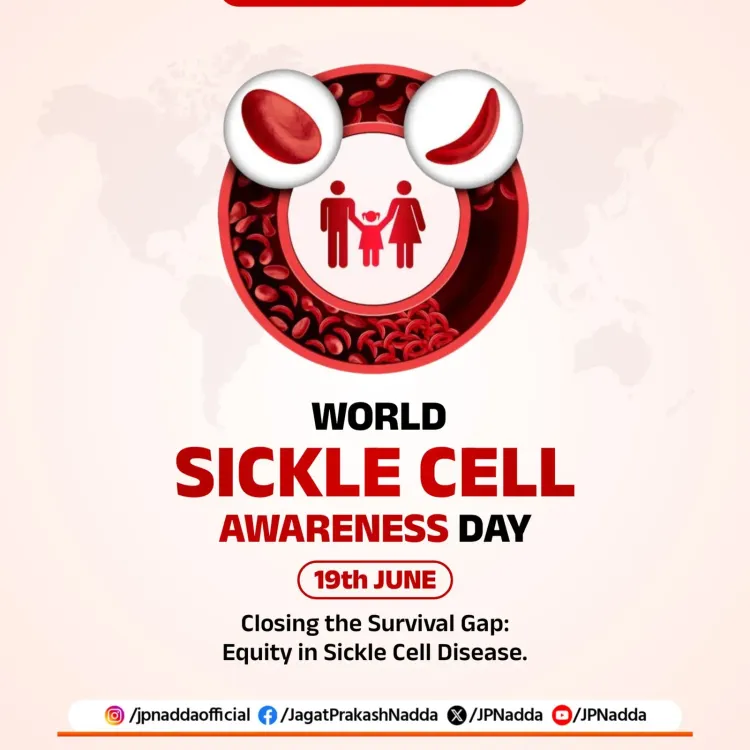
World Sickle Cell Awareness Day, observed annually on 19 June, is a United Nations-recognised global observance dedicated to raising awareness of sickle cell disease — an inherited blood disorder that causes red blood cells to deform, obstructing blood flow and causing chronic pain, organ damage, and early death. In India, the disease disproportionately affects Scheduled Tribe populations concentrated in central and southern states, making it both a public health and an equity concern.
Nadda reaffirmed the government's target of 'eliminating Sickle Cell Disease as a public health challenge by 2047,' aligning the mission with the broader Viksit Bharat 2047 development agenda. His post stated: 'These achievements reflect our collective efforts to ensure early diagnosis, timely treatment, genetic counselling and comprehensive care, particularly among tribal populations and vulnerable communities.'
Policy Backdrop
The National Sickle Cell Anaemia Elimination Mission was launched on 1 July 2023 by Prime Minister Narendra Modi with an initial target to screen 7 crore people across 17 high-prevalence states. The latest figures cited by Nadda indicate the mission has already surpassed that original screening benchmark. The mission operates under the broader National Health Mission framework and focuses on universal newborn screening, population-level carrier detection, and genetic counselling to reduce disease transmission across generations.
The programme forms part of India's expanded approach to genetic and non-communicable diseases, sitting alongside elimination drives for tuberculosis and malnutrition that also carry disproportionate tribal burden. Diagnosed individuals are being progressively integrated into the Ayushman Bharat scheme to ensure treatment coverage without out-of-pocket expenditure.
Stakeholders and Impact
Tribal communities and other vulnerable populations across states such as Madhya Pradesh, Chhattisgarh, Jharkhand, Odisha, Maharashtra, and Gujarat are the primary beneficiaries of the mission's screening and counselling infrastructure. The distribution of 4.82 crore Sickle Cell Cards is intended to give every screened individual a documented health record that can travel with them across healthcare facilities, reducing repeat testing and enabling faster clinical decisions.
For the 2.46 lakh persons diagnosed with the disease, the mission's value lies in connecting them to specialised care pathways — including hydroxyurea therapy, blood transfusion support, and pain management — that were previously inaccessible in remote tribal districts. Carriers identified through the programme are offered genetic counselling to make informed reproductive choices, a key lever for reducing new disease incidence over the coming decades.
What's Next
The Ministry of Health is expected to release periodic mission progress reports, and the programme may come under review during parliamentary health committee sessions and upcoming budget discussions. Analysts will watch whether the pace of screening and card distribution is matched by commensurate investment in treatment infrastructure, particularly in districts with high tribal density where healthcare access remains limited.
With 2047 set as the elimination horizon — the same year India marks a century of independence — the mission's trajectory will be a key indicator of whether the country can translate large-scale screening into sustained reduction in disease burden for its most marginalised communities.
Point of View
The government is embedding a niche genetic disease into the mainstream development narrative — a politically significant move that elevates tribal health as a priority rather than a footnote. The key policy question going forward is whether screening numbers translate into durable treatment access, since identifying carriers and patients without adequate follow-up infrastructure risks creating a diagnostic gap. The mission's integration with Ayushman Bharat will be the real test of whether political commitment converts into health outcomes for India's most marginalised communities.
NationPress
19 Sept 2026
Frequently Asked Questions
What is the National Sickle Cell Anaemia Elimination Mission?
The National Sickle Cell Anaemia Elimination Mission is a central government programme launched on 1 July 2023 by Prime Minister Narendra Modi to screen populations, identify carriers, diagnose patients, and provide genetic counselling and care, with the goal of eliminating sickle cell disease as a public health challenge in India by 2047.
How many people have been screened under the sickle cell mission in India?
According to Union Health Minister J. P. Nadda's statement on 19 June 2026, over 7.19 crore individuals have been screened under the National Sickle Cell Anaemia Elimination Mission since its launch.
Who is most affected by sickle cell disease in India?
Sickle cell disease in India disproportionately affects Scheduled Tribe populations concentrated in central and southern states, including Madhya Pradesh, Chhattisgarh, Jharkhand, Odisha, Maharashtra, and Gujarat, which is why the mission focuses specifically on tribal and vulnerable communities.
What is a Sickle Cell Card and why is it distributed?
A Sickle Cell Card is a health record issued to individuals screened under the mission. It documents their screening result — whether they are disease-free, a carrier, or diagnosed — so they can access faster clinical decisions at any healthcare facility without undergoing repeat testing.
When is World Sickle Cell Awareness Day observed?
World Sickle Cell Awareness Day is observed every year on 19 June. It is a United Nations-recognised global observance aimed at raising awareness about sickle cell disease, its impact on patients and families, and the importance of early diagnosis and treatment.