Did Nadda Accuse Kamal Nath and Siddaramaiah of Ignoring Vande Mataram?
Click to start listening
Synopsis
In a heated debate in the Rajya Sabha, J.P. Nadda accused Congress leaders Kamal Nath and Siddaramaiah of neglecting the significance of Vande Mataram. As discussions on national symbols unfold, Nadda's remarks highlight the ongoing ideological divide between the BJP and Congress regarding India's cultural heritage. Will Vande Mataram finally receive the respect it deserves?
Key Takeaways
- J.P. Nadda criticized Congress leaders for neglecting Vande Mataram.
- The song is an important part of India's cultural heritage.
- The debate reflects a significant ideological divide in Indian politics.
- Nadda called for Vande Mataram to receive the same respect as the National Anthem.
- Congress defended its leaders' decisions as pragmatic.
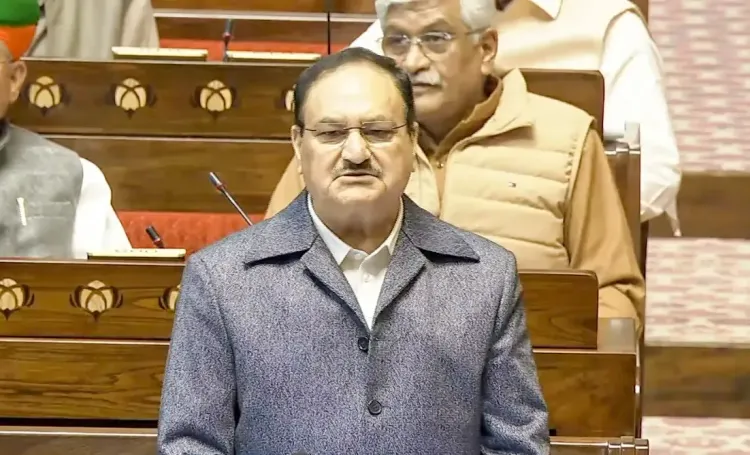
New Delhi, Dec 11 (NationPress) The Leader of House in the Rajya Sabha, J.P. Nadda, escalated his criticisms of the Congress party on Thursday, alleging that its leaders have consistently downplayed the importance of Vande Mataram. During a focused discussion on national symbols, Nadda charged that former Chief Minister of Madhya Pradesh, Kamal Nath, had effectively "removed" Vande Mataram from official observance on the first working day of each month. He also claimed that in Karnataka, Siddaramaiah instructed Congress members not to perform Vande Mataram on Constitution Day.
Nadda’s comments were made amidst a broader dialogue on the song's historical and cultural importance, which has long been revered as a symbol of the freedom struggle. He argued that both historical and current Congress governments have displayed a reluctance to embrace Vande Mataram, despite its profound connection to India’s civilisational heritage. "This is not merely about the BJP, RSS, or Jan Sangh," Nadda stated, "but about words that have arisen from millennia of Indian history and are integral to our culture."
By referencing Kamal Nath’s decision in Madhya Pradesh, Nadda aimed to underscore what he termed as a calculated effort to weaken national sentiment. He reminded the House that the debate surrounding the song is not new, recalling that Jawaharlal Nehru voiced similar concerns in the 1930s when he labeled parts of the song as "absurd" or difficult for the average person to grasp.
Nadda contended that such attitudes have persisted into contemporary Congress politics, reflected in the actions of its state governments. His mention of Karnataka added a new layer to the discussion, as he criticized the Congress-led government there for also limiting the song’s performance in official contexts.
This exchange provoked strong reactions from opposition members, with Congress representatives accusing the BJP of twisting history and politicizing cultural symbols for electoral advantage. The discourse highlighted the ideological rift over national symbols, with the BJP portraying Vande Mataram as a timeless representation of patriotism, while Congress defended its leaders’ decisions as pragmatic and inclusive.
In conclusion, Nadda emphasized that the ongoing dialogue would only hold substantial meaning when Vande Mataram is given the same reverence as the National Anthem and the National Flag. He stressed that the song embodies India's cultural essence and merits equal acknowledgment.
In response, Congress leader Jairam Ramesh reminded the assembly that Dr. Rajendra Prasad had made a comparable statement in 1950, affirming that both the National Anthem and the National Song are to be held in equal regard. He added that this equality was explicitly recognized by the Constituent Assembly decades earlier.
Point of View
It's vital to recognize the ongoing tensions between political parties regarding national symbols. The debate surrounding Vande Mataram is emblematic of broader ideological divides in India. While the BJP champions Vande Mataram as a patriotic anthem, the Congress defends its leaders' pragmatic decisions, underscoring the complexities of cultural representation in politics. It's crucial to keep the dialogue constructive and inclusive.
NationPress
13/12/2025
Frequently Asked Questions
What did J.P. Nadda accuse Kamal Nath of?
J.P. Nadda accused Kamal Nath of removing Vande Mataram from official observance in Madhya Pradesh.
Why is Vande Mataram significant?
Vande Mataram is a revered song that symbolizes India's freedom struggle and cultural identity.
What does Nadda suggest about Congress's attitude towards Vande Mataram?
Nadda suggests that Congress has historically shown reluctance to embrace Vande Mataram, undermining its significance.
How did Congress respond to Nadda's accusations?
Congress members accused the BJP of distorting history and politicizing cultural symbols for electoral gain.
What was concluded about Vande Mataram's status?
Nadda asserted that Vande Mataram should be given equal respect as the National Anthem and National Flag.