Nadda says Ayushman Bharat now reaches West Bengal after years of TMC resistance
Synopsis
Union Health Minister J. P. Nadda has declared that the Ayushman Bharat Yojana is now reaching West Bengal's residents, eight years after Chief Minister Mamata Banerjee refused to implement the central health insurance scheme, alleging TMC leaders had destroyed the scheme's enrolment forms.
Key Takeaways
Nadda stated on June 8, 2026 that Ayushman Bharat Yojana is now being implemented in West Bengal .
West Bengal declined to join PM-JAY when it launched in September 2018 , citing its own Swasthya Sathi programme.
Nadda alleged that TMC leaders had torn up Ayushman Bharat enrolment forms in 2018 .
The scheme offers health insurance cover of up to Rs 5 lakh per family per year for hospitalisation at empanelled hospitals nationwide.
The development marks a significant shift in centre-state health policy alignment for West Bengal .
Formal state notifications on scheme integration and impact on Swasthya Sathi beneficiary lists remain to be watched.
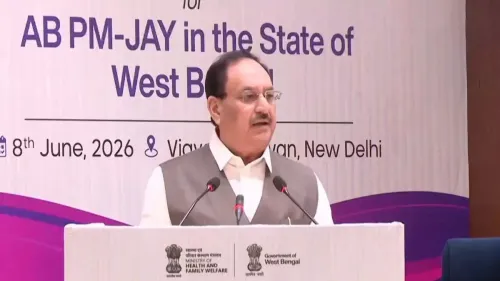
Union Health Minister J. P. Nadda on Monday, June 8, 2026, recalled that West Bengal had flatly refused to implement the Ayushman Bharat Yojana when he urged Chief Minister Mamata Banerjee in 2018, asserting that the scheme has now finally reached the state's residents despite that opposition.
In his post on X, Nadda wrote: 'Maine Mamata ji ko varsh 2018 mein Paschim Bengal mein Ayushman Bharat Yojana laagu karne ka aagraha kiya to unhone sire se mana kar diya tha.' ('When I urged Mamata ji to implement the Ayushman Bharat Yojana in West Bengal in 2018, she refused outright.') He further alleged that TMC leaders had torn up the scheme's forms and discarded them in drains. He concluded by saying it had been the BJP's resolve that the scheme would be implemented in West Bengal regardless, and that the people there would now benefit from it.
Context
The Ayushman Bharat Pradhan Mantri Jan Arogya Yojana (PM-JAY) was launched by the Government of India in September 2018, offering health insurance cover of up to Rs 5 lakh per family per year for secondary and tertiary hospitalisation. It is among the largest publicly funded health insurance programmes in the world by intended beneficiary count.
West Bengal was among the states that declined to join PM-JAY at launch, preferring instead to continue and expand its own Swasthya Sathi programme. The Trinamool Congress government argued that the state scheme offered comparable or broader coverage and that welfare delivery should remain within state jurisdiction.
Policy Backdrop
Centre-state friction over Ayushman Bharat has been a recurring feature of federal health policy since 2018, with several opposition-governed states opting out and retaining their own insurance frameworks. The debate reflects a deeper constitutional tension over whether large welfare programmes should be co-implemented or run in parallel at the state level.
West Bengal under the Trinamool Congress has consistently positioned its own social schemes as distinct from and competitive with central government offerings, a stance that has been a source of sustained political contestation with the BJP-led central government.
Stakeholders and Impact
The primary beneficiaries of any integration would be West Bengal's economically weaker sections who are eligible under PM-JAY's criteria, which targets low-income families identified through socio-economic data. These households would gain access to cashless treatment at any empanelled hospital across India, not just within the state.
The state health department and existing Swasthya Sathi beneficiaries would also be affected, as any formal rollout would require alignment — or at minimum, coexistence — between the two schemes' beneficiary lists, empanelled hospitals, and reimbursement structures.
What's Next
Formal state government notifications on the integration of PM-JAY with West Bengal's existing health infrastructure will be closely watched by policy observers. Any changes to Swasthya Sathi beneficiary rolls or budget allocations would signal the depth of the scheme's adoption. Nadda's statement signals that the BJP intends to make the rollout of Ayushman Bharat in West Bengal a visible political and policy achievement ahead of future electoral cycles in the state.
Point of View
The timing suggests the BJP is building a pre-election narrative around central scheme penetration in a state it has long contested. More broadly, this episode illustrates the enduring tension in India's federal structure between centrally sponsored schemes and state-level welfare autonomy.
NationPress
19 Sept 2026
Frequently Asked Questions
What is Ayushman Bharat Yojana and what does it offer?
Ayushman Bharat Pradhan Mantri Jan Arogya Yojana (PM-JAY) is India's central government health insurance scheme, launched in September 2018, providing cashless hospitalisation cover of up to Rs 5 lakh per family per year at empanelled hospitals for secondary and tertiary care.
Why did West Bengal not implement Ayushman Bharat earlier?
West Bengal under Chief Minister Mamata Banerjee declined to join PM-JAY in 2018, choosing instead to continue with its own Swasthya Sathi health insurance programme and citing state autonomy over welfare delivery.
What did JP Nadda say about Mamata Banerjee and Ayushman Bharat?
Nadda stated that he personally urged Mamata Banerjee in 2018 to implement Ayushman Bharat in West Bengal but she refused outright, and he alleged that TMC leaders had torn up the scheme's enrolment forms.
What is the Swasthya Sathi scheme in West Bengal?
Swasthya Sathi is West Bengal's state-run health insurance programme that the Trinamool Congress government has continued and expanded as an alternative to the central government's Ayushman Bharat scheme.
Will Ayushman Bharat replace Swasthya Sathi in West Bengal?
That is not yet confirmed. Formal state government notifications on integration and any changes to Swasthya Sathi beneficiary lists or budgets will determine how the two schemes coexist or are aligned going forward.