Nadda flags R&D push as chemicals enter ₹1 lakh cr RDI scheme
Synopsis
At IndiaChem2026, Union Minister J. P. Nadda highlighted the inclusion of advanced chemicals and petrochemicals in India's ₹1 lakh crore RDI Scheme as a landmark policy step, calling on industry to significantly scale up R&D and innovation investment.
Key Takeaways
Advanced chemicals and petrochemicals have been included in India's ₹1 lakh crore RDI Scheme , according to Union Minister J.
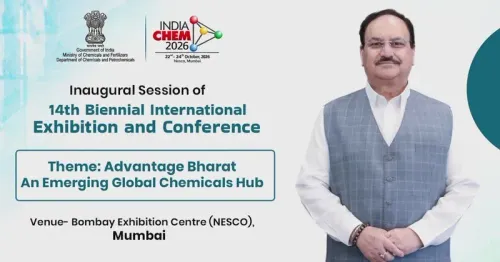
Nadda made the announcement at IndiaChem2026 on 22 October 2026 in his capacity as Minister of Chemicals and Fertilizers.
The minister called on industry to increase investment in innovation and research, framing the scheme inclusion as an opportunity that must be acted upon.
The move builds on the PLI scheme for chemicals and petrochemicals notified in 2020 , extending policy support from manufacturing to R&D.
The development aligns with the Atmanirbhar Bharat objective of reducing import dependence through indigenous innovation in the chemicals sector.
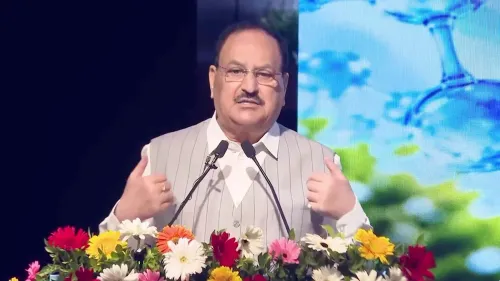
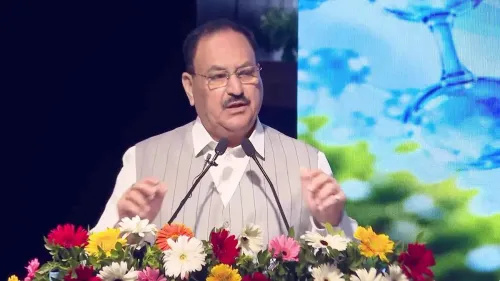
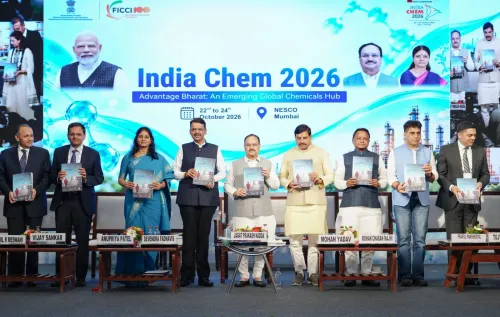
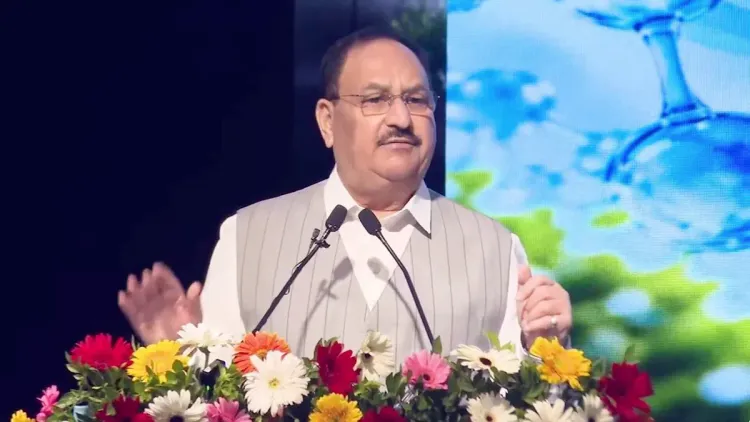
India's chemicals and petrochemicals sector just got a significant policy upgrade — and Union Minister J. P. Nadda wants the industry to move fast. Speaking at #IndiaChem2026 on Thursday, 22 October 2026, the Minister of Chemicals and Fertilizers declared that the inclusion of advanced chemicals and petrochemicals in the Government of India's ₹1 lakh crore Research, Development and Innovation (RDI) Scheme marks a major milestone — and challenged industry to match the government's ambition with its own investment in innovation.
What the RDI scheme's expanded scope means for chemicals
Nadda's post, written in Hindi, states plainly: 'रिसर्च एंड डेवलपमेंट पर विशेष ध्यान देना होगा' — 'Special attention must be given to research and development.' The incorporation of advanced chemicals and petrochemicals into the ₹1 lakh crore RDI Scheme opens a new channel of state-backed funding for a sector that has historically relied on manufacturing incentives rather than innovation grants. The Minister described the development as 'a big achievement,' signalling it was not a routine administrative update but a deliberate strategic choice.
From PLI to R&D: the policy arc behind the push
The move builds on a trajectory that began with the Production Linked Incentive (PLI) scheme for chemicals and petrochemicals, notified in 2020, which was designed to expand domestic manufacturing capacity and reduce India's heavy import dependence. That scheme addressed the 'make it here' problem. The RDI scheme now targets the harder question: 'invent it here.' Together, they form a two-stage ladder — production scale-up first, indigenous innovation next — consistent with the broader Atmanirbhar Bharat framework that has governed industrial policy across successive budget cycles.
The call Nadda put directly to industry
The Minister did not frame this as government largesse alone. His message carried an explicit challenge: 'अब उद्योग जगत को इस अवसर का लाभ उठाकर नवाचार और अनुसंधान में निवेश बढ़ाना होगा' — 'Now the industry must seize this opportunity and increase investment in innovation and research.' That phrasing shifts accountability squarely onto chemical manufacturers and R&D institutions, making IndiaChem2026 not just a showcase event but a moment of public expectation-setting. The industry's response — how many proposals are submitted under the RDI scheme and what R&D commitments are announced — will determine whether today's policy milestone translates into tangible output.
India's chemicals sector has long punched below its weight in patents and proprietary processes relative to its production volume. With ₹1 lakh crore now formally available and advanced chemicals explicitly in scope, the architecture for change is in place. Whether boardrooms convert that into lab investment is the real test ahead.
Point of View
The announcement serves a dual purpose: it demonstrates policy delivery in a ministry he holds alongside the BJP presidency, and it sets a public benchmark against which industry performance can later be measured. The explicit challenge to 'industry' to invest in innovation suggests the government is wary of a familiar pattern where policy windows open but private capital stays on the sidelines. Watch whether IndiaChem2026 yields concrete R&D commitment announcements that can be tracked against the scheme's ₹1 lakh crore envelope.
NationPress
22 Oct 2026
Frequently Asked Questions
What is the RDI Scheme and how much is its budget?
The Research, Development and Innovation (RDI) Scheme is a Government of India initiative with a corpus of ₹1 lakh crore aimed at supporting R&D and innovation across industrial sectors, including, now, advanced chemicals and petrochemicals.
Why has J. P. Nadda called for more R&D investment in chemicals?
Nadda, as Union Minister of Chemicals and Fertilizers, stated at IndiaChem2026 that the inclusion of advanced chemicals in the RDI Scheme creates a major opportunity, and that industry must now match the government's investment by ramping up its own R&D and innovation spending.
What is IndiaChem2026?
IndiaChem2026 is an industry platform and event focused on highlighting advancements and policy developments in India's chemical sector; it served as the occasion for Nadda's announcement on the RDI Scheme.
How does the RDI Scheme relate to the earlier PLI scheme for chemicals?
The PLI scheme for chemicals and petrochemicals, notified in 2020, focused on expanding domestic manufacturing capacity. The RDI Scheme adds a second layer by funding research and innovation, creating a more complete policy stack for the sector.
What is the connection to Atmanirbhar Bharat?
Both the PLI and RDI schemes for chemicals sit within the broader Atmanirbhar Bharat framework, which seeks to reduce India's dependence on chemical imports by building domestic production scale and, now, indigenous innovation capabilities.