Nadda Greets West Bengal on Paschimbanga Divas

Synopsis
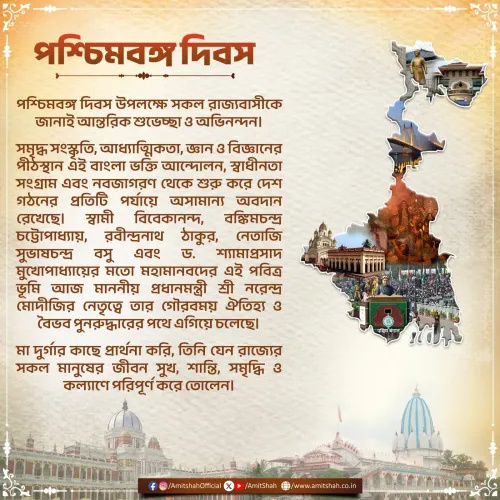
Union Health Minister J. P. Nadda marked Paschimbanga Divas on 20 June 2026 by honouring West Bengal's contributions to India's cultural, spiritual, and intellectual heritage, invoking icons from Vivekananda to Syama Prasad Mookerjee in a message to the state's people.
Key Takeaways
Union Health Minister J.
Nadda posted greetings on Paschimbanga Divas , observed on 20 June 2026 .
He cited Swami Vivekananda , Rabindranath Tagore , Netaji Subhas Chandra Bose , Bankim Chandra Chattopadhyay , and Dr.
Syama Prasad Mookerjee as defining figures of Bengal's legacy.
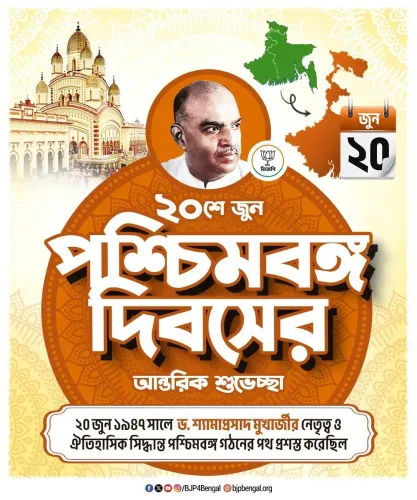
Syama Prasad Mookerjee , founder of the Bharatiya Jana Sangh, is the ideological predecessor of the BJP — his inclusion carries specific political resonance.
The BJP has issued state-day greetings as part of its eastern India outreach strategy since 2014 .
The message underscores the party's sustained effort to build cultural and electoral connect in West Bengal .
Union Health Minister and BJP national president J. P. Nadda extended greetings to the people of West Bengal on Paschimbanga Divas, observed annually on 20 June, honouring the state's cultural and historical identity.
Context
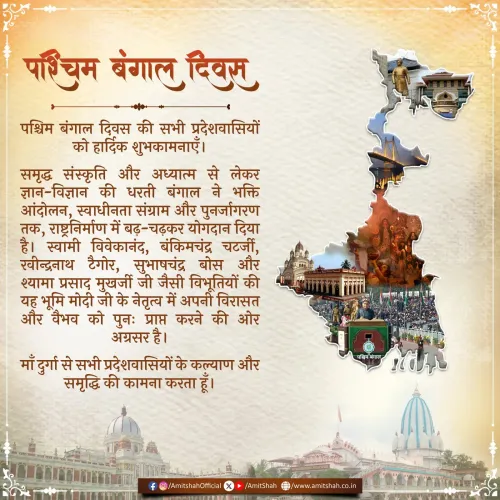
In his message, Nadda described West Bengal as 'the land of Swami Vivekananda, Bankim Chandra Chattopadhyay, Rabindranath Tagore, Netaji Subhas Chandra Bose, and Dr. Syama Prasad Mookerjee' — five figures whose contributions span spiritual reform, literature, the independence movement, and political thought. He called on citizens to 'take pride in Bengal's rich legacy and its enduring contribution to nation-building.'
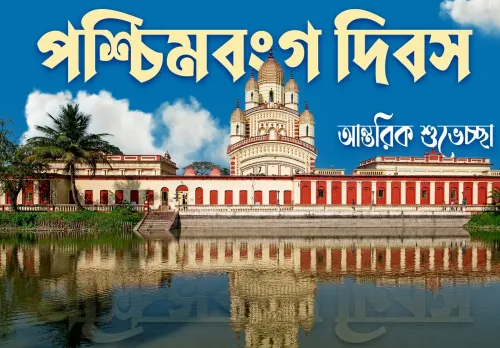
Paschimbanga Divas is observed each year as an occasion to reflect on West Bengal's distinct place in India's civilisational fabric. The day draws attention to the state's outsized role in shaping modern India's intellectual and political landscape.
Policy Backdrop
Since 2014, the BJP has made state-day greetings a consistent part of its outreach strategy in eastern India, a region where the party has invested heavily in electoral expansion. References to icons such as Vivekananda, Tagore, and Bose recur regularly in BJP messaging as the party seeks to align itself with a shared civilisational heritage that transcends party lines.
The inclusion of Dr. Syama Prasad Mookerjee carries particular ideological weight. Mookerjee, a Bengal-born leader, founded the Bharatiya Jana Sangh in 1951 — the direct ideological predecessor of the BJP. His name in such greetings underscores the party's effort to claim deep roots in Bengal's political history.
Stakeholders and Impact
The message is addressed to all residents of West Bengal, a state of over 9 crore people that has historically been governed by regional parties. Central ministers issuing cultural greetings of this nature serve both a ceremonial function and a political one, keeping the party visible in states where it contests against entrenched regional forces.
For ordinary Bengalis, the occasion is a moment of cultural pride. For political observers, messages from senior Union ministers on such days are read as part of a sustained long-term engagement with the state's electorate ahead of future assembly and Lok Sabha contests.
What's Next
Similar ministerial messages are expected on other state-formation and cultural anniversaries across 2026. Observers will also watch whether the Union Health Ministry announces any region-specific health programmes or schemes timed to coincide with regional cultural milestones in West Bengal and other eastern states.
Point of View
Issued consistently since 2014, reflects a long-game electoral strategy rather than a one-off ceremonial gesture. How effectively it translates into political capital in a state with a deeply entrenched regional identity remains the central question for the BJP's Bengal calculus.
NationPress
18 Sept 2026
Frequently Asked Questions
What is Paschimbanga Divas and when is it celebrated?
Paschimbanga Divas is an annual observance held on 20 June to mark West Bengal's cultural and historical identity. It is a day when leaders and citizens reflect on the state's contributions to India's heritage.
Why did J. P. Nadda post greetings on Paschimbanga Divas?
As Union Health Minister and BJP national president, J. P. Nadda extended greetings to acknowledge West Bengal's cultural significance and to connect with the state's people on a day of regional pride.
Who is Syama Prasad Mookerjee and why is he mentioned?
Dr. Syama Prasad Mookerjee was a Bengal-born leader who founded the Bharatiya Jana Sangh in 1951 , the direct ideological predecessor of the BJP. His inclusion in BJP messaging on Bengal occasions highlights the party's claim to deep roots in the state's political history.
What is the BJP's strategy in West Bengal?
Since 2014 , the BJP has used state-day greetings and references to cultural icons like Vivekananda , Tagore , and Bose as part of a sustained outreach effort in West Bengal, a state historically governed by regional parties.
What did Nadda say about West Bengal's contribution to India?
Nadda said West Bengal has made 'immense contributions to India's cultural, spiritual, and intellectual heritage' and called on citizens to 'take pride in Bengal's rich legacy and its enduring contribution to nation-building.'