Nadda hails Ayushman Bharat PM-JAY's cashless care reach
Synopsis
Union Health Minister J. P. Nadda invoked beneficiary stories to highlight Ayushman Bharat PM-JAY's role in removing financial barriers to hospital care, posting under the Seva Sankalp Abhiyan campaign on 27 September 2026.
Key Takeaways
Nadda praised Ayushman Bharat PM-JAY on 27 September 2026 under the Seva Sankalp Abhiyan campaign.
PM-JAY provides up to ₹5 lakh in annual cashless health coverage per eligible family for secondary and tertiary care.
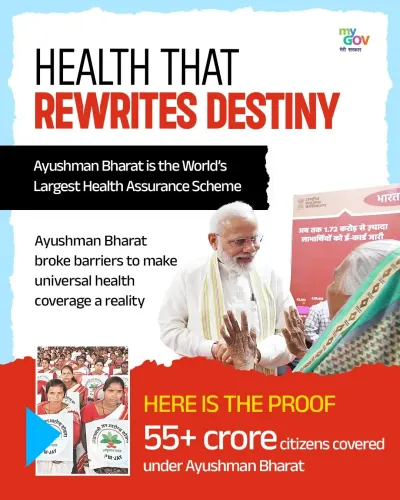
The scheme was launched in September 2018 and is considered the world's largest government-funded health assurance programme.
The post emphasised reducing out-of-pocket expenditure — a persistent challenge in India's healthcare landscape.
PM-JAY forms the insurance component of Ayushman Bharat, complementing Health and Wellness Centres at the primary care level.
State governments manage scheme implementation and may offer additional top-up coverage beyond the central benefit.
When a medical emergency strikes a low-income household, the first question is rarely 'which hospital?' — it is 'how will we pay?' Union Health Minister J. P. Nadda, posting on Sunday, 27 September 2026, highlighted the Ayushman Bharat PM-JAY scheme as a direct answer to that question, pointing to beneficiary stories as evidence of the programme's on-the-ground impact.
Nadda described the scheme as 'an exemplary initiative towards ensuring that financial hardship does not stand in the way of timely healthcare,' crediting the programme's design to the vision of Prime Minister Narendra Modi. His post was made under the banner of the #SevaSankalpAbhiyan (Seva Sankalp Abhiyan), a government outreach campaign spotlighting citizen impact stories from flagship welfare schemes.
What PM-JAY offers eligible families
Ayushman Bharat Pradhan Mantri Jan Arogya Yojana (PM-JAY) was launched in September 2018 as the world's largest government-funded health assurance scheme. It provides up to ₹5 lakh in annual cashless coverage per eligible family for secondary and tertiary hospital care at empanelled public and private facilities.
The scheme targets economically vulnerable households, directly addressing India's historically high out-of-pocket health expenditure — a burden that has long pushed families into debt or forced them to forgo treatment altogether. PM-JAY forms the insurance pillar of the broader Ayushman Bharat architecture, which also includes Health and Wellness Centres designed to strengthen primary care at the community level.
Seva Sankalp Abhiyan and the politics of beneficiary storytelling
The Seva Sankalp Abhiyan is a structured government campaign that uses real beneficiary accounts to demonstrate welfare scheme outcomes. By anchoring his post in personal stories rather than aggregate statistics, Nadda leaned into a communications strategy that has become central to the ruling party's outreach: making policy tangible through human detail.
The National Health Policy 2017 had already set a framework for reducing catastrophic health spending; PM-JAY was the flagship financial instrument that followed. Successive Union Budgets have expanded both beneficiary numbers and the procedures covered under the scheme, while state governments manage implementation and, in several cases, have added top-up benefits for their residents.
With health budget discussions typically taking shape in the months ahead of the February budget, utilisation data and state-level expansion announcements for PM-JAY will be closely watched as a marker of how far the scheme's reach has grown.
Point of View
The government reinforces its welfare-delivery narrative ahead of what could be a politically sensitive budget season. The deliberate shift from statistics to beneficiary stories reflects a maturing communications strategy designed to make abstract health expenditure data feel personal to voters. At the same time, it keeps PM-JAY in the public conversation at a moment when state-level expansions and scheme utilisation data are expected to sharpen. Whether the campaign translates into measurable enrolment gains or improved hospital empanelment will be the real test.
NationPress
27 Sept 2026
Frequently Asked Questions
What is Ayushman Bharat PM-JAY and who is eligible?
Ayushman Bharat PM-JAY is India's government-funded health assurance scheme that provides up to ₹5 lakh in annual cashless coverage per family for secondary and tertiary hospital care. It targets economically vulnerable households identified through socio-economic census data.
When was Ayushman Bharat PM-JAY launched?
PM-JAY was launched in September 2018 and is recognised as the world's largest government-funded health assurance programme.
What is the Seva Sankalp Abhiyan?
Seva Sankalp Abhiyan is a government outreach campaign that uses real beneficiary stories to showcase the impact of flagship welfare schemes such as PM-JAY.
What did J. P. Nadda say about Ayushman Bharat PM-JAY?
Nadda called PM-JAY 'an exemplary initiative' that ensures financial hardship does not prevent timely healthcare, crediting its design to Prime Minister Narendra Modi's vision.
How does PM-JAY reduce out-of-pocket health spending in India?
PM-JAY enables eligible families to receive cashless treatment at empanelled hospitals, eliminating the need to pay upfront for secondary and tertiary procedures that would otherwise push low-income households into debt.