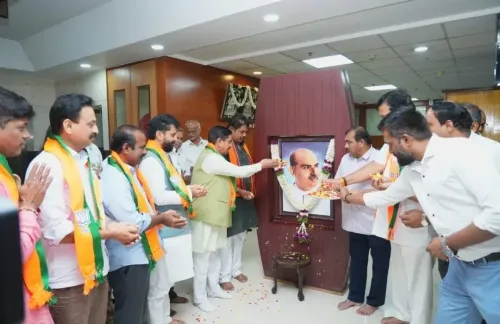
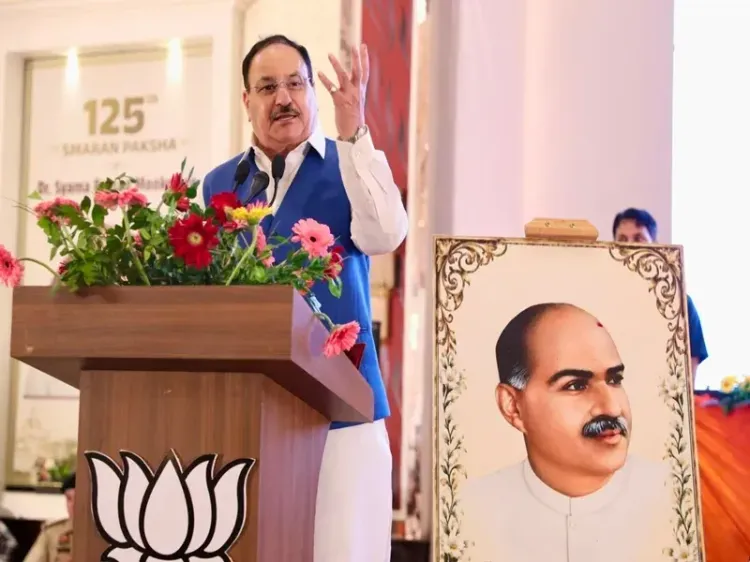
JP Nadda hails Syama Prasad Mookerjee at 125th birth anniversary in Ambala
Synopsis
At Ambala, JP Nadda used Syama Prasad Mookerjee's 125th birth anniversary to draw a direct ideological line from the Bharatiya Jana Sangh's 1951 founding to the BJP's current dominance — claiming the NDA now governs 78 per cent of India's population and that Modi-era policies are the fulfilment of Mookerjee's vision.
Key Takeaways
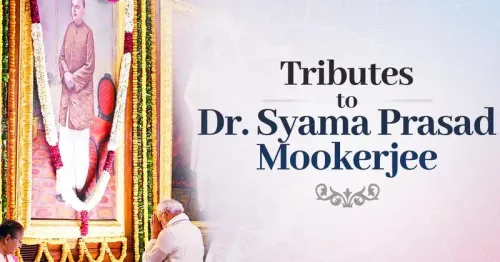
Nadda paid tributes to Dr Syama Prasad Mookerjee in Ambala on 6 July , marking his 125th birth anniversary .
Nadda linked Article 370 abrogation, CAA , Aatmanirbhar Bharat , and the National Education Policy to Mookerjee's founding vision.
The BJP-led NDA reportedly governs nearly 78 per cent of India's population and covers approximately 72 per cent of its geographical area.
Mookerjee founded the Bharatiya Jana Sangh on 21 October 1951 and became Vice-Chancellor of the University of Calcutta at age 33 .
Haryana CM Nayab Singh Saini and BJP state President Archana Gupta were among senior leaders present at the event.
Union Health Minister J.P. Nadda on Monday, 6 July paid tributes to Dr Syama Prasad Mookerjee, founder of the Bharatiya Jana Sangh, at a commemorative event in Ambala, Haryana, marking the statesman's 125th birth anniversary. Nadda asserted that Mookerjee's ideals and resolve have been fully realised under the leadership of Prime Minister Narendra Modi.
Mookerjee's Vision Linked to Modi-Era Policies
Nadda drew direct lines between Mookerjee's philosophy and several flagship initiatives of the current government. He described the abrogation of Article 370, the Citizenship Amendment Act (CAA), Aatmanirbhar Bharat, the National Education Policy, and industrial development as concrete extensions of Dr Mookerjee's vision of 'Ek Bharat, Shreshtha Bharat'.
Haryana Chief Minister Nayab Singh Saini, Haryana Bharatiya Janata Party (BJP) state President Archana Gupta, former Member of Parliament Sudha Yadav, and other senior leaders were present on the dais during the programme.
BJP's Growth Traced to Mookerjee's Founding Legacy
Nadda noted that the sapling Dr Mookerjee nurtured has, under Prime Minister Modi, grown into what he called the world's largest political party. He stated that the BJP and the National Democratic Alliance (NDA) currently govern nearly 78 per cent of India's population, while the NDA's influence extends across approximately 72 per cent of the country's geographical area.
He recalled that Mookerjee established the Bharatiya Jana Sangh on 21 October 1951, rooted in the ideology of national unity and cultural integrity — a foundation he argued the BJP continues to build upon today.
Mookerjee's Distinguished Family and Academic Legacy
Nadda highlighted the extraordinary lineage behind Dr Mookerjee, noting that he was the son of Dr Ashutosh Mookerjee, who served as both Acting Chief Justice and Vice-Chancellor of the University of Calcutta. As Vice-Chancellor, Ashutosh Mookerjee had firmly opposed differential pay between British and Indian professors, an act Nadda described as an early seed of Indian nationalism.
Syama Prasad Mookerjee went on to become Vice-Chancellor of the same university at just 33 years of age, making him the youngest to hold that position in its history. Nadda described him not merely as a historical figure but as a living idea — one embodying cultural heritage, self-reliance, and national unity.
Ambala Honoured as Land of Cultural and Historical Significance
Nadda said he considered himself fortunate to pay tribute at Ambala, which he described as a land deeply associated with the Bhagavad Gita, India's freedom struggle, and the valour of its soldiers. He also acknowledged Haryana's contributions to the nation through its achievements in sports.
As the BJP continues to draw ideological sustenance from its founding figures, the Ambala event signals the party's intent to reinforce its historical narrative ahead of future electoral cycles.
Point of View
But it sidesteps scrutiny of whether those policies have delivered the national unity Mookerjee actually envisioned. The claim that the NDA governs 78 per cent of India's population is a number worth interrogating: governance share by population is not the same as electoral mandate, and the BJP's own 2024 general election result required coalition arithmetic it had previously dismissed. The deeper question — whether Mookerjee's legacy is being faithfully carried forward or selectively curated — is one mainstream coverage rarely asks.
NationPress
5 Oct 2026
Frequently Asked Questions
Who was Syama Prasad Mookerjee?
Dr Syama Prasad Mookerjee was the founder of the Bharatiya Jana Sangh, established on 21 October 1951, and is regarded as a key architect of the 'Ek Bharat, Shreshtha Bharat' vision. He was also the youngest Vice-Chancellor of the University of Calcutta, assuming the role at age 33.
What did JP Nadda say at the Ambala event?
Nadda said Mookerjee's ideals have been realised under Prime Minister Modi's leadership, citing the abrogation of Article 370, the CAA, Aatmanirbhar Bharat, and the National Education Policy as extensions of Mookerjee's vision. He also noted that the BJP-led NDA now governs nearly 78 per cent of India's population.
Why was the event held in Ambala?
The event was organised in Ambala, Haryana, to mark the 125th birth anniversary of Dr Syama Prasad Mookerjee. Nadda described Ambala as a land of cultural, religious, and historical significance, associated with the Bhagavad Gita and India's freedom struggle.
Who attended the Ambala birth anniversary programme?
Haryana Chief Minister Nayab Singh Saini, Haryana BJP state President Archana Gupta, former MP Sudha Yadav, and other senior party leaders were present alongside J.P. Nadda at the commemorative event.
What is the significance of Syama Prasad Mookerjee's family background?
Mookerjee was the son of Dr Ashutosh Mookerjee, who served as Acting Chief Justice and Vice-Chancellor of the University of Calcutta. Ashutosh Mookerjee opposed differential pay between British and Indian professors, an act credited as an early expression of Indian nationalism.