Nadda joins BJP's 'Save Democracy' padyatra in Ahmedabad
Synopsis
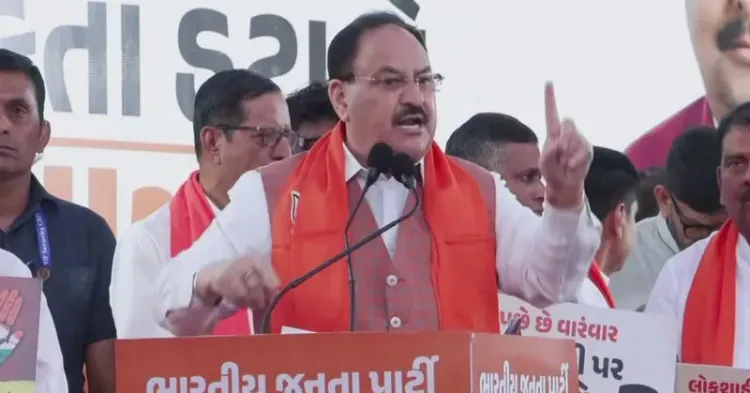
Union Health Minister and BJP national president J. P. Nadda participated in BJP4Gujarat's 'Save Democracy, Remove Anarchy' padyatra in Ahmedabad on October 27, 2026, lending national-level weight to a state-organised political foot-march framed around democratic governance.
Key Takeaways
Nadda , BJP national president and Union Health Minister, joined the padyatra in Ahmedabad on October 27, 2026 .
The march was organised by BJP4Gujarat under the banner 'Loktatantra Bachao, Arajkata Hatao' ('Save Democracy, Remove Anarchy').
The event carried the national hashtag #SaveDemocracyRemoveAnarchy , indicating a broader messaging intent beyond Gujarat.
Nadda's presence as national party president elevated the march from a state event to a nationally visible political statement.
The BJP regularly uses padyatras for cadre mobilisation and narrative framing, particularly in its stronghold of Gujarat .
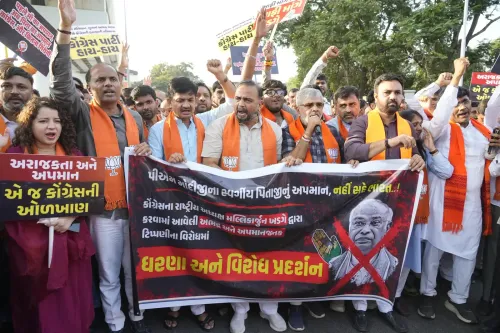
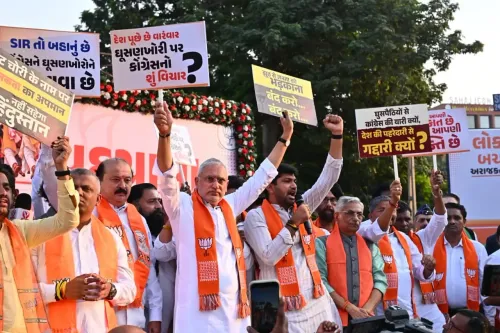
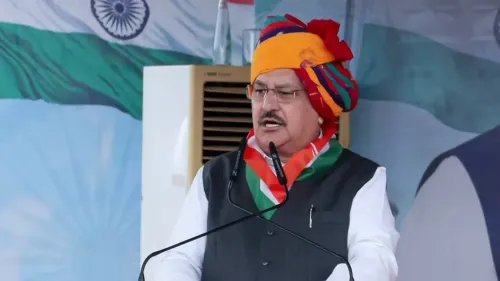
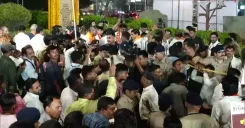
Boots on the pavement in Ahmedabad on Tuesday, October 27, 2026 — Union Health Minister and BJP national president J. P. Nadda joined BJP4Gujarat's mass foot-march titled 'Loktatantra Bachao, Arajkata Hatao' ('Save Democracy, Remove Anarchy'), lending the national party's full weight to a state-level political mobilisation.
A march, a message, and the streets of Ahmedabad
The padyatra — a form of political foot-march with deep roots in Indian grassroots organising — carried the hashtag #SaveDemocracyRemoveAnarchy, signalling that the event was designed to resonate well beyond Gujarat's borders. BJP4Gujarat, the party's state unit, organised the procession, and Nadda's presence elevated it from a routine state-level activity to a nationally visible statement.
Ahmedabad, Gujarat's commercial capital and a city that has hosted some of the BJP's largest organisational gatherings over the past decade, provided both the symbolic and logistical backdrop for the march. The city's streets have long served as a barometer of political energy in what remains one of the party's most reliable strongholds.
Padyatras as political instrument
The BJP has repeatedly deployed foot-marches to serve twin purposes: cadre mobilisation and narrative framing. By putting senior leaders — and in this case, the national president himself — on the ground alongside workers, the party reinforces organisational discipline while projecting a message of street-level connect.
The 'Save Democracy, Remove Anarchy' framing is a combative one, implying a contrast with an opponent the party holds responsible for democratic instability. Such theme-driven marches typically precede intensified political activity — whether an election cycle, a major legislative push, or a campaign to consolidate public opinion ahead of a key vote.
Nadda's dual role in Gujarat's political calculus
As both a Union Cabinet minister and the BJP's national president, Nadda's participation carries weight beyond ceremonial solidarity. His presence signals that the themes on display in Ahmedabad are party-endorsed at the highest level — not just a state-unit initiative. Gujarat BJP has a well-oiled organisational machine, and a padyatra bearing the national president's footprints amplifies the march's political resonance considerably.
Whether this event is a prelude to a formal election campaign, a counter-mobilisation to opposition activity, or part of a wider national messaging exercise will become clearer in the days ahead — but the fact that Nadda flew the flag personally in Ahmedabad leaves little ambiguity about the stakes the party attaches to the moment.
Gujarat's streets have spoken before. Today, the BJP wanted the country to hear them again.
Point of View
Remove Anarchy' frame is a tried-and-tested BJP narrative weapon, typically deployed when the party wants to place its opponents on the defensive over governance legitimacy. The choice of Ahmedabad, a city with outsized symbolic value for the party, is unlikely to be accidental; it reinforces that whatever political contest this march is aimed at, the BJP intends to fight it on home turf with maximum visibility. Watching whether opposition parties respond to the framing — or simply ignore it — will be the clearest indicator of how much traction this mobilisation actually gains.
NationPress
27 Oct 2026
Frequently Asked Questions
What is the 'Loktatantra Bachao Arajkata Hatao' padyatra?
It is a political foot-march organised by BJP4Gujarat in Ahmedabad, translating to 'Save Democracy, Remove Anarchy,' aimed at mobilising party cadres around themes of democratic governance and stability.
Why did JP Nadda attend the Ahmedabad padyatra?
As BJP national president, Nadda's participation signals that the themes and messaging of the march have the full endorsement of the party's national leadership, not just the state unit.
What is a padyatra in Indian politics?
A padyatra is a political foot-march used by Indian parties — across the spectrum — to mobilise grassroots workers, connect with the public, and project political momentum on a specific issue or campaign theme.
Is Gujarat a BJP stronghold?
Yes. Gujarat has been one of the BJP's most consistent strongholds for over two decades, and the party regularly holds large organisational events there to maintain cadre energy and demonstrate political strength.
What does #SaveDemocracyRemoveAnarchy mean in context?
The hashtag is the BJP's framing device for this campaign, positioning the party as a defender of democratic order while implicitly casting its political opponents as sources of instability or 'anarchy.'