Nadda hails India's decolonisation journey under PM Modi
Synopsis
Union Health Minister and BJP chief J. P. Nadda invoked the renaming of Rajpath, Mughal Gardens, and the Netaji statue at India Gate to celebrate India's journey away from colonial-era symbols under PM Modi, posting during the #HarGharTiranga campaign.
Key Takeaways
Nadda posted on August 9, 2026 celebrating India's 'Indianisation' drive under PM Narendra Modi .
Rajpath was renamed Kartavya Path (Path of Duty) in 2022 as part of the Central Vista redevelopment.
Mughal Gardens inside Rashtrapati Bhavan were renamed Amrit Udyan during the Azadi Ka Amrit Mahotsav celebrations.
A granite statue of Netaji Subhas Chandra Bose was unveiled at India Gate in 2022 , replacing the former site of a King George V statue.
The post was tagged #HarGharTiranga , linking cultural reassertion to the annual national flag-hoisting campaign.
These changes are part of a broader pattern of replacing colonial-era symbols with markers of Indian heritage since 2014 .
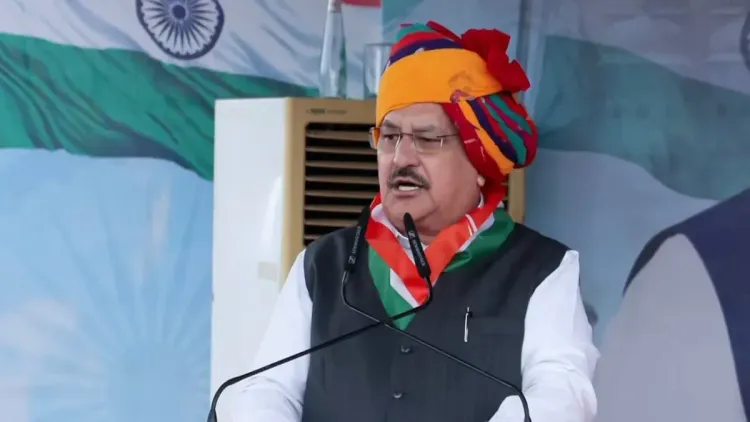
India's most visible public spaces have been quietly rewritten — and Union Health Minister and BJP National President J. P. Nadda wants the country to notice. On Sunday, August 9, 2026, Nadda took to X to celebrate what he called India's march toward self-respect and 'Bharatiyakaran' — the Indianisation of national identity — under the leadership of Prime Minister Narendra Modi.
In his post, Nadda wrote: 'Gulami ki virasat se bahar nikalkar Bharat ke aatmsamman aur Bharatiyakaran ki yatra aage badhi hai' — 'India has moved forward on a journey of self-respect and Indianisation, stepping out of the legacy of slavery.' He pointed to three changes as proof: the renaming of Rajpath to Kartavya Path, Mughal Gardens to Amrit Udyan, and the installation of a statue of Subhas Chandra Bose at India Gate in New Delhi. The post carried the hashtag #HarGharTiranga, linking the message to the national flag-hoisting campaign that mobilises millions of households each Independence Day season.
From Rajpath to Kartavya Path: the logic of a rename
Rajpath — literally 'King's Way' — was the ceremonial boulevard built during British rule as an axis of imperial power. In 2022, the Modi government rechristened it Kartavya Path, or 'Path of Duty', reframing the same stretch of tarmac as a symbol of citizen responsibility rather than colonial authority. The redesigned promenade was inaugurated by PM Modi as part of the Central Vista redevelopment project, one of the most consequential urban overhauls of the capital in decades. Around the same period, the Mughal Gardens inside Rashtrapati Bhavan — the President's estate — were renamed Amrit Udyan, or 'Nectar Garden', shedding a Mughal-era appellation for one drawn from the lexicon of India's Azadi Ka Amrit Mahotsav, the 75th anniversary of Independence.Netaji's statue at India Gate: a freedom fighter reclaimed
Perhaps the most striking of the three changes Nadda cited is the granite statue of Netaji Subhas Chandra Bose that now stands beneath the canopy at India Gate — the same canopy that once held a statue of King George V, removed decades after Independence. The Netaji statue, unveiled by PM Modi in 2022, places the commander of the Indian National Army at the symbolic heart of the capital's ceremonial landscape. For the government, it is a deliberate act of historical correction — a freedom fighter, long argued to have been under-acknowledged, now occupies the space once reserved for the colonial sovereign.Cultural reassertion as a governing philosophy
These three changes are not isolated gestures. Since 2014, the renaming and recasting of public spaces — from city names to stadiums to government schemes — has been a recurring instrument of cultural policy. The argument, consistently advanced by the BJP, is that India's post-colonial state inherited too many markers of subjugation and that correcting them is an act of civilisational dignity. Critics have countered that such renamings risk erasing layered, composite histories. Nadda's post, timed to the #HarGharTiranga campaign, is a reminder that this debate is not settled — it is, in fact, an ongoing pillar of the ruling party's political identity. As the tricolour goes up on millions of homes, the government's message is clear: the flag and the landscape it flies over should speak the same language of a free, self-assured India.Point of View
Visible changes that resonate with a broad base. The three examples he cites (Kartavya Path, Amrit Udyan, Netaji's statue) are carefully chosen because they are tangible and photogenic, making the abstract idea of 'decolonisation' legible to ordinary citizens. This fits squarely into the BJP's decade-long strategy of using symbolic cultural governance — renaming, reinstating, reclaiming — to reinforce a narrative of civilisational restoration. The #HarGharTiranga hashtag amplifies the reach, turning a political statement into a participatory patriotic moment.
NationPress
23 Sept 2026
Frequently Asked Questions
Why was Rajpath renamed Kartavya Path?
Rajpath was renamed Kartavya Path in 2022 by the Modi government to replace a colonial-era name meaning 'King's Way' with one meaning 'Path of Duty', symbolising a shift from imperial legacy to citizen responsibility.
What is Amrit Udyan and why was it renamed?
Amrit Udyan is the new name for the gardens within Rashtrapati Bhavan , previously called Mughal Gardens . The renaming in 2022 was part of India's Azadi Ka Amrit Mahotsav celebrations marking 75 years of Independence.
When was the Subhas Chandra Bose statue installed at India Gate?
The granite statue of Netaji Subhas Chandra Bose was unveiled at India Gate in 2022 by PM Narendra Modi , placed under the canopy that once held a statue of King George V.
What is the #HarGharTiranga campaign?
#HarGharTiranga ('Tricolour in Every Home') is a government-led campaign encouraging Indian citizens to hoist the national flag at their homes around Independence Day to promote patriotism and national pride.
What did JP Nadda say about India's decolonisation?
J. P. Nadda said that under PM Modi's leadership, India has stepped out of the 'legacy of slavery' and is advancing on a journey of self-respect and Indianisation, citing the renaming of public spaces and the Netaji statue as evidence.