Nadda pays tribute on Quit India Movement anniversary
Synopsis
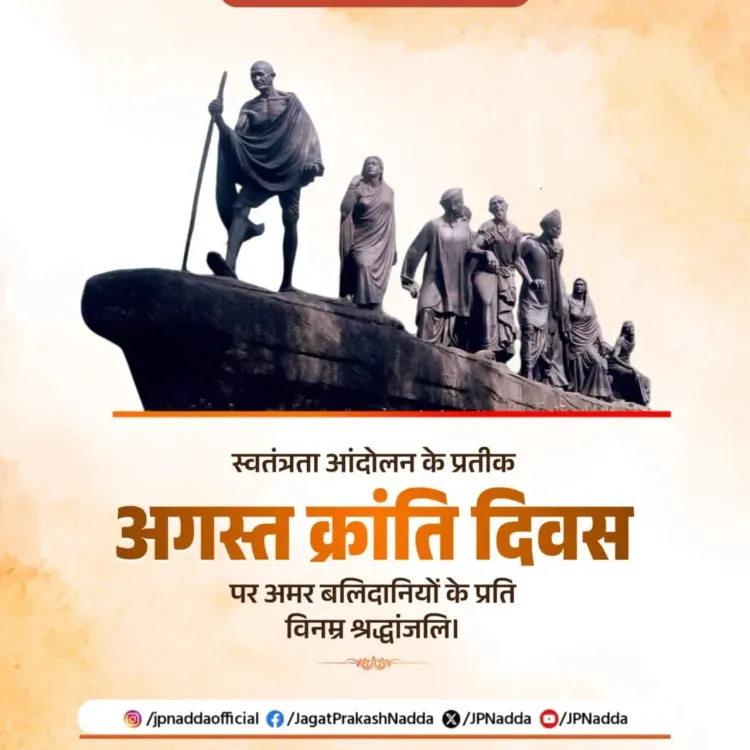
On the 84th anniversary of the Quit India Movement, Union Health Minister and BJP president J. P. Nadda honoured Mahatma Gandhi and the unnamed freedom fighters of the August 1942 uprising, calling it a decisive chapter that united millions in India's independence struggle.
Key Takeaways
Nadda , Union Health Minister and BJP national president, posted a tribute on 9 August 2026 marking the Quit India Movement anniversary.
The Quit India Movement was launched by Mahatma Gandhi in August 1942 , demanding immediate British withdrawal from India.
Nadda specifically honoured 'innumerable anonymous warriors' alongside named leaders, emphasising grassroots sacrifice.
The movement, also called August Kranti , is widely credited as a turning point that accelerated Indian independence in 1947 .
Annual commemorations on 9 August are observed by political leaders across party lines as a fixture of India's national calendar.
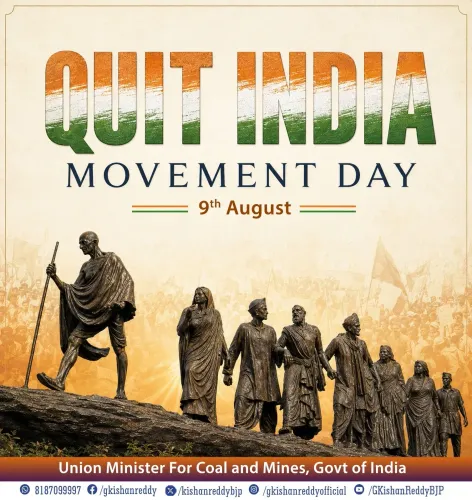
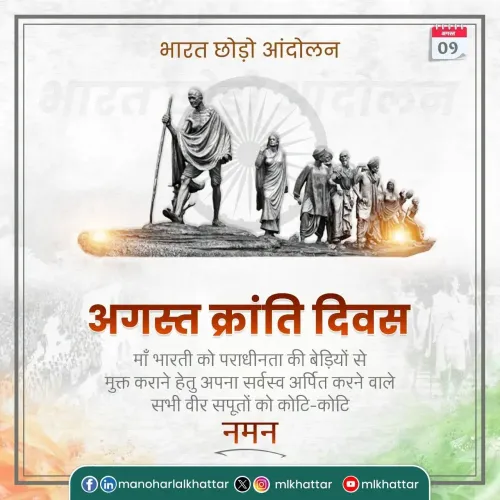
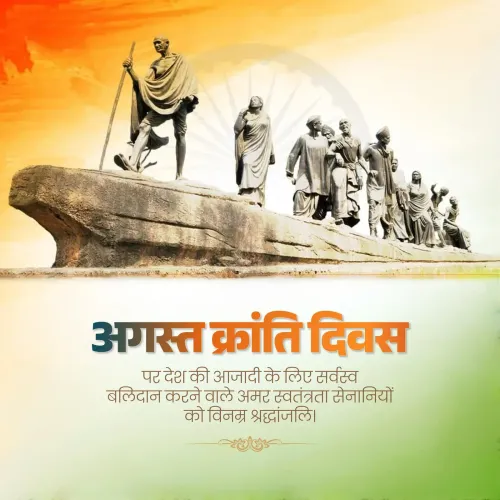
Eighty-four years ago on this date, Mahatma Gandhi stood before a nation and issued a call that would shake an empire: 'Karo ya maro' — do or die. On 9 August 2026, Union Health Minister J. P. Nadda marked the anniversary of the Quit India Movement with a tribute to Gandhi and the countless unnamed freedom fighters whose sacrifice built the foundation of independent India.
In his post, Nadda wrote that the August Kranti — launched in August 1942 — became 'a decisive chapter in the country's freedom struggle,' awakening a new national consciousness and uniting millions of Indians in the fight for independence. He paid particular homage to the 'innumerable anonymous warriors' whose courage, he said, would continue to inspire future generations toward patriotism and national service.
What the August Kranti set in motion
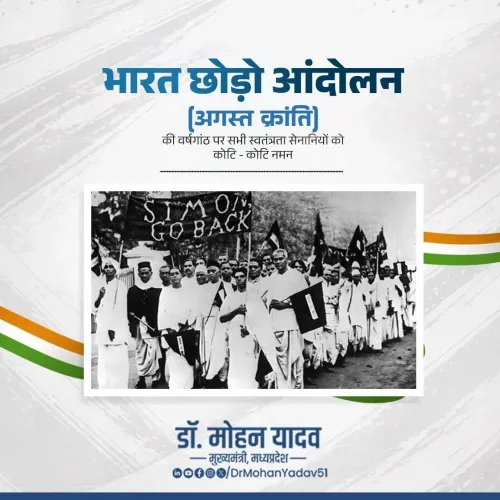
The Quit India Movement, formally adopted by the Indian National Congress on 8 August 1942 at the Gowalia Tank Maidan in Bombay, was Gandhi's most uncompromising demand yet: immediate British withdrawal from India. Within hours of Gandhi's speech, the British colonial administration arrested him and virtually the entire Congress leadership. What followed was a leaderless, spontaneous uprising — strikes, protests, and acts of civil disobedience that spread from cities to villages across the subcontinent.
The movement did not achieve immediate independence, but it permanently altered the political calculus. It demonstrated that ordinary Indians — farmers, students, women, workers — were willing to risk imprisonment and worse for freedom. That mass mobilisation is widely credited as a turning point that accelerated the path to independence in 1947.
A ritual of remembrance that carries political weight
Annual tributes on 9 August are a fixture of Indian political life, observed across party lines. For the ruling BJP, invoking the August Kranti serves a dual purpose: honouring a shared national inheritance while also anchoring the party's leaders within the broader narrative of India's civilisational pride and sacrifice. Nadda, as both BJP national president and a senior Union minister, occupies a position where such commemorations carry institutional as well as political resonance.
The unnamed fighters Nadda salutes are a recurring motif in these tributes — a reminder that independence was not won by leaders alone, but by millions whose names never made the history books. That emphasis on collective, grassroots sacrifice remains as relevant a political message today as it was in 1942.
Point of View
Broadening the movement's credit beyond any single political family. On a day when multiple parties issue similar statements, the minister's post is as much about staking symbolic ground as it is about historical remembrance. The August Kranti anniversary has thus become a soft-power contest in modern Indian politics, fought through the language of tribute.
NationPress
9 Aug 2026
Frequently Asked Questions
What is the Quit India Movement and when did it start?
The Quit India Movement was a mass civil disobedience campaign launched by Mahatma Gandhi and the Indian National Congress on 8 August 1942 , demanding immediate British withdrawal from India. It is also known as the August Kranti (August Revolution).
Why is 9 August celebrated in India?
9 August is observed as Quit India Movement Day (August Kranti Diwas) in India, marking the day in 1942 when Gandhi's call for British withdrawal triggered a nationwide uprising that became a decisive moment in the independence struggle.
What did JP Nadda say about the Quit India Movement?
J. P. Nadda called the movement 'a decisive chapter in the country's freedom struggle' and paid tribute to Mahatma Gandhi and the countless unnamed freedom fighters whose sacrifice, he said, would inspire future generations toward patriotism and national service.
What was the impact of the Quit India Movement on Indian independence?
Though it did not achieve immediate independence, the Quit India Movement demonstrated the breadth of popular opposition to British rule and is widely regarded as a turning point that accelerated India's path to independence in 1947 .