Rajasthan CM Bhajanlal Receives UCC Draft from Panel
Synopsis
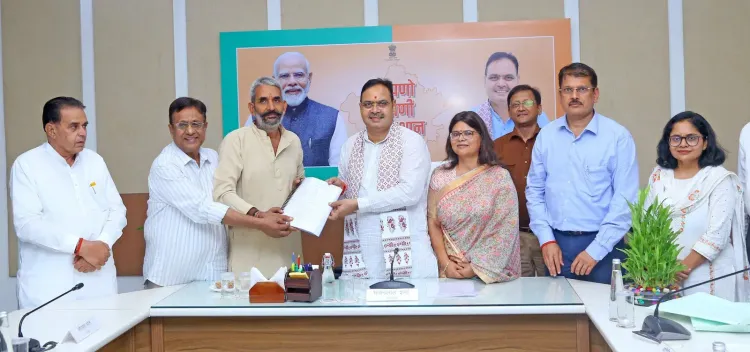
Rajasthan's UCC Draft Committee formally submitted its prepared Uniform Civil Code draft to Chief Minister Bhajanlal Sharma on 9 August 2026, with Law Minister Jogaram Patel and key committee members present. The state now awaits legislative introduction of the bill.
Key Takeaways
The UCC Draft Committee submitted Rajasthan's Uniform Civil Code draft to CM Bhajanlal Sharma on 9 August 2026 .
Law Minister Jogaram Patel and committee members Basant Singh Chhaba , Ramswroop Aggarwal , and Dr.
Shuchi Chauhan were present at the handover.
Minister of State for Home Jawahar Singh Bedham participated via video conferencing.
Uttarakhand became India's first state to enact a UCC law in 2024 ; Rajasthan's draft advances a broader BJP-led state-level push.
A UCC would create uniform personal laws on marriage, divorce, inheritance, and adoption for all citizens regardless of religion.
The next key step is introduction of a UCC bill in the Rajasthan Legislative Assembly .
Rajasthan moved a significant step closer to a Uniform Civil Code on Sunday, 9 August 2026, as the UCC Draft Committee handed its prepared draft to Chief Minister Bhajanlal Sharma — a moment that places the state squarely in the vanguard of a national legislative push that began when Uttarakhand became India's first state to enact such a law in 2024.
The handover took place at the Chief Minister's Office in Jaipur, with Law and Legal Affairs Minister Jogaram Patel present alongside committee members Basant Singh Chhaba, Ramswroop Aggarwal, and Dr. Shuchi Chauhan, as well as the Additional Chief Secretary. Minister of State for Home Jawahar Singh Bedham joined the proceedings via video conferencing.
What the UCC Would Change for Rajasthan's Citizens
A Uniform Civil Code replaces the patchwork of religion-specific personal laws — governing marriage, divorce, inheritance, and adoption — with a single framework applicable to every citizen regardless of faith. Article 44 of the Indian Constitution has long enshrined this as a Directive Principle of State Policy, making it a constitutional aspiration that has waited decades for state-level action.
For Rajasthan, a state of roughly 80 million people with diverse religious communities, the implications are wide-ranging. Women's rights advocates have historically argued that a uniform code could close gaps in inheritance and divorce protections that vary sharply across personal law systems. Religious community leaders, meanwhile, have raised concerns about cultural autonomy — a debate certain to intensify as the draft enters public and legislative scrutiny.
Rajasthan Joins a BJP-Led State-Level Wave
Uttarakhand's 2024 UCC legislation cracked open the door; several other BJP-governed states have since initiated their own drafting exercises. Rajasthan, under CM Bhajanlal Sharma — who took office in December 2023 — is now among the furthest along, with a committee-vetted draft formally in the Chief Minister's hands. The BJP has championed a UCC as a core ideological commitment for decades, and state-level action accelerates pressure on the national legislative calendar.
The next critical milestone is the introduction of a bill in the Rajasthan Legislative Assembly. How the government navigates consultations with religious bodies, legal experts, and civil society before tabling the legislation will define both the bill's content and its political reception.
A draft delivered is not a law enacted — but in the long arc of India's UCC debate, 9 August 2026 in Jaipur will be a date worth remembering.
Point of View
Each additional state that advances a draft tightens the political argument for central legislation. How Rajasthan's government manages the consultation process before tabling the bill will test whether the UCC can be framed as a rights-expansion measure rather than a majoritarian one — a framing that will determine both its legal durability and its electoral returns.
NationPress
23 Sept 2026
Frequently Asked Questions
What is the Uniform Civil Code and why does it matter in India?
The Uniform Civil Code (UCC) is a proposed set of common personal laws covering marriage, divorce, inheritance, and adoption for all Indian citizens regardless of religion, replacing the current system of separate religion-specific laws. Article 44 of the Indian Constitution lists it as a Directive Principle of State Policy.
Which state first enacted a UCC law in India?
Uttarakhand became the first Indian state to enact a Uniform Civil Code law, passing the legislation in 2024.
Who submitted the UCC draft to Rajasthan CM Bhajanlal Sharma?
Members of the Rajasthan UCC Draft Committee — including Basant Singh Chhaba, Ramswroop Aggarwal, and Dr. Shuchi Chauhan — submitted the draft to CM Bhajanlal Sharma on 9 August 2026. Law Minister Jogaram Patel was also present.
What happens next after the UCC draft is submitted in Rajasthan?
The government is expected to review the draft and introduce a UCC bill in the Rajasthan Legislative Assembly. Consultations with religious communities, legal experts, and civil society are likely before the bill is tabled.
Is Rajasthan the only BJP state working on a UCC?
No. Following Uttarakhand's 2024 UCC law, several other BJP-governed states have initiated their own drafting exercises, consistent with the party's long-standing policy position on replacing religion-specific personal laws with a common code.