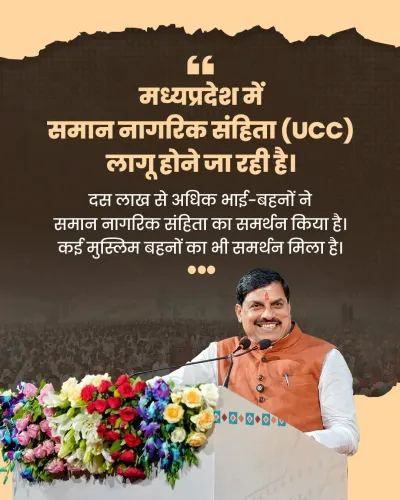
CM Bhajan Lal clears Rajasthan UCC Bill draft in cabinet

Synopsis
Rajasthan Chief Minister Bhajan Lal Sharma announced on 13 August 2026 that the state cabinet approved the draft Rajasthan UCC Bill 2026, proposing uniform personal laws on marriage, divorce, inheritance and succession for all communities — a major BJP policy milestone.
Key Takeaways
Rajasthan cabinet approved the draft of 'The Rajasthan Uniform Civil Code (Samaan Nagrik Sanhita) Bill, 2026' on 13 August 2026 .
The bill proposes uniform laws on marriage, divorce, inheritance, and succession for all religions and communities in the state.
Chief Minister Bhajan Lal Sharma described the move as an 'historic step' promoting equality and fairness.
Article 44 of the Constitution of India provides the constitutional basis, directing the state to secure a Uniform Civil Code.
The bill must next be introduced and passed in the Rajasthan Legislative Assembly before it becomes law.
Legal challenges in higher courts are widely anticipated if the bill clears the Assembly.
Rajasthan is poised to join a select group of Indian states moving toward a single, religion-neutral legal framework for personal life — as Chief Minister Bhajan Lal Sharma announced on Thursday, 13 August 2026 that his cabinet has approved the draft of 'The Rajasthan Uniform Civil Code (Samaan Nagrik Sanhita) Bill, 2026'. The move marks one of the most consequential governance decisions from Jaipur since the BJP government took office in December 2023.
Posting on X, Chief Minister Sharma wrote that the bill, cleared in today's cabinet meeting, will make laws related to 'vivah, talaq, virasat aur uttaradhikar' (marriage, divorce, inheritance, and succession) 'uniform, transparent, and orderly' for all religions and communities across the state. He called it an 'historic step' that will promote 'equality and fairness.'
What the Rajasthan UCC Bill proposes to change
At its core, the bill targets the patchwork of religion-specific personal laws that currently govern how citizens marry, separate, and inherit property. Under the existing framework, a Hindu, a Muslim, a Christian, and a Parsi in Rajasthan each operate under distinct legal codes for these intimate life events — producing outcomes that critics have long argued are unequal, particularly for women.
The proposed legislation would replace this mosaic with a single, state-wide standard. Article 44 of the Constitution of India, a Directive Principle of State Policy since 1950, explicitly directs the state to 'endeavour to secure' a Uniform Civil Code for all citizens — giving the bill a constitutional anchor that the government is likely to lean on heavily during legislative debate.
BJP's long-running platform meets state-level action
The Bharatiya Janata Party has carried the Uniform Civil Code as a flagship commitment in successive national election manifestos. With this cabinet approval, Rajasthan moves from promise to legislative process — a signal moment for a party that has governed the state for barely two years under Sharma's leadership.
The pattern is not without precedent at the state level. BJP-led governments have explored similar measures elsewhere, testing the legal and political ground ahead of any potential national legislation. Each state-level attempt also generates its own judicial scrutiny, since personal law intersects with both fundamental rights and religious freedoms protected under the Constitution.
The road into the Rajasthan Assembly — and the courts
Cabinet approval of a draft is the first gate, not the last. The bill must now be introduced, debated, and passed in the Rajasthan Legislative Assembly before it can become law. That floor debate will be the real test — of political arithmetic, of community responses, and of the government's ability to address concerns from religious minorities and civil society groups who have historically viewed UCC proposals with deep caution.
Legal challenges are a near-certainty if the bill passes. Courts will be asked to weigh the state's authority over personal law — a domain the Constitution places on the Concurrent List — and to examine whether a state-level UCC is constitutionally valid without a parallel central framework. Those questions could travel all the way to the Supreme Court.
What is clear today is that Rajasthan has moved the needle: a draft exists, a cabinet has endorsed it, and a legislative clock has started ticking.
Point of View
The government insulates itself from the charge of acting without constitutional warrant, but the harder battle lies ahead in the Assembly and almost inevitably in the courts. The bill also serves a dual function: it advances a substantive governance goal while reinforcing the party's ideological identity heading into future electoral cycles. How minority communities, opposition parties, and the judiciary respond will determine whether Rajasthan becomes a template or a cautionary tale for a national UCC.
NationPress
27 Sept 2026
Frequently Asked Questions
What is the Rajasthan Uniform Civil Code Bill 2026?
It is a draft legislation approved by the Rajasthan cabinet on 13 August 2026 that proposes a single, uniform legal framework for marriage, divorce, inheritance, and succession applicable to all citizens of Rajasthan regardless of their religion or community.
Who approved the Rajasthan UCC Bill?
Chief Minister Bhajan Lal Sharma's state cabinet approved the draft bill on 13 August 2026. The bill must still be passed by the Rajasthan Legislative Assembly to become law.
What is the constitutional basis for a Uniform Civil Code in India?
Article 44 of the Constitution of India, a Directive Principle of State Policy, directs the state to endeavour to secure a Uniform Civil Code for all citizens — providing the legal foundation cited by proponents of UCC legislation.
Which other states have implemented a Uniform Civil Code?
Uttarakhand became the first state to enact a UCC law in 2024. Rajasthan's cabinet approval of a draft bill in August 2026 signals a similar intent, though the bill must clear the state Assembly before taking effect.
What happens next after the Rajasthan cabinet approved the UCC draft?
The draft bill will be introduced in the Rajasthan Legislative Assembly for debate and voting. If passed, it is likely to face legal challenges in higher courts, potentially reaching the Supreme Court, over questions of state authority over personal law.