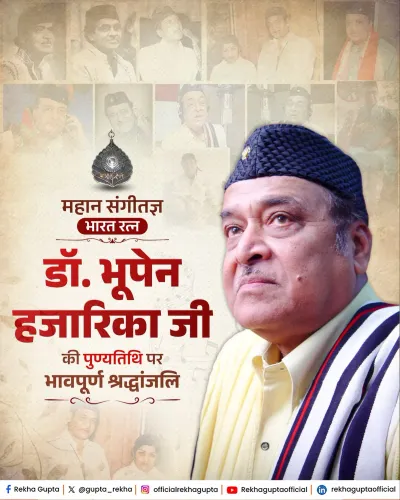
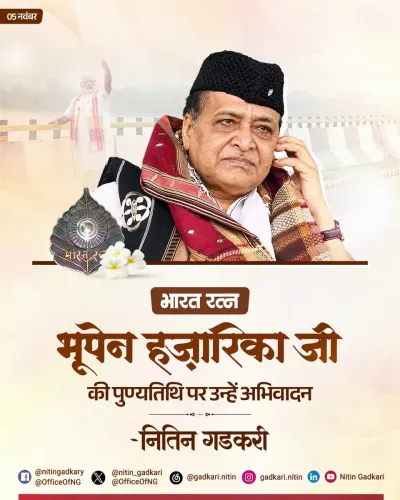
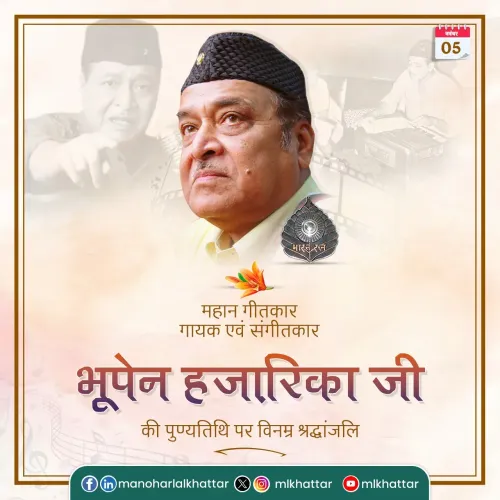
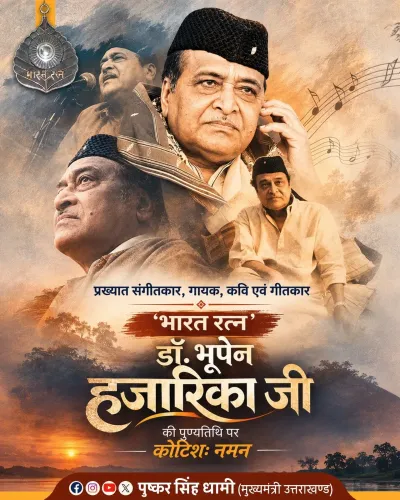
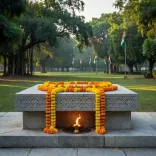
Nadda pays tribute to Bharat Ratna Dr. Bhupen Hazarika on Punyatithi
Synopsis
Union Health Minister J. P. Nadda marked the Punyatithi of Bharat Ratna Dr. Bhupen Hazarika on November 5, 2026, paying tribute to the Assamese singer-songwriter whose music bridged cultural celebration and social transformation for millions across India.
Key Takeaways
Union Health Minister J.
Nadda offered tributes to Dr.
Bhupen Hazarika on his death anniversary, November 5 .
Hazarika was an Assamese singer-songwriter who used music to highlight social issues and celebrate India's cultural heritage.
He was conferred the Bharat Ratna — India's highest civilian honour — in 2019 .
His compositions spanned Assamese, Hindi, and Bengali, giving him a nationwide and cross-cultural reach.
Indian leaders across the spectrum mark his Punyatithi annually, reflecting his status as a figure of national cultural significance.
On the death anniversary of one of India's most celebrated cultural icons, Union Health Minister J. P. Nadda offered heartfelt tributes to Bharat Ratna Dr. Bhupen Hazarika on Thursday, November 5, 2026, honouring a legacy that fused soulful music with a lifelong mission for social justice and human dignity.
Nadda wrote: 'Through his soulful music, he beautifully celebrated India's rich cultural heritage while demonstrating the power of art to raise awareness and drive meaningful social transformation. His timeless compositions continue to resonate with millions, spreading messages of hope, compassion and humanity.'
A voice that made the Brahmaputra sing for all of India
Dr. Bhupen Hazarika was born in Sadiya, Assam, and grew up to become the defining artistic voice of the Brahmaputra valley — and far beyond. His compositions drew from Assamese folk tradition while addressing themes of oppression, displacement, and brotherhood, earning him an audience that stretched across linguistic and regional lines. He wrote, composed, and sang in Assamese, Hindi, and Bengali, ensuring his message was never confined to a single geography.
His most iconic works carried an unmistakable moral weight — songs that did not merely entertain but agitated, consoled, and united. That rare convergence of aesthetic beauty and social conscience is precisely why successive generations have returned to his music as a kind of compass.
Bharat Ratna conferred in 2019
India's highest civilian honour, the Bharat Ratna, was conferred upon Dr. Hazarika in 2019, posthumously recognising a contribution that had already shaped the country's cultural identity for decades. He had passed away on November 5, 2011, making each anniversary both a moment of mourning and a national reckoning with what his art continues to mean.
Indian leaders across the political spectrum mark his Punyatithi each year — a ritual that speaks to how thoroughly Hazarika transcended partisan lines to become, simply, a figure of the nation.
Art of that reach does not fade — it compounds. Dr. Bhupen Hazarika's songs are not museum pieces; they are still played, still taught, and still wept over — which is the only immortality that actually counts.Point of View
Figures like Bhupen Hazarika — whose roots lie in the Northeast — also carry a strategic resonance, affirming the party's engagement with Assam's cultural identity ahead of any electoral cycle. Nadda's tribute fits a consistent pattern of using art and culture as soft-power instruments of national cohesion. The enduring popularity of Hazarika's music, however, ensures that such tributes rarely feel hollow — the icon's credibility outlasts any political moment.
NationPress
5 Nov 2026
Frequently Asked Questions
Who was Dr. Bhupen Hazarika?
Dr. Bhupen Hazarika was a celebrated Assamese singer-songwriter, composer, and filmmaker whose music addressed themes of social justice, cultural unity, and human compassion. He composed and sang in Assamese, Hindi, and Bengali and is widely regarded as one of India's most influential cultural figures.
When did Bhupen Hazarika pass away?
Dr. Bhupen Hazarika passed away on November 5, 2011 . His death anniversary is observed as his Punyatithi.
When was Bhupen Hazarika awarded the Bharat Ratna?
Dr. Bhupen Hazarika was awarded the Bharat Ratna — India's highest civilian honour — in 2019 , posthumously recognising his extraordinary contribution to Indian art and culture.
What did J. P. Nadda say about Bhupen Hazarika?
Union Health Minister J. P. Nadda said that through his soulful music, Dr. Hazarika celebrated India's rich cultural heritage and demonstrated the power of art to raise awareness and drive meaningful social transformation, with his timeless compositions continuing to spread messages of hope, compassion, and humanity.
Why is Bhupen Hazarika significant for Assam and India?
Bhupen Hazarika is significant because he gave Assamese folk and cultural traditions a national and international platform while using his music as a vehicle for social commentary — making him both a regional icon and a figure of pan-Indian cultural pride.