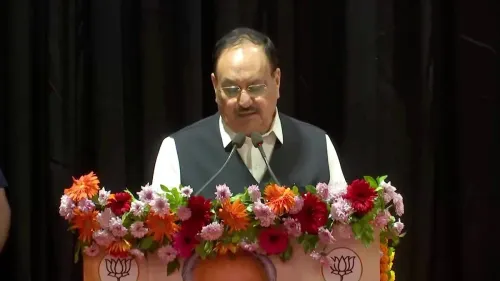
Nadda pays tribute to Jana Sangh veteran Kedarnath Sahni
Synopsis
Union Health Minister J. P. Nadda paid tribute to veteran Jana Sangh and BJP leader Kedarnath Sahni, honouring his role as Delhi president, national general secretary, governor of Sikkim and Goa, and his humanitarian work for 1984 riot survivors and Kashmiri displaced persons.
Key Takeaways
Union Health Minister J.
Nadda posted a tribute to veteran Kedarnath Sahni on 24 October 2026 .
Sahni served as Delhi president and national general secretary of the Bharatiya Jana Sangh , and later as Governor of Sikkim and Governor of Goa .
He played a significant role during the Emergency (1975–77) , when civil liberties were suspended across India.
Sahni contributed to the relief and rehabilitation of survivors of the 1984 anti-Sikh riots .
He also worked for the assistance of Kashmiri displaced persons , earning recognition for his humanitarian commitment.
Nadda's tribute emphasises that Sahni remained anchored in ideology and service rather than the positions he held.
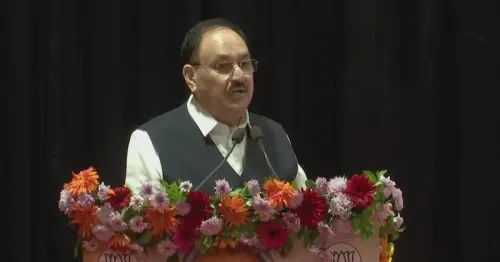
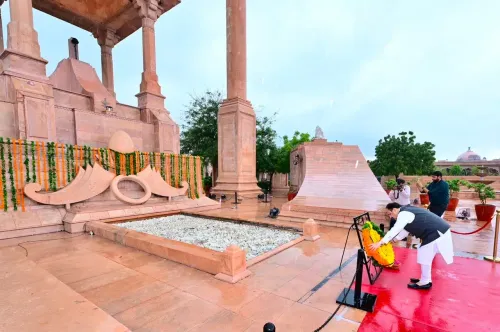
A life measured not by the offices held but by the service rendered — that is how Union Health Minister J. P. Nadda chose to remember veteran Jana Sangh leader Kedarnath Sahni in a tribute posted on X on Saturday, 24 October 2026. From the frontlines of political organisation to the quiet dignity of humanitarian relief, Nadda's homage traces a career defined by ideology over ambition.
Nadda wrote that Sahni 'laid a strong foundation of good governance and public service in Jana Sangh,' rising from Delhi president to national general secretary of the party. His role during the Emergency (1975–77) — a period in which civil liberties were suspended and opposition leaders faced detention — is cited as a defining chapter of his political life.
Governor of two states, but anchored in ideology
Sahni went on to serve as Governor of Sikkim and later Governor of Goa, constitutional roles that place a politician at arm's length from party activity. Nadda's tribute pointedly notes that despite these high offices, Sahni 'remained connected not to position, but to ideology and service.' For a party that traces its lineage to the Bharatiya Jana Sangh — founded in 1951 as a nationalist organisation — such continuity of conviction carries symbolic weight.
Relief for 1984 riot survivors and Kashmiri displaced persons
The most striking passages of Nadda's tribute concern Sahni's humanitarian work. His contribution to 'the assistance and rehabilitation of victims of the 1984 anti-Sikh riots' and 'Kashmiri displaced persons' is described as a symbol of his sensitivity and humanity. The 1984 violence, which erupted after the assassination of Prime Minister Indira Gandhi, left thousands dead and communities shattered across north India. Sahni's reported relief efforts placed him among those who responded outside formal government structures. His work for Kashmiri displaced persons adds another layer — communities uprooted by militancy in the Kashmir Valley through the late 1980s and 1990s.
Together, these two references — riots and displacement, two of independent India's most scarring episodes — form the emotional core of Nadda's tribute. They present Sahni not as a party functionary, but as a man who walked towards human suffering rather than away from it.
Point of View
In 1984, and for Kashmiri displaced persons aligns with recurring party narratives around governance failures and humanitarian response in those episodes. By highlighting that Sahni remained committed to ideology rather than office, the tribute implicitly draws a contrast with political culture that prioritises position over principle — a framing that serves both commemoration and contemporary messaging. For the BJP, keeping such figures in public memory reinforces the depth of the party's social-service roots beyond electoral politics.
NationPress
24 Oct 2026
Frequently Asked Questions
Who was Kedarnath Sahni?
Kedarnath Sahni was a veteran leader of the Bharatiya Jana Sangh who served as Delhi president, national general secretary, and later as Governor of Sikkim and Governor of Goa. He is remembered for his role during the Emergency and humanitarian work for 1984 riot victims.
What is the Bharatiya Jana Sangh?
The Bharatiya Jana Sangh was a nationalist political party founded in 1951. It formed the ideological core of what later became the Bharatiya Janata Party (BJP).
Why did JP Nadda post a tribute to Kedarnath Sahni?
Nadda posted the tribute to honour Sahni's contributions to Jana Sangh, his role during the Emergency, and his humanitarian work for survivors of the 1984 anti-Sikh riots and Kashmiri displaced persons.
What was Kedarnath Sahni's role in the 1984 anti-Sikh riots?
According to Nadda's tribute, Sahni contributed to the assistance and rehabilitation of victims of the 1984 anti-Sikh riots that followed the assassination of Prime Minister Indira Gandhi.
Which states did Kedarnath Sahni govern?
Kedarnath Sahni served as Governor of Sikkim and Governor of Goa.