Nadda marks BJP's Jana Sangh roots, credits Modi for growth
Synopsis
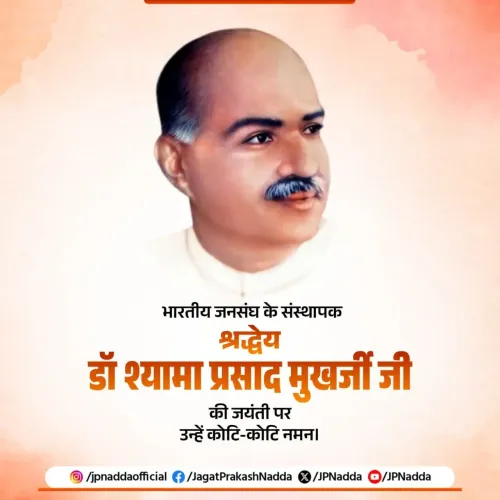
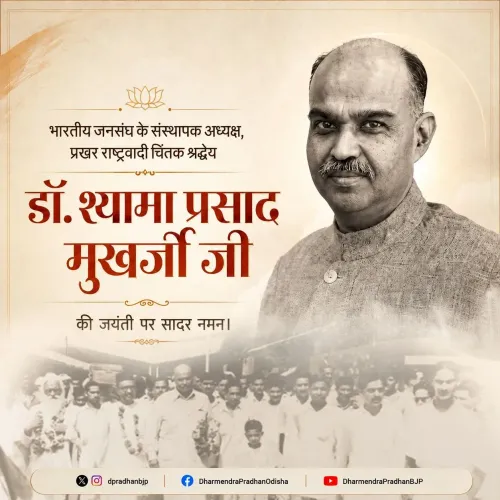
BJP national president J. P. Nadda on 6 July 2026 honoured Dr. Shyama Prasad Mukherjee, founder of the Bharatiya Jana Sangh on 21 October 1951, and credited Prime Minister Narendra Modi with growing the ideological successor party into what the BJP describes as the world's largest political organisation.
Key Takeaways
Nadda , BJP national president and Union Health Minister, posted a tribute to Dr.
Shyama Prasad Mukherjee on 6 July 2026 .
Mukherjee founded the Bharatiya Jana Sangh on 21 October 1951 in Delhi.
The Jana Sangh is the direct ideological predecessor of the Bharatiya Janata Party , constituted in 1980 .
Nadda credited Prime Minister Narendra Modi's leadership with transforming the party into what the BJP calls the world's largest political organisation.
The post included a video and was written in Hindi, reflecting the party's internal communication style with its grassroots membership.
Union Health Minister and BJP national president J. P. Nadda on Monday, 6 July 2026, paid tribute to Dr. Shyama Prasad Mukherjee, crediting the founding leader's ideological legacy for the party's rise to what he called the world's largest political organisation under Prime Minister Narendra Modi.
Context
In his post on X, Nadda wrote in Hindi: 'हम जिस पार्टी के सदस्य हैं, उसके डॉ. श्यामा प्रसाद मुखर्जी जी संस्थापक सदस्य रहे' — ('Dr. Shyama Prasad Mukherjee was a founding member of the party we belong to'). He noted that on 21 October 1951, Mukherjee had established the Bharatiya Jana Sangh, describing the event as the planting of an ideological seed. Nadda expressed satisfaction that the party nurtured from those roots had, under the leadership of Prime Minister Narendra Modi, emerged as the largest party in the world.
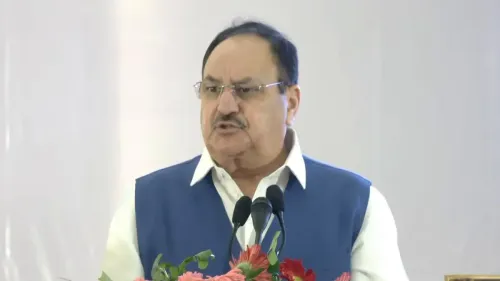
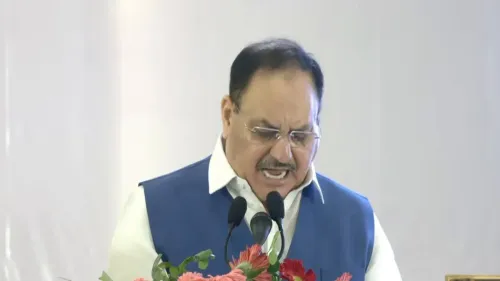
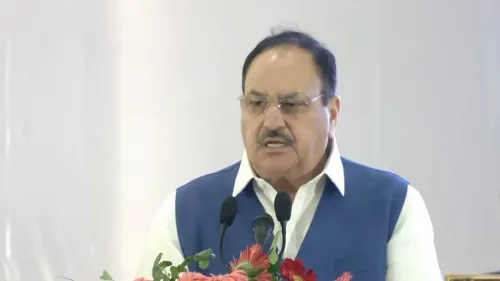
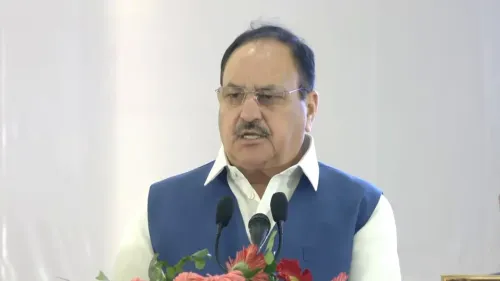
The post carries a video attachment, suggesting the tribute was part of a broader commemorative communication from the party's national president.
Policy Backdrop
Dr. Shyama Prasad Mukherjee formally launched the Bharatiya Jana Sangh at a convention in Delhi on 21 October 1951, positioning it as an electoral platform aligned with the ideological tradition of the Rashtriya Swayamsevak Sangh. Before founding the Jana Sangh, Mukherjee had served as India's first Minister of Industries in the Union Cabinet before resigning over policy differences.
The Jana Sangh merged into the Janata Party in 1977, and in 1980 the Bharatiya Janata Party was constituted as the reconstituted political platform carrying forward the Jana Sangh's core ideology. The BJP has since positioned itself as the direct organisational and ideological successor to Mukherjee's 1951 founding moment.
Stakeholders and Impact
Tributes of this nature are directed primarily at BJP members and party workers, reinforcing a narrative of unbroken ideological continuity from 1951 to the present. The messaging links the grassroots organisational identity of millions of enrolled members to the foundational figures of the pre-1980 Jana Sangh era.
Such commemorations also serve an internal mobilisation function: the BJP regularly invokes its organisational lineage alongside membership drives and state-level reviews, using the founding story to frame current electoral and governance achievements as the fulfilment of a decades-long ideological mission.
What's Next
Statements and events tied to Dr. Mukherjee's legacy typically intensify around 21 October each year, the Jana Sangh's founding anniversary, as well as during national executive meetings and election campaign cycles. Nadda's post signals that the party intends to keep the founding narrative prominent in its public communication through 2026. Further commemorative events or organisational announcements referencing the 1951 founding are likely in the months ahead, particularly as the BJP continues to assert its status as a mass-membership organisation.
Point of View
The BJP's national president anchors the party's current mass-membership claim in a 75-year ideological arc, lending historical legitimacy to contemporary electoral dominance. The framing — a seed planted by Mukherjee, a tree grown by Modi — is a recurring BJP narrative device that simultaneously honours the past and consolidates the present leadership's stature. Such posts also serve an internal audience, reinforcing loyalty among party workers who identify with the Jana Sangh tradition. Over time, this kind of messaging builds a durable founding myth that the party deploys during both elections and organisational drives.
NationPress
5 Oct 2026
Frequently Asked Questions
Who founded the Bharatiya Jana Sangh?
Dr. Shyama Prasad Mukherjee founded the Bharatiya Jana Sangh on 21 October 1951 at a convention in Delhi , establishing it as an electoral platform aligned with the RSS ideological tradition.
What is the connection between Jana Sangh and BJP?
The Bharatiya Jana Sangh merged into the Janata Party in 1977 ; in 1980 , former Jana Sangh members reconstituted as the Bharatiya Janata Party , which the BJP regards as its direct organisational and ideological successor.
Why did J. P. Nadda post about Shyama Prasad Mukherjee?
As BJP national president , Nadda regularly commemorates the party's founding figures to reinforce ideological continuity; his 6 July 2026 post credited Mukherjee's legacy and PM Modi's leadership for the party's growth.
Was Dr. Shyama Prasad Mukherjee part of the Union Cabinet?
Yes. Dr. Mukherjee served as India's first Minister of Industries before resigning from the cabinet over policy differences, after which he founded the Jana Sangh in 1951 .
What does BJP claim about its membership size?
The BJP has claimed to be the world's largest political party by membership; Nadda's post reiterates this claim, attributing the growth to Prime Minister Narendra Modi's leadership, though independent verification of precise figures is not available.