Nagpur Airport Officially Handed Over to GMR Group
Synopsis
The Chief Minister's Office of Maharashtra announced on 26 June 2026 that Dr. Babasaheb Ambedkar International Airport in Nagpur has been officially transferred to GMR Group under a public-private partnership, continuing India's policy of shifting major airports from AAI management to private operators.
Key Takeaways
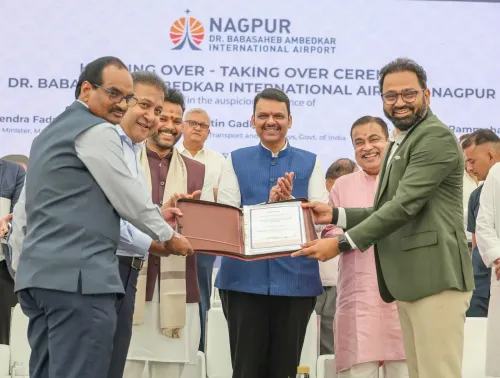
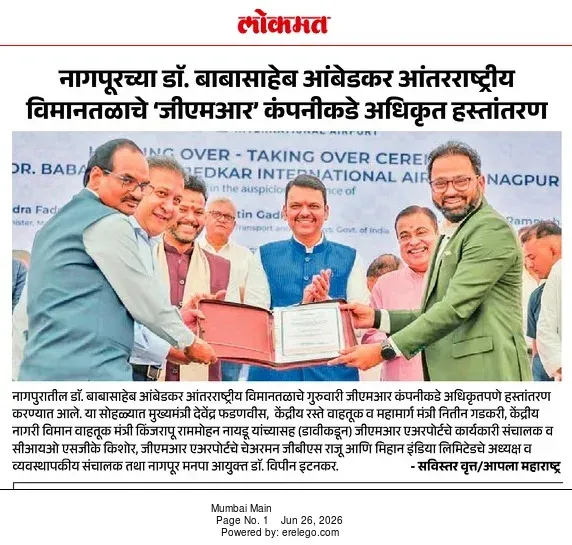
Babasaheb Ambedkar International Airport, Nagpur has been officially handed over to GMR Group , as confirmed by the Chief Minister's Office of Maharashtra on 26 June 2026 .
The airport was previously managed by the Airports Authority of India (AAI) before the transfer to private hands.
The Maharashtra government had announced plans for a PPP-based transfer as far back as 2019 .
GMR Group already operates Delhi and Hyderabad international airports, bringing established expertise to Nagpur.
The handover is part of India's broader national policy of privatising major airports to attract investment and improve efficiency.
Key watchpoints include GMR's capital expenditure plans, new route additions, and terminal expansion timelines at Nagpur.
The Chief Minister's Office of Maharashtra announced on Friday, 26 June 2026 that Dr. Babasaheb Ambedkar International Airport, Nagpur has been officially transferred to GMR Group, marking a landmark shift in the airport's management from the public to the private sector under a public-private partnership model.
Context
The CMO's post, tagging Chief Minister Devendra Fadnavis, confirmed the formal handover using the Marathi phrase 'अधिकृत हस्तांतरण' ('official transfer'). The airport, named after Dr. B. R. Ambedkar, serves as the primary aviation gateway for central India and had been under the operational control of the Airports Authority of India (AAI) prior to this transfer.
The development represents the culmination of a process that began in 2019, when the Maharashtra government announced its intent to bring a private operator on board to accelerate modernisation of the Nagpur facility through a PPP framework.
Policy Backdrop
India has steadily moved major airports from AAI management to private concessionaries through competitive bidding, a trend visible at Delhi's Indira Gandhi International Airport and Hyderabad's Rajiv Gandhi International Airport — both of which GMR already operates. The Nagpur handover is a continuation of that national policy direction.
GMR Group is one of India's largest infrastructure conglomerates with deep experience in airport development, terminal expansion, and commercial aerotropolis projects. Its entry into Nagpur is expected to bring institutional capital and operational expertise to a facility that serves a rapidly growing passenger and cargo base in the Vidarbha region.
Stakeholders and Impact
Air travellers across central India, particularly those in Nagpur, Wardha, and the broader Vidarbha belt, stand to be the most immediate beneficiaries if the transfer leads to expanded routes, upgraded terminals, and improved passenger amenities. The Nagpur business community, which has long advocated for better air connectivity to support trade and logistics, has a direct stake in how GMR shapes the airport's growth trajectory.
Aviation sector investors and cargo operators will also watch closely, given Nagpur's geographic centrality and its Multi-Modal International Cargo Hub and Airport at Nagpur (MIHAN) project, which has positioned the city as a potential logistics hub for the subcontinent.
What's Next
Attention will now turn to GMR's capital expenditure commitments, the concession period agreed with the government, and the timeline for terminal expansion and new route additions. The group's track record at Delhi and Hyderabad airports will serve as a benchmark against which its Nagpur performance is likely to be measured.
Chief Minister Devendra Fadnavis, who has championed infrastructure upgrades as a pillar of Maharashtra's economic agenda, is expected to use this handover as a signal of the state's openness to private investment in public assets. The coming months will reveal whether GMR's entry translates into the accelerated development that both the government and the travelling public are anticipating.
Point of View
An area historically seen as economically lagging behind the Konkan coast. For GMR, Nagpur is a strategic node given its central location and the MIHAN project's cargo potential, making this concession commercially significant beyond just passenger numbers. The handover also reinforces the Centre's airport privatisation template, which has faced scrutiny over revenue-sharing terms but has broadly delivered capacity upgrades at Delhi and Hyderabad. Whether Nagpur follows that trajectory will be a test case for the next wave of Tier-2 airport privatisations across India.
NationPress
26 Jun 2026
Frequently Asked Questions
Which company has taken over Nagpur airport?
GMR Group has officially taken over the management of Dr. Babasaheb Ambedkar International Airport in Nagpur, as announced by the Chief Minister's Office of Maharashtra on 26 June 2026.
What is the full name of Nagpur airport?
The full name is Dr. Babasaheb Ambedkar International Airport, Nagpur, named after the architect of the Indian Constitution, Dr. B. R. Ambedkar.
Why was Nagpur airport transferred to a private company?
The transfer follows India's national policy of moving major airports from Airports Authority of India management to private operators under public-private partnerships to attract investment, modernise infrastructure, and improve passenger services.
Which other airports does GMR Group operate in India?
GMR Group operates Delhi's Indira Gandhi International Airport and Hyderabad's Rajiv Gandhi International Airport, making Nagpur its third major Indian airport concession.
What does the Nagpur airport handover mean for passengers?
Passengers can expect infrastructure upgrades, potential new route additions, and improved terminal facilities over time, though the specific timeline and capital expenditure commitments from GMR are yet to be publicly detailed.