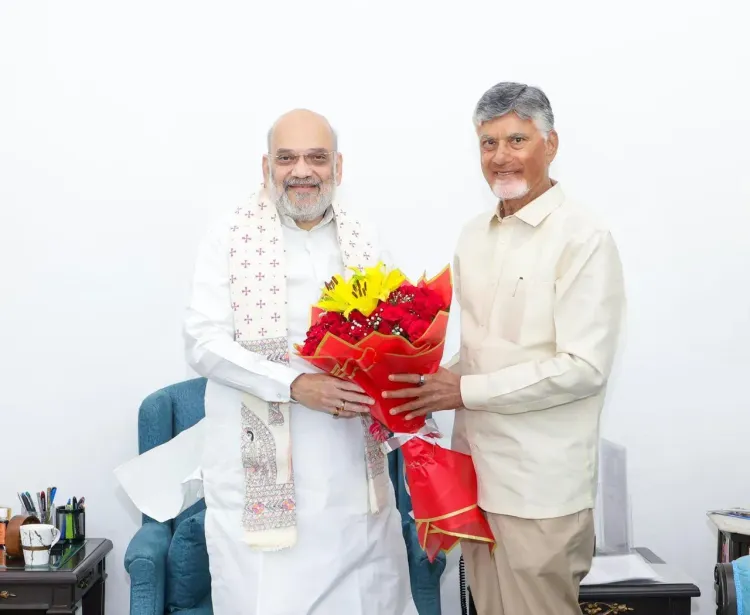
CM Naidu Meets Amit Shah, Flags AP Drought and River-Link Plan
Synopsis
Andhra Pradesh CM Chandrababu Naidu met Home Minister Amit Shah on 8 October 2026 to seek Central relief for El Niño-driven drought and push the ambitious Godavari–Krishna–Penna–Palar–Cauvery river-linking project covering four southern states.
Key Takeaways
Chandrababu Naidu called on Union Home Minister Amit Shah on 8 October 2026 in New Delhi.
Naidu sought Central government support for Andhra Pradesh's drought crisis caused by El Niño -driven deficient rainfall.
The meeting focused on the distress in Andhra Pradesh's agricultural sector due to below-normal monsoon.
Naidu tabled the proposal to advance the Godavari–Krishna–Penna–Palar–Cauvery river-linking project .
The river-linking chain is designed to serve water needs across Andhra Pradesh, Telangana, Tamil Nadu and Karnataka .
TDP's position as an NDA ally gives Naidu direct political access to fast-track Central approvals.
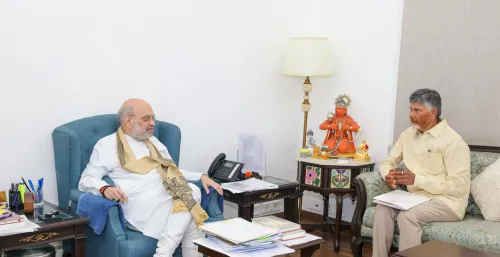
A drought-stricken Andhra Pradesh carried its case to the highest level on Thursday, 8 October 2026, when Andhra Pradesh Chief Minister N. Chandrababu Naidu called on Union Home Minister Amit Shah in New Delhi, seeking Central government support for farmers reeling under deficient rainfall triggered by the El Niño weather phenomenon — and used the moment to revive one of southern India's most ambitious water-management proposals.
El Niño's shadow over AP's farmland
Naidu apprised Shah of the 'drought situation prevailing in Andhra Pradesh due to the impact of El Niño,' according to his post on X, specifically highlighting the blow to the agricultural sector from deficient rainfall. El Niño — the periodic warming of Pacific Ocean surface temperatures — has historically disrupted the Indian monsoon, suppressing rainfall across peninsular India and leaving rain-fed farming communities exposed. The Chief Minister's direct appeal to the Home Minister signals that the state views the crisis as severe enough to warrant emergency Central intervention.
The relief ask comes at a sensitive juncture: Andhra Pradesh's economy leans heavily on agriculture, and a compressed kharif season compounds pressure on rural incomes, groundwater tables, and state finances already stretched by post-bifurcation commitments. Getting the Government of India to formally acknowledge the drought and release funds or relief packages is the immediate political and administrative prize Naidu was pursuing in the meeting.
The grand water vision: Godavari to Cauvery
Beyond immediate drought relief, the meeting opened a far larger conversation. Naidu placed before Shah the proposal to advance the Godavari–Krishna–Penna–Palar–Cauvery river-linking project — a multi-state interlinking chain that, if realised, would knit together the water economies of Andhra Pradesh, Telangana, Tamil Nadu and Karnataka. The project's logic is straightforward: move surplus monsoon flows from the Godavari basin southward through a cascade of links to water-deficit river systems, including the Penna, Palar and ultimately the Cauvery.
River interlinking at this scale is an old Indian ambition — the National River Linking Project has been on the drawing board in various forms for decades — but execution has repeatedly stalled on inter-state disputes over sharing ratios, environmental clearances, and financing. A four-state corridor touching Andhra Pradesh, Telangana, Tamil Nadu and Karnataka represents precisely the kind of politically complex, multi-jurisdiction engineering that requires Central arbitration and funding muscle. Naidu's choice to table it alongside drought relief is deliberate: a crisis creates urgency that routine planning cycles rarely do.
Why the Home Ministry, and why now
The meeting with the Home Minister — rather than, say, the Water Resources or Agriculture ministries — is itself a signal. Amit Shah is a key decision-maker whose political weight can fast-track inter-ministerial coordination, unlock Cabinet Committee approvals, and, critically, broker between state governments that compete fiercely over river waters. For a project that crosses four state boundaries, Home Ministry backing is often the prerequisite that unlocks everything else.
Naidu's Telugu Desam Party (TDP) is a constituent of the ruling National Democratic Alliance at the Centre, giving the Chief Minister direct access that many opposition-governed states lack. That political capital, deployed at a moment of genuine agrarian distress, makes this meeting more than a courtesy call — it is a structured play to convert alliance leverage into concrete relief and long-term infrastructure commitment for Andhra Pradesh.
Whether the Centre responds with a formal drought declaration, a financial package, or a project sanction, the ball is now firmly in New Delhi's court. Southern India's water future may hinge on what happens next.
Point of View
And attaching it to an immediate crisis is a classic statecraft move that makes it harder for New Delhi to defer. For the NDA coalition, delivering for a key ally in a water-stressed election geography is also sound political arithmetic. Watch whether the Centre responds with a formal drought declaration or a joint river-project task force — either would be a significant win for Naidu.
NationPress
8 Oct 2026
Frequently Asked Questions
Why did CM Chandrababu Naidu meet Amit Shah in October 2026?
Naidu met Home Minister Amit Shah on 8 October 2026 to seek Central government support for Andhra Pradesh's drought caused by El Niño and to push forward the Godavari–Krishna–Penna–Palar–Cauvery river-linking project.
How is El Niño affecting Andhra Pradesh's agriculture?
El Niño, which causes below-normal monsoon rainfall across peninsular India, has created deficient rainfall conditions in Andhra Pradesh, severely impacting the agricultural sector and rural livelihoods.
What is the Godavari–Krishna–Penna–Palar–Cauvery river-linking project?
It is a multi-state river interlinking proposal aimed at transferring surplus water from the Godavari basin southward through a chain of links to the Krishna, Penna, Palar and Cauvery rivers, addressing water deficits across Andhra Pradesh, Telangana, Tamil Nadu and Karnataka.
Which states will benefit from the southern river-linking project?
The project is designed to benefit four states — Andhra Pradesh, Telangana, Tamil Nadu and Karnataka — by improving water security across southern India.
What is TDP's relationship with the Central government in 2026?
The Telugu Desam Party (TDP), led by Naidu, is a constituent of the ruling National Democratic Alliance (NDA) at the Centre, giving Naidu direct political access to senior Union ministers including Amit Shah.