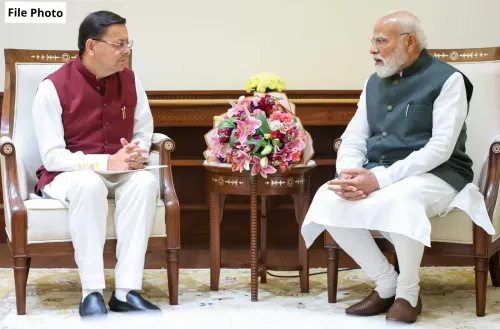
CM Dhami: Namo Bharat RRTS to extend to Rishikesh
Synopsis
Uttarakhand CM Pushkar Singh Dhami has announced key consensus on extending the Namo Bharat RRTS from Modipuram in Meerut to Laxman Jhula in Rishikesh. A survey of the roughly 150 km proposed route will begin soon to prepare the Detailed Project Report, promising faster connectivity for pilgrims, tourists, and residents.
Key Takeaways
Consensus has been reached to extend the Namo Bharat (RRTS) from Modipuram, Meerut to Laxman Jhula, Rishikesh .
The proposed corridor spans approximately 150 kilometres ; a survey will begin shortly to prepare the DPR.
The decision follows requests by CM Dhami to PM Modi and detailed discussions with Union Minister Manohar Lal Khattar .
The extension builds on the existing Delhi–Meerut RRTS , which began partial commercial operations in 2023 .
The project is expected to boost pilgrimage tourism, trade, and the broader economy of Uttarakhand .
Land acquisition, inter-state coordination, and central funding sanctions remain key steps before construction can begin.
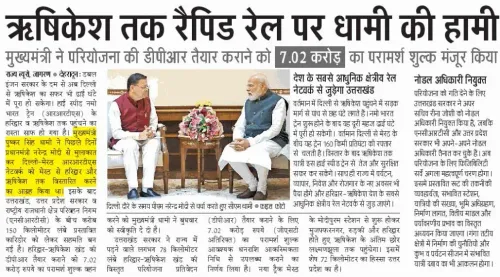
Uttarakhand Chief Minister Pushkar Singh Dhami announced on Wednesday, 17 June 2026 that a significant consensus has been reached to extend the Namo Bharat (RRTS) train service from Modipuram in Meerut to Laxman Jhula in Rishikesh, marking a major step toward connecting the hill state to India's high-speed regional rail network.
Context
In his post, CM Dhami described the development as 'atyanth sukhad samachar' (extremely welcome news) for Uttarakhand, crediting earlier requests made to Prime Minister Narendra Modi and detailed discussions with Union Minister of Housing and Urban Affairs Manohar Lal Khattar. He stated that a survey of the approximately 150-kilometre proposed route will begin shortly to prepare the Detailed Project Report (DPR). The announcement signals a formal shift from lobbying to pre-project groundwork.
Policy Backdrop
The Namo Bharat RRTS is a semi-high-speed regional rail system designed for speeds of up to 180 km/h, developed under the National Capital Region Transport Corporation (NCRTC). The Delhi–Meerut RRTS corridor was approved by the Union Cabinet in 2016, with construction commencing in 2019; partial commercial operations on that corridor began in 2023, establishing the operational and logistical template for further extensions. The proposed Modipuram–Rishikesh stretch would use the existing Modipuram depot in Meerut, Uttar Pradesh as its southern launchpad, extending the network northward into the Himalayan foothills.
The Modi government has consistently prioritised multi-modal rapid transit to decongest the National Capital Region (NCR) and improve last-mile connectivity to pilgrimage and tourism circuits. Integrating Uttarakhand into this network aligns with the broader policy of linking secondary cities and religious destinations via dedicated high-speed corridors.
Stakeholders and Impact
The corridor, if built, would directly benefit pilgrims and tourists heading to Rishikesh — one of India's foremost spiritual destinations — as well as residents of Uttarakhand seeking faster connectivity to the NCR. CM Dhami specifically noted that the project would provide fast, safe, and modern transport while giving fresh momentum to tourism, trade, and the local economy of the state. Land acquisition, inter-state coordination between Uttarakhand and Uttar Pradesh, and central funding sanctions will be critical milestones before construction can begin.
What's Next
The immediate next step is the commencement of the alignment survey covering the approximately 150 km route between Modipuram and Laxman Jhula, Rishikesh. Findings from this survey will feed into the DPR, which will determine technical feasibility, cost estimates, and environmental considerations. Subsequent state-central coordination meetings on land acquisition and funding allocation will determine how quickly the project moves from planning to execution. If the DPR clears scrutiny, the corridor could become a defining infrastructure legacy for Uttarakhand in the coming decade.
Point of View
Not merely a political statement. For the BJP government in Uttarakhand, connecting a Himalayan pilgrimage hub to the NCR's rapid transit spine carries both electoral and developmental weight ahead of future state polls. The move also reinforces the Centre's pattern of using the Meerut RRTS depot as a springboard for northward expansion, suggesting a deliberate corridor-by-corridor strategy rather than ad hoc project approvals. Whether the DPR survey translates into funded construction will be the true test of this consensus.
NationPress
18 Sept 2026
Frequently Asked Questions
What is the Namo Bharat RRTS extension announced for Uttarakhand?
The Namo Bharat (RRTS) extension proposed for Uttarakhand would connect Modipuram in Meerut, Uttar Pradesh, to Laxman Jhula in Rishikesh — a route of approximately 150 kilometres. CM Pushkar Singh Dhami announced on 17 June 2026 that a key consensus has been reached and a route survey will begin soon to prepare the Detailed Project Report.
What is the current status of the Namo Bharat RRTS Rishikesh project?
As of June 2026, the project is in its pre-planning stage. A consensus has been reached between the Uttarakhand government and central authorities, and a survey of the roughly 150 km alignment is expected to begin shortly. The DPR has not yet been prepared, and no construction timeline has been announced.
How fast is the Namo Bharat RRTS train?
The Namo Bharat RRTS is a semi-high-speed regional rail system designed to operate at speeds of up to 180 km/h. It is developed and operated by the National Capital Region Transport Corporation (NCRTC) and is distinct from conventional suburban rail or metro services.
Who approved the Namo Bharat RRTS extension to Rishikesh?
No formal cabinet approval has been announced yet. CM Dhami credited earlier requests to Prime Minister Narendra Modi and discussions with Union Minister Manohar Lal Khattar for building the consensus. A DPR survey is the next formal step before any funding or construction approval.
How will the Rishikesh RRTS corridor benefit Uttarakhand?
The corridor is expected to provide fast, safe, and modern transport connectivity for pilgrims, tourists, and residents of Uttarakhand, reducing travel time between the NCR and Rishikesh. CM Dhami has also cited expected benefits for tourism, trade, and the local economy of the state.