CM Dhami Secures Namo Bharat RRTS Extension to Rishikesh
Synopsis
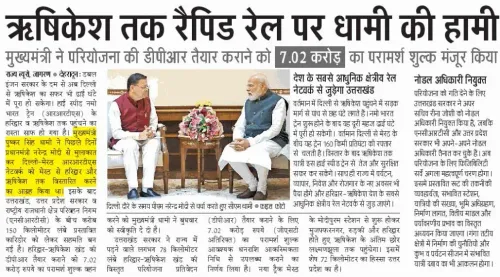
Uttarakhand, Uttar Pradesh, and NCRTC have formally agreed to extend the Namo Bharat RRTS network 150 km from Modipuram, Meerut to Lakshman Jhula, Rishikesh. CM Pushkar Singh Dhami drove the consensus after meetings with PM Modi and Union Minister Khattar. A DPR survey is set to begin shortly.
Key Takeaways
Uttarakhand, Uttar Pradesh, and NCRTC have reached a tripartite agreement to extend the Namo Bharat RRTS corridor from Modipuram, Meerut to Lakshman Jhula, Rishikesh .
The proposed extension spans 150 km — 72 km in Uttar Pradesh and 78 km in Uttarakhand — passing through Muzaffarnagar, Roorkee, Haridwar , and Rishikesh .
A DPR survey for the full corridor is set to commence shortly, following nodal officer appointments by both Uttarakhand and NCRTC.
The Namo Bharat train operates at up to 160 km/h , projected to cut the Delhi-Rishikesh journey from 5-6 hours by road to 2.5-3 hours .
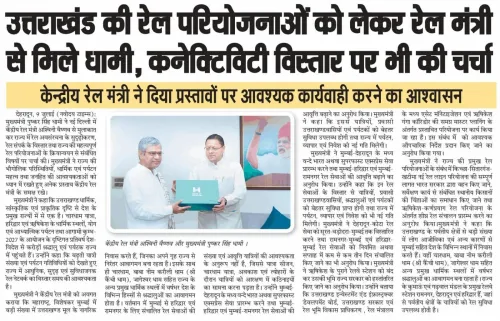
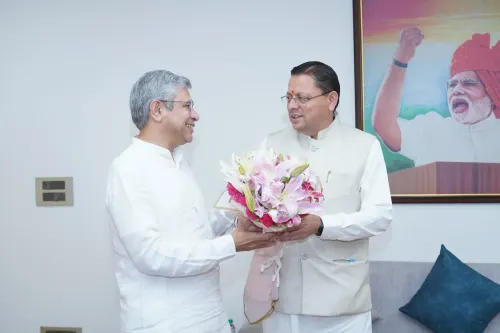
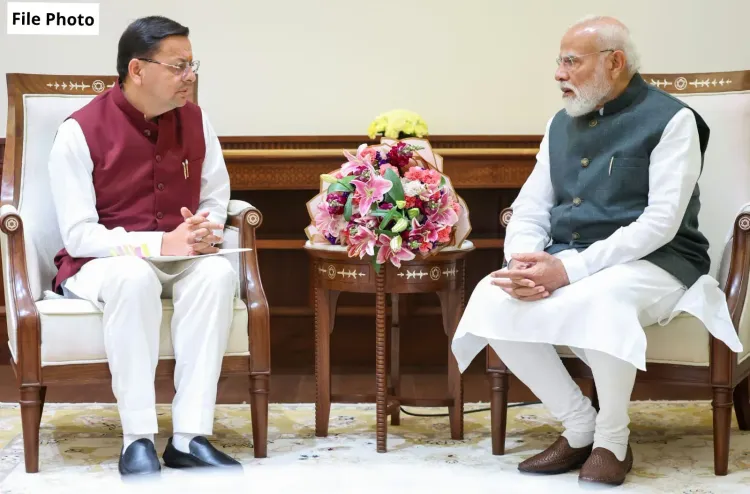
CM Pushkar Singh Dhami personally met PM Narendra Modi and Union Minister Manohar Lal Khattar to submit the extension proposal before the agreement was reached.
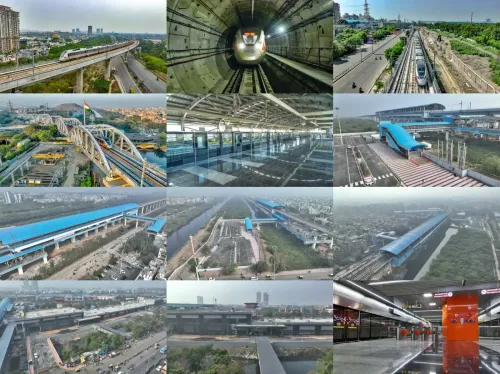
The Namo Bharat service on the Delhi-Modipuram section was launched in February 2026 , making it India's first operational RRTS corridor.
The Chief Minister's Office of Uttarakhand announced on Wednesday, 17 June 2026 that a formal agreement has been reached among Uttarakhand, Uttar Pradesh, and the National Capital Region Transport Corporation (NCRTC) to extend the high-speed Namo Bharat (RRTS) train network from Modipuram, Meerut to Lakshman Jhula, Rishikesh — a proposed corridor of 150 kilometres. Chief Minister Pushkar Singh Dhami has been credited with driving the tripartite consensus, which now paves the way for a Detailed Project Report (DPR) survey to begin shortly.
Context
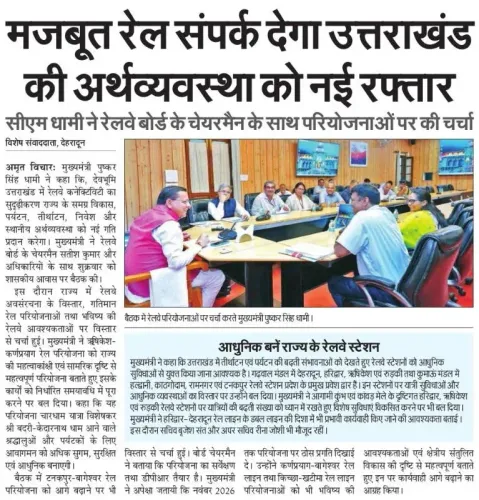
The Namo Bharat train service between Delhi and Modipuram was inaugurated in February 2026, marking the full operationalisation of the Delhi-Meerut RRTS corridor — India's first Regional Rapid Transit System. CM Dhami subsequently lobbied for extending the line northward into Uttarakhand, meeting Prime Minister Narendra Modi and Union Minister for Housing and Urban Affairs Manohar Lal Khattar to formally submit the extension proposal. Those meetings have now yielded a tripartite agreement, with the Uttarakhand government appointing Additional Secretary Reena Joshi as the state's nodal officer for the project and NCRTC designating its own nodal counterpart.
Policy Backdrop
The RRTS network is executed by NCRTC under the Union Ministry of Housing and Urban Affairs, with funding shared between the central government, participating state governments, and multilateral loans. The proposed 150 km extension will split across two states: 72 km through Uttar Pradesh — passing through Muzaffarnagar — and 78 km through Uttarakhand, running via Roorkee and Har Ki Pauri, Haridwar before terminating at Lakshman Jhula. This aligns with the National Infrastructure Pipeline's emphasis on multimodal regional transit connecting economic hubs and pilgrimage circuits, and addresses chronic road congestion on NH-334 and NH-58.
Stakeholders and Impact
The corridor is expected to transform travel between Delhi and Rishikesh. At present, the road journey takes approximately five to six hours; the Namo Bharat train, operating at up to 160 km per hour, is projected to cut that to two-and-a-half to three hours. Beneficiaries will include pilgrims travelling to the Char Dham circuit, domestic and international tourists visiting Rishikesh and Haridwar, daily commuters from western Uttar Pradesh, and residents of Uttarakhand who regularly travel to Delhi for work or medical care. CM Dhami stated that the extension 'will give Uttarakhand's connectivity a new direction and provide pilgrims, tourists, and local residents with fast, safe, and modern transport.'
What's Next
The immediate step is the commencement of a field survey to prepare the DPR for the 150 km proposed track. Once the DPR is finalised, the project will require tripartite funding agreements, statutory environmental clearances, and likely a cabinet or parliamentary nod for full corridor sanction. CM Dhami affirmed that the state government 'is continuously coordinating with the central government, the Uttar Pradesh government, and NCRTC to advance this ambitious project.' If approvals proceed on schedule, the corridor could become a model for extending RRTS connectivity to Tier-2 pilgrimage and tourism cities across northern India.
Point of View
Demonstrating his ability to leverage central government relationships to deliver marquee infrastructure. For the BJP-led Centre, connecting the Char Dham pilgrimage belt to the NCR via high-speed rail fits neatly into the broader narrative of modernising religious tourism infrastructure — a priority visible across multiple Union Budget cycles. The project also signals that the RRTS model, initially conceived as an NCR commuter solution, is being deliberately repurposed as a tool for inter-state connectivity, setting a precedent that other state governments in the Ganga basin are likely to watch closely. The real test will come at the DPR and funding-agreement stage, where land acquisition through the Haridwar-Rishikesh stretch and environmental sensitivities along the Ganga corridor could introduce significant delays.
NationPress
16 Sept 2026
Frequently Asked Questions
What is the Namo Bharat RRTS extension to Rishikesh?
It is a proposed 150 km extension of the existing Namo Bharat high-speed RRTS rail network from Modipuram in Meerut, Uttar Pradesh, to Lakshman Jhula in Rishikesh, Uttarakhand. Uttarakhand, Uttar Pradesh, and NCRTC have formally agreed on the extension, and a DPR survey is set to begin soon.
How long will it take to travel from Delhi to Rishikesh by Namo Bharat train?
Once operational, the Namo Bharat train — running at up to 160 km per hour — is expected to cover the Delhi-to-Rishikesh journey in approximately two-and-a-half to three hours, compared to five to six hours by road currently.
Which stations will the Meerut-Rishikesh RRTS corridor pass through?
The proposed corridor will originate at Modipuram station in Meerut, pass through Muzaffarnagar in Uttar Pradesh, then enter Uttarakhand via Roorkee and Har Ki Pauri in Haridwar, before terminating at Lakshman Jhula in Rishikesh.
What is the current status of the Meerut-Rishikesh RRTS project?
As of June 2026, a tripartite agreement among Uttarakhand, Uttar Pradesh, and NCRTC has been reached. Nodal officers have been appointed by both Uttarakhand and NCRTC, and a field survey for the 150 km Detailed Project Report (DPR) is set to begin shortly.
Who is driving the Rishikesh Namo Bharat train project?
Uttarakhand Chief Minister Pushkar Singh Dhami has been the primary advocate, meeting Prime Minister Narendra Modi and Union Minister Manohar Lal Khattar to formally submit the extension proposal. The agreement followed those high-level meetings.