Nava Raipur Nesting Island to Boost Eco-Tourism, Biodiversity
Synopsis
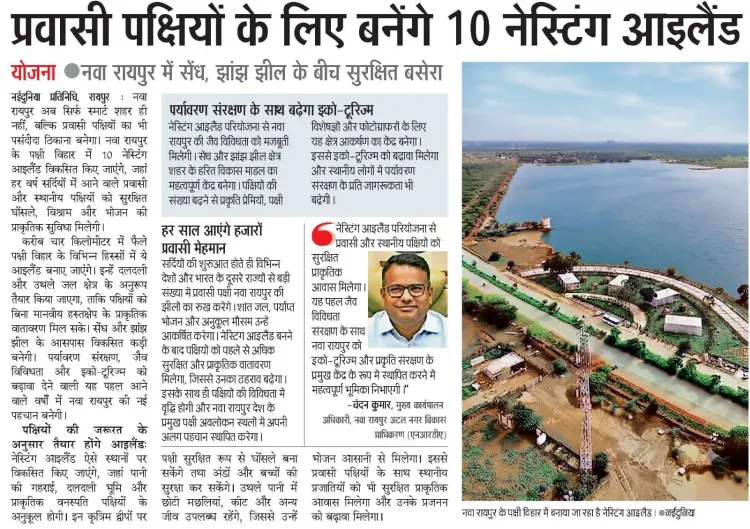
The Chhattisgarh Chief Minister's Office has announced a Nesting Island at Nava Raipur designed to draw thousands of migratory birds each year, boosting eco-tourism and biodiversity in the state's planned capital city — blending conservation with urban development.
Key Takeaways
The Chief Minister's Office of Chhattisgarh announced a Nesting Island at Nava Raipur on 14 July 2026 .
The island is expected to attract thousands of migratory birds every year.
The initiative aims to strengthen both eco-tourism and biodiversity in the planned capital.
Nava Raipur 's original master plan from the mid-2000s already incorporated wetlands and green corridors, making this a natural extension of existing policy.
Local communities and eco-tourists are the primary beneficiaries, with potential for seasonal economic activity around birdwatching and nature tourism.
Annual migratory bird counts and future state budget allocations will be key indicators of the project's success and scalability.
The Chief Minister's Office of Chhattisgarh announced on Tuesday, 14 July 2026 that a dedicated Nesting Island at Nava Raipur will attract thousands of migratory birds annually, positioning the planned capital as a hub for eco-tourism and biodiversity conservation.
Context
The official post declared: 'हर साल आएंगे हजारों प्रवासी मेहमान' ('Thousands of migratory guests will arrive every year'), adding that the Nesting Island will strengthen both eco-tourism and biological diversity — described as a 'beautiful confluence of nature and development.'
The announcement centres on a dedicated habitat zone within Nava Raipur, the greenfield capital city of Chhattisgarh that was master-planned from the mid-2000s with integrated wetlands and green corridors as core features of its sustainable urban design.
Policy Backdrop
Nava Raipur's original master plan explicitly incorporated wetland buffers and green corridors — making a Nesting Island a natural extension of that foundational framework rather than a new departure. The city was conceived as a model of sustainable urban planning, distinct from the older commercial capital Raipur.
Chhattisgarh's move aligns with a broader national emphasis on eco-tourism as an instrument of economic diversification. Since the 2010s, several Indian states have launched urban biodiversity projects that pair habitat creation with structured tourism revenue, positioning secondary cities as conservation nodes alongside growth centres.
Stakeholders and Impact
Eco-tourists and birdwatching communities stand to benefit most directly, with the prospect of reliable annual migratory arrivals creating a predictable seasonal draw. Local communities around Nava Raipur could see ancillary economic activity — hospitality, guided tours, and craft markets — tied to the influx of nature tourists.
Conservation stakeholders will watch whether the Nesting Island generates measurable gains in species counts and habitat health. The initiative also signals that urban planners in Chhattisgarh are treating biodiversity infrastructure as a civic asset rather than a peripheral concern.
What's Next
Annual migratory bird counts at the Nesting Island will be a key metric for assessing whether the project delivers on its ecological promise. State budget allocations in forthcoming fiscal cycles will indicate how seriously the government intends to scale similar wetland infrastructure across other urban zones.
If the Nava Raipur model demonstrates measurable tourism revenue alongside biodiversity gains, it could serve as a replicable template for other planned cities in central and eastern India seeking to integrate conservation into urban economic strategies.
Point of View
Not just administrative function. This fits a pattern where Indian state governments increasingly use biodiversity infrastructure to generate soft-power narratives around 'green governance.' The real test will be whether the initiative secures dedicated budget lines and independent monitoring, or remains a headline without institutional follow-through. If it succeeds, it could reframe how central Indian states pitch secondary cities to investors and tourists alike.
NationPress
12 Oct 2026
Frequently Asked Questions
What is the Nesting Island at Nava Raipur?
The Nesting Island is a dedicated habitat zone within Nava Raipur, Chhattisgarh's planned capital city, designed to attract and shelter thousands of migratory birds annually while supporting eco-tourism and biodiversity.
Which migratory birds will come to Nava Raipur's Nesting Island?
The specific species have not been officially listed yet. The Chhattisgarh CMO's announcement refers broadly to thousands of migratory bird visitors each year; detailed species data will likely emerge as the project develops.
How does the Nesting Island support eco-tourism in Chhattisgarh?
By creating a reliable seasonal habitat for migratory birds, the island is expected to draw birdwatchers and nature tourists to Nava Raipur, generating ancillary economic activity for local communities and positioning the city as an eco-tourism destination.
Is Nava Raipur already known for wildlife or nature conservation?
Nava Raipur was master-planned from the mid-2000s with integrated wetlands and green corridors, so conservation infrastructure is part of its foundational design — the Nesting Island builds on that existing framework.
What is Chhattisgarh's broader policy on eco-tourism and biodiversity?
Chhattisgarh's approach aligns with a national trend of using urban biodiversity projects to combine habitat creation with tourism revenue, mirroring schemes that promote sustainable development and wildlife corridors across Indian states.