NCP picks Rajendra Jain for Rajya Sabha, Bhujbal steps back after nephew demand rejected
Synopsis
The NCP's Rajya Sabha pick was never just about a seat — it was a controlled detonation. Chhagan Bhujbal's exit, engineered through a face-saving promise of a future berth in 2028, masked a hard BJP veto on his nephew's cabinet demand. Rajendra Jain's elevation rewards Praful Patel's loyalist network and plants an NCP flag in Vidarbha ahead of 2029 — all without a single public fracture.
Key Takeaways
NCP has nominated Rajendra Jain , a close aide of Working President Praful Patel , for the Rajya Sabha ; nomination deadline is 8 June , polling on 18 June .
Chhagan Bhujbal withdrew after the BJP rejected his demand that nephew Sameer Bhujbal be inducted into the Maharashtra cabinet.
The NCP core committee hinted Bhujbal could be considered for the Rajya Sabha in 2028 and that Sameer Bhujbal may represent the Yeola assembly seat .
Rajendra Jain is a former state council member and Patel's long-time operational lieutenant in the Gondia-Bhandara belt of Eastern Vidarbha.
The selection was designed to neutralise generational pressure from the Parth Pawar -led youth brigade while preserving MahaYuti alliance stability.
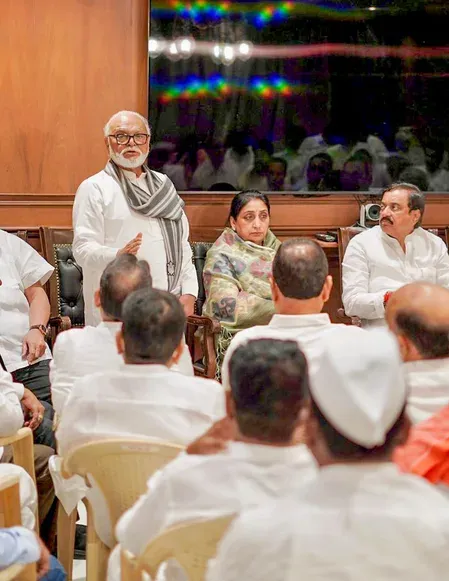
The Nationalist Congress Party (NCP) on 8 June concluded its Rajya Sabha nomination process by fielding Rajendra Jain, a close aide of party Working President Praful Patel, after Maharashtra Minister Chhagan Bhujbal withdrew from the race following the rejection of his key condition. The decision, managed by a core committee headed by national president and state Deputy Chief Minister Sunetra Pawar, averted an open factional clash while projecting an image of internal cohesion. Today, 8 June, is the last date for filing nominations; polling is slated for 18 June.
Why Bhujbal Stepped Back
Chhagan Bhujbal did not simply seek a seat in the Upper House — he attached a firm condition to his nomination. He demanded that his nephew, Sameer Bhujbal, be inducted into the state cabinet before he filed his papers, arguing that since both the Pawar and Tatkare families held dual representation in governance, equity demanded the same for the Bhujbal family.
The demand was taken up with the Bharatiya Janata Party (BJP) high command in New Delhi by Chief Minister Devendra Fadnavis following his meeting with the NCP delegation. The BJP, which heads the MahaYuti alliance, did not accept the condition. Faced with a choice between a Delhi berth and his family's active ministerial foothold in Maharashtra, Bhujbal retreated, leaving his base in Yeola and the Nashik region politically insulated for now.
Bhujbal has, however, urged the party leadership to grant a ministerial berth to Sameer Bhujbal whenever Chief Minister Fadnavis expands the cabinet, and offered to step down as both minister and legislator. The core committee reportedly assured him his request would be considered and hinted he could be revisited for the Rajya Sabha in 2028 for a six-year term, while Sameer Bhujbal could represent the Yeola assembly seat.
Who Is Rajendra Jain
Rajendra Jain's political identity is inseparable from Praful Patel. A former personal assistant to Patel and his key operational lieutenant in the Gondia-Bhandara belt of Eastern Vidarbha, Jain has been the regional backbone of the NCP's organisational machinery for years. He is also a former member of the state legislative council and has remained active in party grassroots work across the belt.
Patel made a strong case for Jain's nomination before the core committee, arguing that Jain's presence in the Rajya Sabha would help consolidate the party's organisational base ahead of the 2029 Lok Sabha elections — particularly relevant as Patel is reportedly keen to contest the next general election from the Gondia-Bhandara seat. Nominating a Vidarbha leader also ensures NCP maintains structural presence in a region heavily dominated by the BJP and Congress.
The Generational Calculation
Beneath the procedural calm lay a deeper generational anxiety. The party's younger brigade, centred around Parth Pawar, has been pressing to step out of the senior leadership's shadow and claim institutional rewards. This friction has repeatedly threatened to surface publicly.
By choosing Jain — an organisational insider rather than another senior minister — the NCP leadership signalled that parliamentary seats are not the exclusive preserve of front-row veterans. Notably, had Bhujbal been openly denied the ticket without a face-saving exit, it would have reinforced the opposition's narrative that senior leaders and OBC icons are being systematically sidelined within the reconstituted NCP.
What This Means for MahaYuti
The episode demonstrated to coalition partner BJP that the NCP can contain its internal contradictions without unsettling the MahaYuti alliance's equilibrium. By keeping negotiations behind closed doors, the party allowed Bhujbal to withdraw gracefully while framing the final choice as a collective decision — a choreography that serves both internal discipline and alliance optics.
With local body elections and the next legislative assembly cycle on the horizon, the NCP's ability to hold its generational and factional lines together will be tested further. The Jain nomination buys the leadership time, but the underlying pressures — OBC representation, youth ambitions, and Vidarbha consolidation — remain unresolved.
Point of View
And a promise of 2028 is a promissory note, not a settlement. The real test is whether Sameer Bhujbal's cabinet inclusion materialises at the next reshuffle; if it does not, Bhujbal's public restraint will have a shelf life. Meanwhile, Patel's consolidation of the Gondia-Bhandara belt through Jain is a clear 2029 play — and signals that the NCP's internal geography is already being redrawn for the next Lok Sabha cycle.
NationPress
23 Oct 2026
Frequently Asked Questions
Why did Chhagan Bhujbal withdraw from the NCP Rajya Sabha race?
Bhujbal withdrew after the BJP declined his condition that his nephew Sameer Bhujbal be inducted into the Maharashtra cabinet before he filed his nomination papers. Chief Minister Devendra Fadnavis had taken the demand to the BJP's high command in New Delhi, but it was not accepted, leaving Bhujbal without the family ministerial foothold he sought in exchange for moving to the Upper House.
Who is Rajendra Jain and why was he chosen?
Rajendra Jain is a former member of the Maharashtra legislative council and a long-time personal aide and regional lieutenant of NCP Working President Praful Patel in the Gondia-Bhandara belt of Eastern Vidarbha. He was chosen as a trusted organisational insider whose elevation rewards party loyalty, strengthens NCP's presence in Vidarbha ahead of the 2029 Lok Sabha elections, and avoids triggering envy among senior ministerial aspirants.
What has the NCP promised Chhagan Bhujbal after his withdrawal?
The NCP core committee reportedly assured Bhujbal that his request for a cabinet berth for nephew Sameer Bhujbal would be considered at the next cabinet expansion. The committee also hinted that Bhujbal himself could be considered for the Rajya Sabha in 2028 for a six-year term, while Sameer Bhujbal could represent the Yeola assembly seat.
When is the Rajya Sabha nomination deadline and polling date?
8 June is the last date for filing Rajya Sabha nominations, and polling is scheduled for 18 June.
How does this nomination affect the MahaYuti alliance?
By resolving the Bhujbal standoff without a public confrontation, the NCP demonstrated to its coalition partner BJP that it can manage internal contradictions without disrupting the MahaYuti alliance's stability. The episode reinforced the NCP's image as a predictable coalition partner ahead of local body and assembly elections.